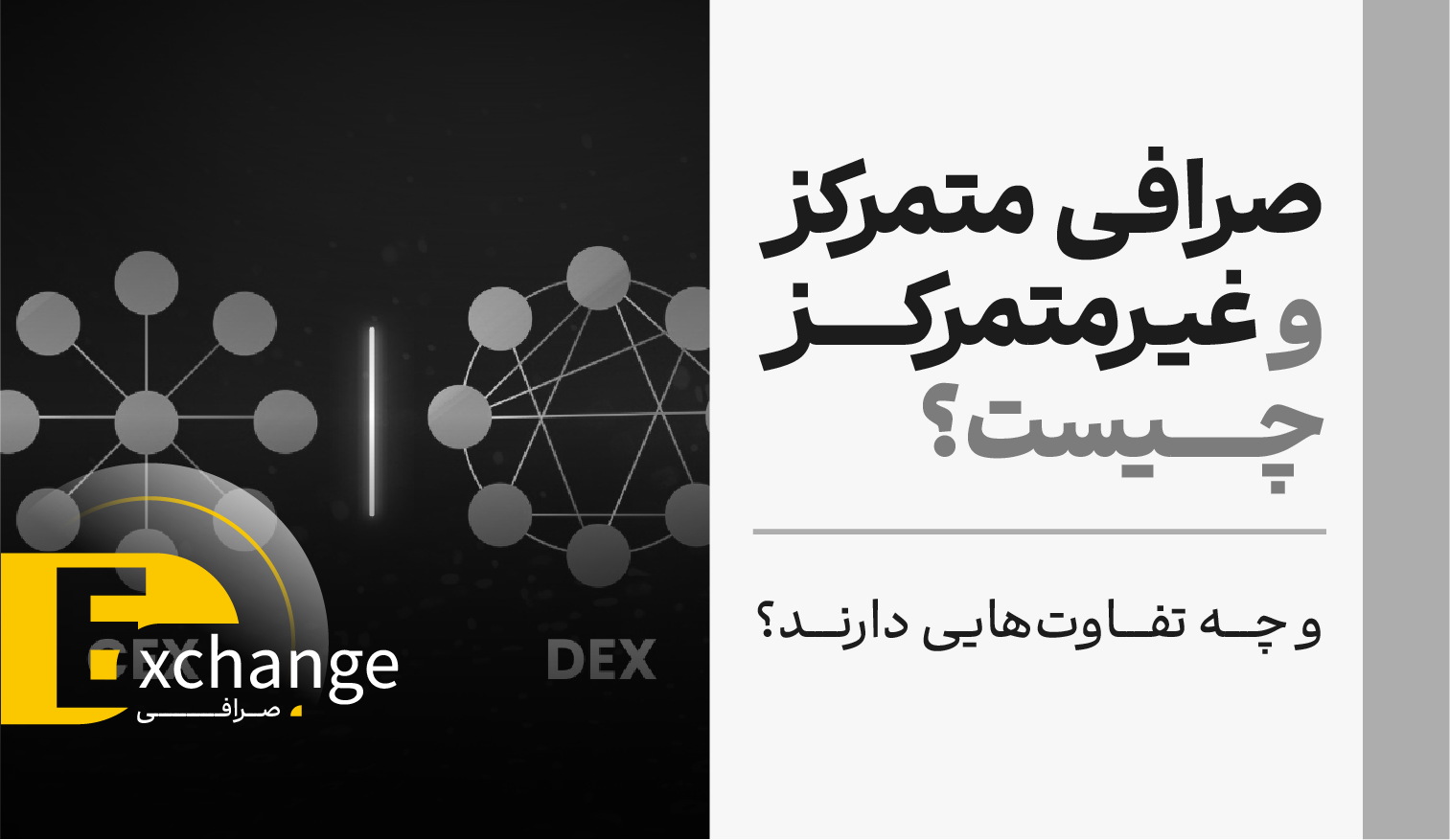
What are centralized and decentralized exchanges, and what are the differences between them?

Author
نویسنده تیگل
Last Updated
 2026/05/16
Read Time
5 Min


Today, choosing the right exchange for buying and selling cryptocurrencies is one of the most important decisions for any trader, especially in Iran! The two main types of exchanges in this market are Centralized Exchanges (CEX) and Decentralized Exchanges (DEX). This article examines their advantages and disadvantages, key differences, and a list of the best centralized and decentralized exchanges for Iranians.
What is a Centralized Exchange (CEX)?
Centralized exchanges are a category of exchanges where the control and oversight of all operations, including buying and selling cryptocurrencies, are managed centrally by a single entity. In these types of exchanges, users must transfer their assets to the exchange's wallet to perform transactions, and the exchange itself takes responsibility for maintaining security, settlements, and other financial matters.
Types of Trading on Centralized Exchanges
1. Spot Trading: In these trades, the cryptocurrency is bought and sold directly.
2. Futures Trading: Traders can buy and sell cryptocurrency at a specific price in the future.
3. Margin Trading: Users can borrow from the exchange to have more assets for trading.
Advantages and Disadvantages of Centralized Exchanges
Regarding the advantages of centralized exchanges, one must mention high trading volume, high security, and ease of use. Centralized exchanges usually have higher trading volumes and, therefore, offer more liquidity for transactions. In these types of exchanges, complex security mechanisms such as two-factor authentication, security codes, and cold storage of assets are used. It is worth noting that centralized exchange platforms usually have a simpler and more user-friendly interface.
However, the disadvantages of centralized exchanges include the high risk of hacking and the concentration of power. Centralized exchanges are the primary targets of cyberattacks; if they are hacked, there is a possibility of losing traders' assets. Since all transactions are under the supervision of a single entity, users face issues related to censorship and legal problems.
What is a Decentralized Exchange (DEX)?
A decentralized exchange (DEX) refers to exchanges where there is no central entity to manage and oversee transactions. In these types of exchanges, users buy and sell cryptocurrency directly with each other, and there is no need to entrust assets to the exchange.
Advantages and Disadvantages of Decentralized Exchanges
The advantages of decentralized exchanges include privacy preservation, higher security, and no geographic restrictions. Users have full control over their assets and do not need to trust a central entity. Because assets remain in the users' personal wallets, hacking these exchanges is significantly more difficult. In many decentralized exchanges, there is no need for identity verification or creating a user account, and traders from anywhere in the world can easily use them.
Lower liquidity and complexity of use are the disadvantages of decentralized exchanges. Due to the limited number of users and low trading volume, some decentralized exchanges may not have sufficient liquidity for transactions. Working with such exchanges may be difficult for novice users, as it requires more technical knowledge.
List of the Best and Most Reliable Centralized Exchanges for Iranians
Tigel has reviewed some of the reliable centralized exchanges that are suitable for Iranians and can perform secure cryptocurrency trades.
Iranian Centralized Exchange Nobitex (Nobitex)
One of the most popular Iranian centralized exchanges that allows Iranian users to buy and sell various cryptocurrencies. This exchange has gained attention due to its support for the Rial and high-speed transactions.
Iranian Centralized Exchange Wallex (Wallex)
Wallex is another reliable Iranian exchange that provides various cryptocurrencies to Iranian users. This exchange is highly secure and enables trading in various cryptocurrency markets.
Iranian Centralized Exchange Ramzinex (Ramzinex)
Ramzinex is an Iranian centralized exchange that provides easy buying and selling of cryptocurrencies and features a simple user interface.
Foreign Centralized Exchange Kucoin (Kucoin)
Kucoin is a reputable foreign exchange that also offers its services to Iranians. This exchange supports various types of cryptocurrencies with high trading volume.
Foreign Centralized Exchange Coinex (Coinex)
Coinex is another popular foreign exchange that provides easy access to global cryptocurrency markets for Iranians.
Foreign Centralized Exchange Lbank (Lbank)
Lbank is a reputable foreign exchange that offers users cryptocurrency trading with high security and low fees.
Foreign Centralized Exchange XT (XT)
XT is a reputable foreign exchange that supports various cryptocurrencies and is a suitable option for online trading for Iranians.
List of the Best and Safest Decentralized Exchanges for Iranians
Now, we introduce some of the best decentralized exchanges for Iranians.
Foreign Decentralized Exchange Uniswap Uniswap
Uniswap is one of the world's largest decentralized exchanges that allows buying and selling various cryptocurrencies without the need for identity verification, directly from a personal wallet.
Foreign Decentralized Exchange PancakeSwap PancakeSwap
PancakeSwap is a very popular decentralized exchange that operates on the Binance Smart Chain (BSC) and is widely used among Iranian users.
Foreign Decentralized Exchange dydx
This decentralized exchange is suitable for professional trading in derivatives (futures) and features high security.
Foreign Decentralized Exchange Lighter Lighter
Lighter is another popular decentralized exchange that has special features for professional traders.
Cryptocurrency Exchange HyperLiquid HyperLiquid
This exchange offers its users buying and selling without intermediaries and with high speed, and it is also at a high level in terms of security.
Tutorial on Working with Decentralized Exchanges
To use decentralized exchanges, you must use digital wallets such as MetaMask or Trust Wallet. Working with these exchanges involves the following steps:
1. Creating a wallet: First, create a digital wallet like MetaMask or Trust Wallet.
2. Transferring Currency: Transfer your cryptocurrency to the wallet.
3. Connecting the wallet to the decentralized exchange: Connect your wallet to a decentralized exchange like Uniswap or PancakeSwap.
4. Performing transactions: After connecting, you can perform cryptocurrency trades without any intermediaries.
Frequently Asked Questions about Centralized and Decentralized Exchanges
How do we know if an exchange is centralized or decentralized?
Centralized exchanges usually allow you to transfer your assets to the exchange's wallet, and transactions are under the supervision of a single entity. Conversely, in decentralized exchanges, you have full control over your assets and trades occur without the need for an intermediary.
What is DEX Trading?
DEX trading refers to performing trades on decentralized exchanges (DEX). These types of trades occur without the intervention of central entities and directly between users.
Is it possible for Iranian traders to trade with foreign decentralized exchanges?
Yes, decentralized exchanges like Uniswap and PancakeSwap are easily accessible for Iranians, and they can conduct their trades without the need for identity verification using digital wallets.
Table of contents

Similar Articles
'%3e%3cpath%20d='M5.78443%206.25391H4.96875V7.16435H5.78443V6.25391Z'%20fill='%23666666'/%3e%3cpath%20d='M8.14771%206.25391H7.33203V7.16435H8.14771V6.25391Z'%20fill='%23666666'/%3e%3cpath%20d='M2.60229%207.16602H3.41797V6.25557H2.60229V7.16602Z'%20fill='%23666666'/%3e%3cpath%20d='M5.78443%208.36719H4.96875V9.27763H5.78443V8.36719Z'%20fill='%23666666'/%3e%3cpath%20d='M8.14771%208.36719H7.33203V9.27763H8.14771V8.36719Z'%20fill='%23666666'/%3e%3cpath%20d='M2.60229%209.27734H3.41797V8.3669H2.60229V9.27734Z'%20fill='%23666666'/%3e%3cpath%20d='M0%200V11.9997H10.7507V0H0ZM9.935%2010.1788C9.935%2010.6795%209.56794%2011.0892%209.11932%2011.0892H1.63136C1.18274%2011.0892%200.815681%2010.6795%200.815681%2010.1788V1.82089C0.815681%201.32015%201.18274%200.910447%201.63136%200.910447H1.86791C2.27575%200.910447%202.60202%201.27463%202.60202%201.72985V2.94074H3.4177V1.72985C3.4177%201.27463%203.74398%200.910447%204.15182%200.910447H6.5907C6.99855%200.910447%207.32482%201.27463%207.32482%201.72985V2.94074H8.1405V1.72985C8.1405%201.27463%208.46677%200.910447%208.87461%200.910447C9.45375%200.910447%209.92684%201.43851%209.92684%202.08492V10.1788H9.935Z'%20fill='%23666666'/%3e%3c/g%3e%3cdefs%3e%3cclipPath%20id='clip0_2059_2869'%3e%3crect%20width='10.7507'%20height='11.9997'%20fill='white'/%3e%3c/clipPath%3e%3c/defs%3e%3c/svg%3e)
.webp)
.webp)
User Comments
'%3e%3cpath%20d='M17%200H0V1.05566H17V0Z'%20fill='%234B4B4B'/%3e%3cpath%20d='M8.43767%206.55469H0V7.61035H8.43767V6.55469Z'%20fill='%234B4B4B'/%3e%3cpath%20d='M8.43767%203.27734H0V4.33301H8.43767V3.27734Z'%20fill='%234B4B4B'/%3e%3cpath%20d='M8.43767%209.83398H0V10.8896H8.43767V9.83398Z'%20fill='%234B4B4B'/%3e%3cpath%20d='M12.7445%206.71353L9.85449%204.02685L10.6591%203.27734L11.9455%204.47553C12.1578%204.67215%2012.4451%204.78249%2012.7445%204.78249C13.0439%204.78249%2013.3311%204.67215%2013.5435%204.47553L14.8298%203.27734L15.6345%204.02685L12.7445%206.71353Z'%20fill='%234B4B4B'/%3e%3cpath%20d='M12.7445%2011.0006L9.85449%208.30871L10.6591%207.56445L11.9455%208.76264C12.1578%208.95926%2012.4451%209.06963%2012.7445%209.06963C13.0439%209.06963%2013.3311%208.95926%2013.5435%208.76264L14.8298%207.56445L15.6345%208.30871L12.7445%2011.0006Z'%20fill='%234B4B4B'/%3e%3c/g%3e%3cdefs%3e%3cclipPath%20id='clip0_9931_2952'%3e%3crect%20width='17'%20height='11'%20fill='white'/%3e%3c/clipPath%3e%3c/defs%3e%3c/svg%3e)
Newest
Specify the sections to submit a comment:
 Upload Image
.png)


.png)


Disclaimer
All articles, training materials, analyses, and content provided by Tiggle do not constitute any trading recommendation and are solely for study and informational purposes. This website accepts no responsibility for any potential losses or damages incurred by users. Financial markets (Forex, options, stocks, cryptocurrencies, or any other trading market) inherently carry many risks, and individuals must ensure they have sufficient experience and knowledge before undertaking any investment.