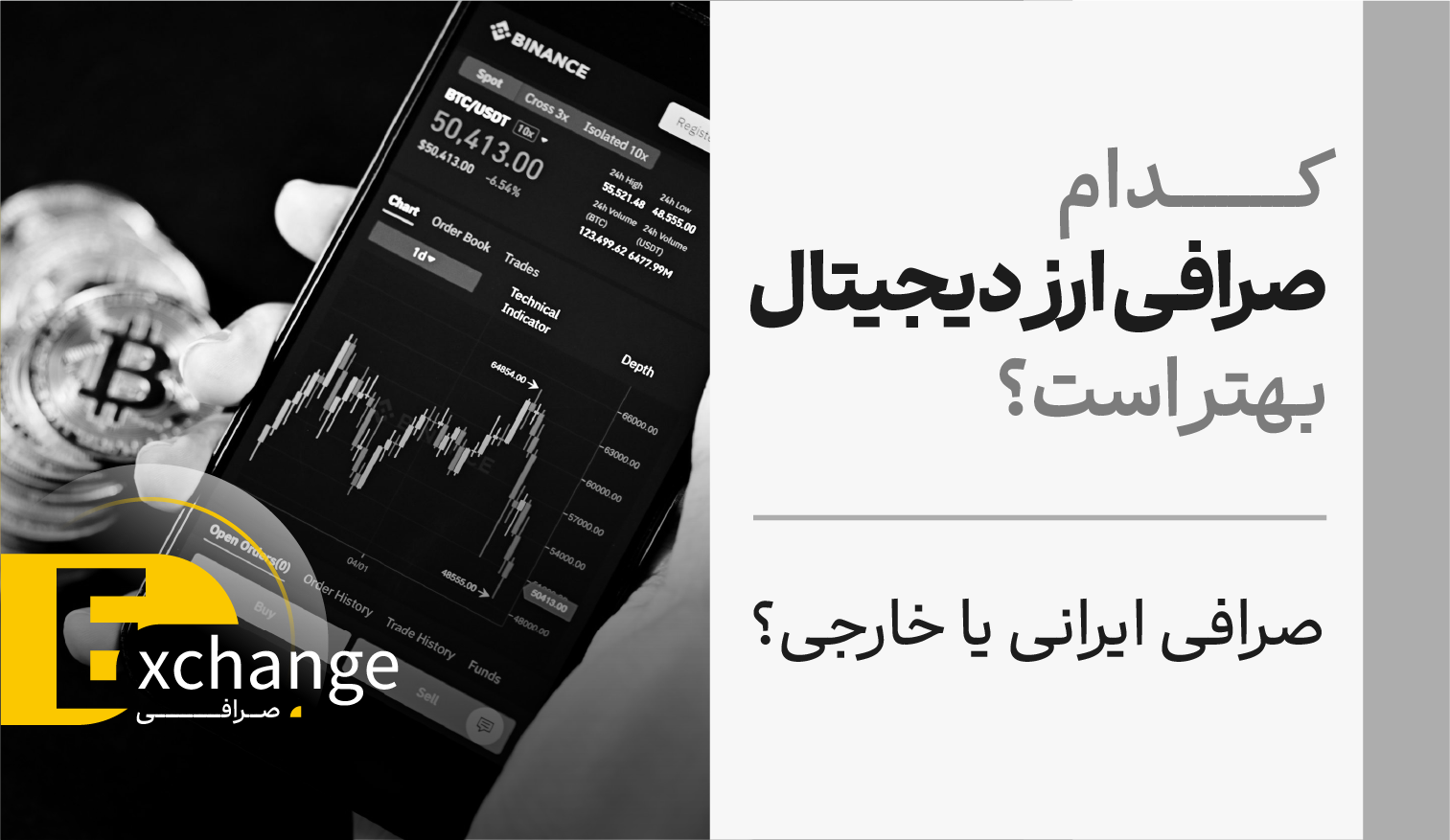
Which cryptocurrency exchange is better? Iranian or foreign exchange?

Author
نویسنده تیگل
Last Updated
 2026/05/17
Read Time
5 Min


To be very clear and direct, the first and perhaps most important step after deciding to invest is choosing how to enter this market, which means selecting a suitable exchange. This is where a fundamental question arises that occupies many of our minds:
Should it be an Iranian or a foreign exchange?
This choice may seem simple, but in reality, it is a decision that directly affects your capital security, ease of access to trading pairs, fee rates, and even your legal standing. Domestic exchanges, which have direct access to the Rial, and international exchanges with high liquidity each have their own pros and cons that must be weighed carefully.
Tigel's goal is to conduct a completely impartial review, looking transparently at your needs and priorities so that you can make the best choice for profitable trading. We want to understand the key differences in security, fees, and the utility of these two trading environments and, ultimately, which option will suit your strategy.
What is a cryptocurrency exchange?
A cryptocurrency exchange is essentially the platform through which users can buy, sell, and convert digital currencies. These exchanges play a role similar to a bank or brokerage in the crypto world. When you buy Bitcoin, Tether, or Ethereum, you are actually using a cryptocurrency exchange that acts as an intermediary between buyers and sellers.Exchanges may generally have two main types:
1. Centralized Exchange (CEX): Binance, Coinbase, or Nobitex, etc. In these types of exchanges, user assets are held in the exchange's wallets and servers.
2. Decentralized Exchange (DEX):
Such as: Uniswap or PancakeSwap, where users connect directly to each other through smart contracts.
The field of digital currencies has introduced us to two main models for exchanging assets: Centralized Exchanges (CEX) and Decentralized Exchanges (DEX). Imagine a centralized exchange like a bank or a large traditional market; in this model, another company is responsible for holding your assets, verifying transactions, and maintaining the overall security of the platform. This structure makes the buying and selling process fast and simple because there is no need to verify each transaction on the blockchain, but at the same time, you relinquish full control of your wallet to that company.
In contrast, a Decentralized Exchange (DEX) is a completely different platform that operates based on smart contracts and without the intervention of any intermediary. In a DEX, you trade directly from your own personal wallet (such as MetaMask) with other individuals and never entrust control of your private keys to a third party. This model gives you the highest level of ownership and independence, but its user interface may be more complex, and in some cases, the speed and liquidity depth may be lower than its centralized competitors. Ultimately, the choice between the two is a trade-off between convenience and control. In Iran, most users still use centralized Iranian exchanges because they offer simpler access, Persian-language support, and the ability to pay in Rials.
What are the important features of a good exchange?
When we want to decide which cryptocurrency exchange is better for us, Iranian or foreign? We must focus on several key features. These features are the determinants of trust and security in transactions.
Security and Identity Verification (KYC)
When money, capital, and personal information are at stake, security always comes first.
Whether in the physical space or online, the concept of Verification plays a key role. Verification is essentially a process aimed at ensuring that the person claiming to be you is truly that person. This step is exactly like showing your ID card to a bank teller; without verifying identity, no sensitive actions should take place.
This process in various organizations and platforms starts from simple verification like passwords and extends to more advanced methods such as two-factor authentication (2FA) or KYC processes, which stands for Know Your Customer and includes providing identity documents.
The ultimate goal of all these security layers is to protect valuable assets such as your capital and your privacy. If these layers are not implemented correctly, the risk of fraud, identity theft, and unauthorized access to personal information increases significantly.
Features of a reliable exchange:
1) Two-Factor Authentication (2FA)
2) Advanced encryption of user information
3) Cold storage for a large portion of assets
4) Anti-phishing monitoring system
5) Compliance with KYC protocol to identify users and prevent money laundering
In a foreign exchange like Binance or KuCoin, the KYC requirement is stricter, but some Iranian exchanges also perform detailed identity verification using national ID cards and phone numbers.
Diversity of cryptocurrencies and trading pairs:
In the world of cryptocurrencies, you, as traders and enthusiasts of financial markets, encounter growing opportunities and projects beyond Bitcoin and Ethereum every moment. This diversity can be seen in thousands of different cryptocurrencies, each formed according to a specific plan and goal; some are designed to execute complex smart contracts, some focus on privacy, and others are created to solve scalability issues or specific applications in Decentralized Finance (DeFi). This breadth allows every investor, with any level of risk tolerance and outlook, to find a way to explore this market.
When it comes to how these assets are traded, the concept of a Trading Pair becomes important. In reality, a cryptocurrency is never traded alone; it is always priced and exchanged against another asset. The most common trading pairs include combinations of cryptocurrencies with stablecoins such as Tether (USDT) or the US Dollar (e.g., BTC/USDT or ETH/BTC). This trading pair structure allows traders to manage liquidity and evaluate the value of an asset in a standard way against a reference asset (such as Tether or Bitcoin) and adjust their trades based on these comparisons.
When choosing an exchange, you should see what variety of cryptocurrencies is offered.
A foreign exchange usually has hundreds of cryptocurrencies and trading pairs; for example, the ability to trade DOGE/BTC or AVAX/USDT.
However, an Iranian exchange often covers well-known cryptocurrencies such as Bitcoin, Ethereum, Tether, and Cardano.
|
Exchange Type |
Number of Tradable Cryptos |
Example of Trading Pairs |
|
Iranian Exchange |
About 30 to 50 cryptos |
BTC/IRT, ETH/USDT |
|
Foreign Exchange |
Over 200 cryptos |
BTC/USDT, SOL/BNB, AVAX/ETH |
Trading Volume and Liquidity
The higher the trading volume, the higher the liquidity, and therefore prices are more realistic.
In a foreign exchange with high volume like Binance, orders are filled quickly, and the price difference between buying and selling is very negligible. In an Iranian exchange, lower volume may cause price differences (spread), especially in less-traded cryptocurrencies.
An important point is that high liquidity is one of the reasons for the popularity of professional users in foreign exchanges.
Fees and transaction speed are a critical factor in user satisfaction.
|
Exchange Type |
Average Transaction Fee |
Transfer Speed |
|
Iranian Exchange |
0.2% to 0.4% |
Fast for Rial conversion |
|
Foreign Exchange |
0.1% to 0.2% |
Fast for global crypto transfer |
In exchange
Iranian exchanges have higher fees but Rial payments are easier. In contrast, foreign exchanges are cheaper but require international transfers or foreign cards.
Support and User Interface
Persian support, native design, and complete and accurate training are great advantages of Iranian exchanges.
In a foreign exchange, support is usually provided in English, and Iranian users might face delays in receiving answers if a problem occurs.
Other good features include instant 24/7 online chat support, a simple and smooth user panel, and in-site training capabilities.
Is an Iranian exchange better or a foreign one?
The answer to this question depends entirely on your goal, the amount of capital, the type of trade (Rial or dollar), and your security concerns as a trader.
Advantages of an Iranian Exchange
When it comes to buying and selling cryptocurrencies in Iran, domestic exchanges have advantages that have made them an acceptable and practical option for the public. The strong point of these platforms is the ability to directly and easily convert Rial to cryptocurrency and vice-versa. You can perform your transactions or bring initial capital into the market directly using bank cards and domestic payment systems without the need for foreign intermediaries or worrying about sanctions.
Another important point for Iranians is that support and customer service in such exchanges are usually provided in Persian and for longer hours; this gives the user peace of mind if any technical problem or question regarding deposits and withdrawals arises. Furthermore, their understanding of the country's domestic laws and regulations and providing tools compatible with Iran's financial infrastructure means that the user experience is better, smoother, and less troublesome than using international exchanges.
1. Ability to buy and sell Rials directly with a bank card
2. Persian support and quick problem-solving
3. Fast connection to the domestic market
4. Reduction of sanction risks and account blocking
5. Suitable for novice users
Example: Nobitex and Ramzinex are among the most famous in Iran.
Disadvantages of an Iranian Exchange
Despite all the advantages that an Iranian exchange has in terms of ease of access and working with Rials, one should not jump in without caution, as using them without considering their disadvantages would not be wise. One of the main concerns relates to the limitation in the variety of cryptocurrencies and trading pairs; unlike global platforms that support many assets, domestic exchanges generally offer a limited number of major and popular cryptocurrencies for trading.
Another issue often pointed out by professional users is market depth and lower liquidity compared to global giants. This can lead to less competitive pricing (higher spread) and difficulty in executing large trades without significantly impacting the price. Ultimately, while cyber security has improved significantly, the high concentration of all assets in a central entity (the custodial issue) can increase centralized security risks; meaning that if a technical or security problem occurs at the exchange itself, your capital is at risk.
1) Limited variety of cryptocurrencies
2) Absence of advanced features like futures or margin trading
3) Prices sometimes change depending on the dollar rate
4) Lower speed compared to foreign exchanges
5) Withdrawal ceiling limited to domestic rules (such as user identification rules)
Advantages of a Foreign Exchange
Using international cryptocurrency exchanges opens a completely different path of opportunities for traders, which is mainly based on market breadth and depth. Their greatest advantage is access to an unparalleled variety of new cryptocurrencies and tokens; with the emergence of innovative projects, all major global exchanges list them, which allows investors to access assets with high growth potential sooner.
On the other hand, because of their very high trading volume, these platforms offer extraordinary liquidity; so much so that you can buy and sell large amounts of any currency at prices close to the market's instantaneous price and with minimal slippage. Also, these exchanges usually provide more advanced trading tools such as futures, margin, staking, and lending, which are essential for professional traders.
1) High variety of trading pairs and new cryptocurrencies
2) Lower fees and very high liquidity
3) Professional tools for market analysis and algorithmic trading
4) High security and global oversight
5) Possibility of creating an account without Rial and with global currencies
Examples: Binance, KuCoin, Coinbase, Kraken are among the most popular exchanges in the world.
Disadvantages of a Foreign Exchange
Despite all the existing advantages, the variety of assets and liquidity, using foreign cryptocurrency exchanges comes with many challenges and disadvantages that become more important for Iranian users. The main barrier is the issue of sanctions and access limitations; most major global exchanges do not provide services to users living in Iran, and the requirement for using them is employing peripheral tools like paid VPNs and constantly changing IPs, which carries security risks and the danger of the account being blocked.
Beyond the risks related to sanctions, matters related to Rial deposits and withdrawals are a huge obstacle for Iranian users, who cannot directly deposit Rial into the exchanges and must use complex intermediate methods (P2P or Iranian exchanges as a bridge) to convert it to Tether or stablecoins, a cycle that is not only time-consuming but also incurs higher fees. These types of exchanges do not provide services in Persian, and if a technical problem occurs or support is needed, communicating and resolving the issue may be difficult and slow, which shows that their rules do not comply with Iranian financial laws.
1) Risk of sanctions and blocking of Iranian user accounts
2) Need to use a VPN or fixed foreign IP
3) Difficulty in identity verification for Iranian users
4) Impossibility of Rial payment
5) English support and slower response times
Best Iranian Cryptocurrency Exchanges
Tigel wants to take a closer look at the best options available in the Iranian market with its sharp eye. Choosing the best Iranian exchange usually depends on your personal priorities; are you looking for the simplest user interface for initial buying and selling, or a platform with the highest level of liquidity and more advanced trading features like fast trading or special orders?
Generally, Iranian exchanges are built based on full Rial support and compliance with domestic laws, and their main goal is to provide a safe and legal platform for Iranian users to enter the cryptocurrency market. The best ones in this field are those that have managed to strike a balance between a user-friendly interface, competitive fees, and a reasonable variety of major cryptocurrencies.
Several reliable and powerful platforms are active in the Iranian market. Depending on the type of trade and experience level, users can choose one of them:
|
Iranian Exchange Name |
Features |
Strengths |
|
Nobitex |
Simple UI, Rial and dollar trading |
Most popular among novice users |
|
Ramzinex |
Fast support, dedicated wallet |
High security and good liquidity |
|
Tabdil |
Technical analysis tools and secure internal IP |
Suitable for medium-term trades |
|
OK Exchange |
Over 70 supported cryptocurrencies |
Variety of cryptocurrencies, high speed |
In any Iranian exchange, full identity verification and a Sheba number are mandatory.
Best Foreign Cryptocurrency Exchanges
When we review that foreign exchanges have disadvantages such as sanctions and Rial deposit/withdrawal issues, they are still the best destination for professional traders and investors looking for maximum potential in the global market due to features such as market depth, high liquidity, access to abundant assets, and advanced trading tools.
The best foreign exchanges at a global level are often centralized exchanges (CEX) whose daily trading volume reaches billions of dollars. This volume ensures that your orders are executed immediately and with minimal slippage, which is the difference between the execution price and the desired price.
These platforms provide features for futures trading, margin trading (trading with leverage), staking, and access to new tokens in the very early days of their release. And as we said, capital entry and exit (in Rial) and the risk of access interruption due to sanctions are the biggest considerations you should keep in mind when choosing these exchanges and the methods for bypassing sanctions.
If you have the ability to work with international platforms, we have categorized them in terms of volume, credibility, and security:
|
Foreign Exchange Name |
Country |
Key Feature |
|
Binance |
Singapore |
High trading volume, professional tools |
|
KuCoin |
Seychelles |
Supports over 600 cryptos |
|
Coinbase |
USA |
Extraordinary security, legal compliance |
|
Bitget |
Hong Kong |
Suitable for futures trading and copy-trading |
|
Bybit |
Dubai |
Attractive UI and popular futures |
Comparison of Iranian Exchange services versus Foreign Exchanges
The choice between an Iranian and a foreign exchange is actually a Trade-off between access and Rial convenience versus market depth and global variety.
Tigel has tabulated the key differences between the two types of cryptocurrency exchanges for better understanding by our followers:
|
Features |
Iranian Exchange |
Foreign Exchange |
|
Fee |
Average to High |
Low |
|
Transaction Speed |
High in Rial conversion |
High in global transfers |
|
Support Language |
Persian |
English |
|
Crypto Variety |
Limited (30-50) |
Wide (200+) |
|
Sanction Risk |
Almost zero |
High for Iranian users |
|
Identity Verification |
Mandatory with National ID |
Difficult or impossible without international docs |
|
Professional Features |
Limited |
Advanced tools like futures, margin, API |
In a way, it can be said if the goal is
An Iranian exchange is a good choice, but if you are a professional trader and cryptocurrency variety and market depth are important to you, a foreign exchange is a better option; although, don't forget that the risk of sanctions is always with you.
Table of contents

Similar Articles
'%3e%3cpath%20d='M5.78443%206.25391H4.96875V7.16435H5.78443V6.25391Z'%20fill='%23666666'/%3e%3cpath%20d='M8.14771%206.25391H7.33203V7.16435H8.14771V6.25391Z'%20fill='%23666666'/%3e%3cpath%20d='M2.60229%207.16602H3.41797V6.25557H2.60229V7.16602Z'%20fill='%23666666'/%3e%3cpath%20d='M5.78443%208.36719H4.96875V9.27763H5.78443V8.36719Z'%20fill='%23666666'/%3e%3cpath%20d='M8.14771%208.36719H7.33203V9.27763H8.14771V8.36719Z'%20fill='%23666666'/%3e%3cpath%20d='M2.60229%209.27734H3.41797V8.3669H2.60229V9.27734Z'%20fill='%23666666'/%3e%3cpath%20d='M0%200V11.9997H10.7507V0H0ZM9.935%2010.1788C9.935%2010.6795%209.56794%2011.0892%209.11932%2011.0892H1.63136C1.18274%2011.0892%200.815681%2010.6795%200.815681%2010.1788V1.82089C0.815681%201.32015%201.18274%200.910447%201.63136%200.910447H1.86791C2.27575%200.910447%202.60202%201.27463%202.60202%201.72985V2.94074H3.4177V1.72985C3.4177%201.27463%203.74398%200.910447%204.15182%200.910447H6.5907C6.99855%200.910447%207.32482%201.27463%207.32482%201.72985V2.94074H8.1405V1.72985C8.1405%201.27463%208.46677%200.910447%208.87461%200.910447C9.45375%200.910447%209.92684%201.43851%209.92684%202.08492V10.1788H9.935Z'%20fill='%23666666'/%3e%3c/g%3e%3cdefs%3e%3cclipPath%20id='clip0_2059_2869'%3e%3crect%20width='10.7507'%20height='11.9997'%20fill='white'/%3e%3c/clipPath%3e%3c/defs%3e%3c/svg%3e)
.webp)
.webp)
User Comments
'%3e%3cpath%20d='M17%200H0V1.05566H17V0Z'%20fill='%234B4B4B'/%3e%3cpath%20d='M8.43767%206.55469H0V7.61035H8.43767V6.55469Z'%20fill='%234B4B4B'/%3e%3cpath%20d='M8.43767%203.27734H0V4.33301H8.43767V3.27734Z'%20fill='%234B4B4B'/%3e%3cpath%20d='M8.43767%209.83398H0V10.8896H8.43767V9.83398Z'%20fill='%234B4B4B'/%3e%3cpath%20d='M12.7445%206.71353L9.85449%204.02685L10.6591%203.27734L11.9455%204.47553C12.1578%204.67215%2012.4451%204.78249%2012.7445%204.78249C13.0439%204.78249%2013.3311%204.67215%2013.5435%204.47553L14.8298%203.27734L15.6345%204.02685L12.7445%206.71353Z'%20fill='%234B4B4B'/%3e%3cpath%20d='M12.7445%2011.0006L9.85449%208.30871L10.6591%207.56445L11.9455%208.76264C12.1578%208.95926%2012.4451%209.06963%2012.7445%209.06963C13.0439%209.06963%2013.3311%208.95926%2013.5435%208.76264L14.8298%207.56445L15.6345%208.30871L12.7445%2011.0006Z'%20fill='%234B4B4B'/%3e%3c/g%3e%3cdefs%3e%3cclipPath%20id='clip0_9931_2952'%3e%3crect%20width='17'%20height='11'%20fill='white'/%3e%3c/clipPath%3e%3c/defs%3e%3c/svg%3e)
Newest
Specify the sections to submit a comment:
 Upload Image
.png)


.png)


Disclaimer
All articles, training materials, analyses, and content provided by Tiggle do not constitute any trading recommendation and are solely for study and informational purposes. This website accepts no responsibility for any potential losses or damages incurred by users. Financial markets (Forex, options, stocks, cryptocurrencies, or any other trading market) inherently carry many risks, and individuals must ensure they have sufficient experience and knowledge before undertaking any investment.