
What is arbitrage in trading and how can it be used?

Author
نویسنده تیگل
Last Updated
 2026/06/21
Read Time
5 Min


The concept of arbitrage is recognized as one of the fundamental pillars in financial markets. In its simplest form, arbitrage means profiting from the price difference of a single asset across different markets with minimal risk. From this definition, it can be understood that arbitrage has traditional roots, and such tools can be used to generate substantial profits in various economic exchanges. Therefore, it can be inferred that when no arbitrage opportunities exist, markets—both in terms of time and location—are in balance and harmony. In this article, we will examine what the concept of arbitrage is, despite its foreign-sounding terminology, and how we can utilize it.
Defining Arbitrage in Simple Terms
To precisely explain arbitrage in simple terms, we must first return to an important economic principle called the "Law of One Price." This law states that in a frictionless market (a market without the intervention of intermediaries or informational barriers), a single asset should not be traded at two different prices in two different locations or at two different times. However, the reality of financial markets deviates from this law due to variables such as transaction costs, the speed of news dissemination, and geographical issues.
Arbitrage arises where this law seems to be violated; that is, buying an asset in a cheap market and quickly selling the same asset in an expensive market. This action is not only profitable for the arbitrageur, but based on the laws of supply and demand, by shifting demand (buying) to the cheaper market and shifting supply (selling) to the expensive market, it ultimately leads to price convergence and the enforcement of the Law of One Price.
Today, arbitrage-based trading has moved beyond physical goods to include financial markets, such as securities, stocks, Forex currency pairs, cryptocurrencies, and even derivatives. Furthermore, the methods of execution have become more optimized and closer to arbitrage-based strategies through the use of technology and trading robots.
Is Arbitrage Risk-Free Profit; Reality or Illusion?
We sometimes hear that arbitrage is synonymous with the concept of "risk-free interest." This association might stem from the simultaneous or nearly simultaneous timing of buying and selling the asset, leading to the expectation that the trader will not be exposed to market fluctuations, thereby earning a risk-free profit. However, in practice, this argument can be misleading; in real markets, there are layers of systematic and operational risks that, if ignored, can lead to losses greater than expected at the end of the road.
The correct analysis is that although arbitrage might not deal with market risks (volatility, etc.), it is involved with execution risks. If we look at arbitrage in cryptocurrencies, this is more tangible; delays in the blockchain network, the locking of the destination wallet, etc., are among the execution and operational risks. On the other hand, one should not overlook liquidity risk and the lack of sufficient volume for selling in the target market.
How Does Arbitrage Work?
The operational mechanism of arbitrage is based on precision and continuous, simultaneous monitoring of multiple markets or trading platforms. Simply put, the arbitrage process begins by identifying market inefficiencies. Differences in liquidity volume and the number of active traders in each platform or market for a single asset make that asset susceptible to arbitrage. This discrepancy guides the arbitrageur to the aforementioned price difference.
Of course, we should not ignore the fact that with technological advancements and living in the age of artificial intelligence, this process is no longer done manually; instead, professional arbitrageurs use arbitrage scanners to continuously monitor hundreds of assets across dozens of different platforms and markets.
As soon as a price difference is found, the second stage begins: precise calculations to maximize profit. This calculation ensures that the profit gained from the aforementioned price difference exceeds the total transaction fees, time costs, and other risks.
After confirming that the calculations result in a definite profit, trades are executed simultaneously at millisecond intervals. This process is repeated in high volumes for the arbitrageur until the price difference is filled.
Arbitrage Calculation Formula
In arbitrage trading, mathematical precision takes precedence over chart analysis. The trader must be able to have an accurate estimate of the final return before clicking the buy button. The base formula for calculating the net profit of a simple arbitrage trade is as follows:
$$Profit = [V \times P_{sell} \times (1 - F_{sell})] - [V \times P_{buy} \times (1 + F_{buy})] - C_{transfer}$$
|
Symbol |
Meaning |
|
Profit |
Net Profit |
|
V |
Asset Volume |
|
P_{sell} |
Price in expensive market (selling) |
|
F_{sell} and F_{buy} |
Fee percentage |
|
C_{transfer} |
Blockchain transfer cost |
|
P_{buy} |
Price in cheap market (buying) exchanges |
In more complex arbitrage cases, such as Triangular Arbitrage, the formula changes to check the parity balance of three currency pairs ($A/B, B/C, C/A$).
The condition for a profitable opportunity in this state is as follows:
$$E = P_{A/B} \times P_{B/C} \times P_{C/A}$$$$
Opportunity\ Condition: E \times (1 - F_1) \times (1 - F_2) \times (1 - F_3) > 1$$
|
Symbol |
Meaning |
|
E |
Product of three currency parity rates |
|
F_1, F_2, F_3 |
Fee for each of the three trades |
If the result of this equation is greater than 1, a triangular arbitrage opportunity exists.
If the result of this fraction is greater than 1, it means that a triangular arbitrage opportunity exists. Of course, using an arbitrage calculator and other mathematical models provides all these formulas in a fraction of a second to assess the profitability of the position and report it to the arbitrageur.
Types of Arbitrage Strategies
Traders use various methods and arbitrage strategies depending on the market type and their level of expertise. The table below compares the most common strategies and their features:
|
Arbitrage Strategy |
Definition |
Complexity Level |
|
Spatial Arbitrage |
Exploiting the price difference of a single asset across two geographical locations or two different financial entities |
Medium |
|
Triangular Arbitrage |
Using the parity rate difference of three different currencies or assets on a single exchange |
High |
|
Temporal Arbitrage |
Profiting from the price difference of an asset at different times (e.g., spot and futures market) |
Medium |
|
Interest Rate Arbitrage |
Buying and selling between a country's market with a low interest rate and a country with a higher interest rate |
Medium |
Arbitrage in Different Markets
Arbitrage opportunities in any financial market are rooted in the structure of that market and the way liquidity is distributed. In the following, we will examine arbitrage by market.
What is Arbitrage in Forex?
Forex, as an active market with high liquidity volume, has a competitive environment for arbitrageurs. Arbitrage in Forex usually focuses on temporary flaws in the parity rates of currency pairs. One common method is interest rate arbitrage, where the trader profits from the interest rate differential (positive swap) by selling a currency with a low interest rate and buying a currency with a high interest rate.
One method of arbitrage, which is, of course, unauthorized by many brokers and leads to account suspension, is Latency Arbitrage. In this method, the trader uses very fast servers to exploit the few-millisecond delay of some brokers in updating prices, executes trades, and thereby earns a lot of profit in high-volume trading.
Arbitrage in the Cryptocurrency Market
The high volatility of cryptocurrencies and the activity of hundreds of centralized and decentralized exchanges worldwide provide an ideal environment for arbitrage. For example, the price difference of Bitcoin or Ethereum in different exchanges can sometimes lead to huge profits. In addition to traditional arbitrage, decentralized arbitrage is also used in the cryptocurrency market. This arbitrage is the result of price differences between centralized exchanges (CEX) and decentralized exchanges (DEX).
Arbitrage in the Stock and Iranian Stock Market
Arbitrage in Iran is mainly in the same usual way; that is, the result of a price difference. One of the existing methods of arbitrage in the Iranian stock market is that arbitrageurs earn profit from the stock price and the price of the same stock in the form of options.
Arbitrage of Commodities (Saffron, Coins, Gold)
The Iran Mercantile Exchange provides a unique platform for commodity arbitrage. In this market, traders profit from the price difference between the spot market (commodity deposit certificates) and the futures market.
- Saffron and Coins: When the futures contract price for saffron or coins for delivery in future months is much higher than the spot price, the arbitrageur buys the commodity from the spot market (deposit certificate) and simultaneously opens a sell position in the futures market. This price difference, also known as the "cost of carry," after deducting storage and fee costs, yields a guaranteed profit for the trader.
- Gold: Gold arbitrage can include the difference between the price of gold bullion on the exchange and the free market, or even the difference between domestic gold prices and the global rate (considering the dollar rate). This method is especially useful as a strategy for capital preservation and gaining secure profit during times of currency turmoil and economic crises.
Suitable Tools and Platforms for Arbitrage
More than anything, success in arbitrage depends on analysis and speed of action. Therefore, with the advancement of technology, precise tools have become available to traders so they can automate arbitrage, which we will examine in the following.
Cryptocurrency Arbitrage Bots
Arbitrage bots have the capability to connect to exchanges using API and analyze prices in a fraction of a second. These bots are capable of simultaneously monitoring hundreds of cryptocurrency assets and, upon observing a price gap, automatically execute arbitrage trades.
|
Arbitrage Bot Name / Platform |
Features |
|
Bitsgap |
Arbitrage scanner in multiple exchanges with smart order placement capability |
|
3Commas |
Supports most exchanges and smart order placement |
|
Cryptohopper |
Smooth user interface and support for most exchanges |
|
Coinrule |
Capability to set up a strategy without the need for programming knowledge |
|
HaasOnline |
Support for various arbitrages and a powerful bot |
It should be noted that for traders, there is the possibility of customizing arbitrage orders and strategies using coding knowledge. It is worth mentioning that many professional traders design their own exclusive arbitrage bots using the Python language and the CCXT library.
Iranian and Foreign Arbitrage Sites
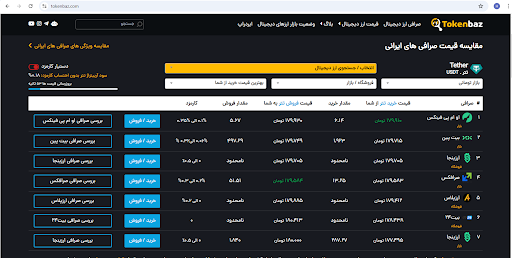
For Iranian arbitrageurs, platforms that display the price difference in domestic exchanges exist. The TokenBaz.com site scans arbitrage opportunities in Iranian exchanges and displays the best buying and selling prices for Tether and other cryptocurrencies, updating its prices every 60 seconds. Abroad, sites such as Bitsgap and https://arbitragescanner.io are well-known sites for identifying global price gaps.
Pros and Cons of Arbitrage Trading
Arbitrage as an income-generating method, like any other method, is a combination of advantages and operational challenges, which we will mention below.
Pros
- Low Market Risk: Unlike regular traders, a professional arbitrageur does not worry about the general market crash or boom; because his profit comes from the price difference, not the price direction.
- Quick Profitability: High-volume arbitrage trades usually yield results in the shortest possible time, leading to quick profitability.
- Variety in Methods: It is possible to perform arbitrage in various markets, from Forex to the commodity exchange, and various types of arbitrage can be implemented in different markets.
- Increased Market Efficiency: Arbitrageurs help the transparency and health of the entire market by correcting unfair prices.
Cons
- Need for Capital and Large Trading Volumes: Due to the smallness of price gaps, to gain meaningful and reliable profit, one must have significant initial capital.
- Transaction Costs: Sometimes the total fees exceed the arbitrage profit, making the trade uneconomical and even loss-making.
- Close Competition: The ultra-fast algorithms of large institutions destroy arbitrage opportunities within seconds.
- Technical Risks: Network delay, exchange outage, or calculation errors can lead to arbitrage trade losses or cause slippage and price changes.
- Legal Risk: On some platforms and brokers, some arbitrage methods may lead to account blocking.
How to Trade with Arbitrage?
To enter the world of arbitrage and arbitrage trading, it is necessary to first have the required knowledge in this field and then follow the path below step-by-step to stay immune from possible risks.
1. Preparing Necessary Infrastructure: In the first step of arbitrage, register in several reputable exchanges and different brokers. Having cash capital (Tether or Rial) in these financial entities is necessary for the quick execution of trades.
2. Selecting a Monitoring Tool: Determine which real-time scanner or arbitrage bots you use to identify price differences. An arbitrageur should not look for price differences manually in the age of technology.
3. Accurate Calculation of Costs: Before making arbitrage operational, you must calculate buying and selling fees and network transfer costs. We recommend that in the arbitrage method, you consider your net profit to be at least 3 times the aforementioned transaction costs.
4. Simultaneous Execution: The element of time is very important in arbitrage. Therefore, the best way to reduce risk is to simultaneously execute the buy order in the first exchange and the sell order in the second exchange. If the trader buys first and then wants to transfer, the price may change in the interval.
5. Capital Management: Successful arbitrageurs never put all their capital into one position and always keep part of the asset to cover unexpected fluctuations.
Who is an Arbitrageur and what are their features?
Arbitrageurs are expert traders who earn money with price differences and the arbitrage strategy. These individuals usually have a structured, math-oriented mindset and, instead of following market emotions, they act based on price data and monitoring prices.
Difference between an Arbitrageur and a Regular Trader
The difference between an arbitrageur and a regular trader is not just in the strategy, but also depends on their view of risk and time. In the table below, we have brought the differences between these two types of traders:
|
Feature |
Regular Trader |
Arbitrageur |
|
Analysis |
Technical, Fundamental, Market Psychology |
Technical, Fundamental, Mathematics, Modeling, Fee Assessment, Quantitative Analysis |
|
Risk |
Risk of price fluctuation over time |
Risk of delay in execution and liquidity |
|
Trade Time |
A few seconds (Scalp) to a few months (Investing) |
A few milliseconds (Robotic) to a few days (Temporal/Futures Arbitrage) |
Frequently Asked Questions about Arbitrage
How much is the profit of arbitrage trades?
The profit from arbitrage depends directly on the amount of capital and the frequency of trades. Generally, the profit that is spoken of in arbitrage trades is obtained with high capital and trading volumes.
Are arbitrage bots better than manual trading?
Definitely the answer is yes; because in today's world where speed is everything, bots have a decisive advantage. Bots have the capability to detect the price gap by comparing prices in a fraction of a second; something that is practically not possible even for a professional trader.
Why do some brokers not allow arbitrage?
This issue is about latency arbitrage; not all types of arbitrage. Latency arbitrageurs earn a profit by exploiting the system slowness of some brokers, which is basically not the result of expert analysis, but the result of system flaws.

Similar Articles

'%3e%3cpath%20d='M5.78443%206.25391H4.96875V7.16435H5.78443V6.25391Z'%20fill='%23666666'/%3e%3cpath%20d='M8.14771%206.25391H7.33203V7.16435H8.14771V6.25391Z'%20fill='%23666666'/%3e%3cpath%20d='M2.60229%207.16602H3.41797V6.25557H2.60229V7.16602Z'%20fill='%23666666'/%3e%3cpath%20d='M5.78443%208.36719H4.96875V9.27763H5.78443V8.36719Z'%20fill='%23666666'/%3e%3cpath%20d='M8.14771%208.36719H7.33203V9.27763H8.14771V8.36719Z'%20fill='%23666666'/%3e%3cpath%20d='M2.60229%209.27734H3.41797V8.3669H2.60229V9.27734Z'%20fill='%23666666'/%3e%3cpath%20d='M0%200V11.9997H10.7507V0H0ZM9.935%2010.1788C9.935%2010.6795%209.56794%2011.0892%209.11932%2011.0892H1.63136C1.18274%2011.0892%200.815681%2010.6795%200.815681%2010.1788V1.82089C0.815681%201.32015%201.18274%200.910447%201.63136%200.910447H1.86791C2.27575%200.910447%202.60202%201.27463%202.60202%201.72985V2.94074H3.4177V1.72985C3.4177%201.27463%203.74398%200.910447%204.15182%200.910447H6.5907C6.99855%200.910447%207.32482%201.27463%207.32482%201.72985V2.94074H8.1405V1.72985C8.1405%201.27463%208.46677%200.910447%208.87461%200.910447C9.45375%200.910447%209.92684%201.43851%209.92684%202.08492V10.1788H9.935Z'%20fill='%23666666'/%3e%3c/g%3e%3cdefs%3e%3cclipPath%20id='clip0_2059_2869'%3e%3crect%20width='10.7507'%20height='11.9997'%20fill='white'/%3e%3c/clipPath%3e%3c/defs%3e%3c/svg%3e)

.webp)
.webp)
User Comments
'%3e%3cpath%20d='M17%200H0V1.05566H17V0Z'%20fill='%234B4B4B'/%3e%3cpath%20d='M8.43767%206.55469H0V7.61035H8.43767V6.55469Z'%20fill='%234B4B4B'/%3e%3cpath%20d='M8.43767%203.27734H0V4.33301H8.43767V3.27734Z'%20fill='%234B4B4B'/%3e%3cpath%20d='M8.43767%209.83398H0V10.8896H8.43767V9.83398Z'%20fill='%234B4B4B'/%3e%3cpath%20d='M12.7445%206.71353L9.85449%204.02685L10.6591%203.27734L11.9455%204.47553C12.1578%204.67215%2012.4451%204.78249%2012.7445%204.78249C13.0439%204.78249%2013.3311%204.67215%2013.5435%204.47553L14.8298%203.27734L15.6345%204.02685L12.7445%206.71353Z'%20fill='%234B4B4B'/%3e%3cpath%20d='M12.7445%2011.0006L9.85449%208.30871L10.6591%207.56445L11.9455%208.76264C12.1578%208.95926%2012.4451%209.06963%2012.7445%209.06963C13.0439%209.06963%2013.3311%208.95926%2013.5435%208.76264L14.8298%207.56445L15.6345%208.30871L12.7445%2011.0006Z'%20fill='%234B4B4B'/%3e%3c/g%3e%3cdefs%3e%3cclipPath%20id='clip0_9931_2952'%3e%3crect%20width='17'%20height='11'%20fill='white'/%3e%3c/clipPath%3e%3c/defs%3e%3c/svg%3e)
Newest
Specify the sections to submit a comment:
 Upload Image
.png)


.png)



Disclaimer
All articles, training materials, analyses, and content provided by Tiggle do not constitute any trading recommendation and are solely for study and informational purposes. This website accepts no responsibility for any potential losses or damages incurred by users. Financial markets (Forex, options, stocks, cryptocurrencies, or any other trading market) inherently carry many risks, and individuals must ensure they have sufficient experience and knowledge before undertaking any investment.