The Concept of Stop Loss in Financial Markets and How to Set It

Author
نویسنده تیگل
Last Updated
 2026/06/21
Read Time
5 Min


The Concept of Stop Loss in Financial Markets and How to Set It
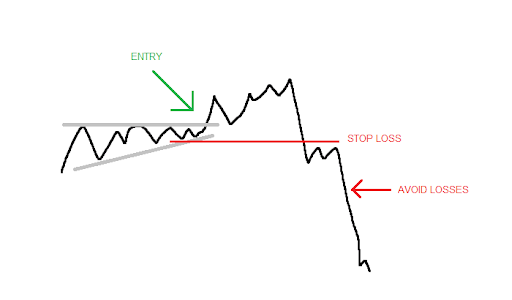
Financial markets are inherently accompanied by both profit and loss. The fundamental difference between a professional and a novice trader lies in their ability to manage losses and preserve capital and profits. Therefore, the concept of stop loss, risk management, and others in financial markets play a more prominent role in trading strategies. In this article, we attempt to provide a comprehensive review of the concept of stop loss and related topics, including types of stop loss, differences from stop out and stop limit, and training on how to determine and calculate a stop loss.
What is a Stop Loss?
Simply put, a stop loss is a conditional automated order placed by a trader with a broker or exchange to close a trade at a specific price (stop loss) if the market moves against their prediction, or potentially at a different price due to slippage. By understanding what a stop loss is, we can grasp the fundamental goal of this mechanism, which is to act as a barrier against capital destruction during periods of extreme volatility. Activating a stop loss also helps remove emotions like fear and greed from the trader's mindset. In the following sections, we will explore stop loss in various financial markets.
Stop Loss in the Forex Market
The Forex market is a highly sensitive environment due to high liquidity and leverage. Consequently, a stop loss in Forex can play a significant role in determining a trader's results. For instance, in scalping, where small fluctuations combined with high leverage can significantly impact account balance, calculating the stop loss in Forex involves considering various variables. Generally, how a stop loss is placed in Forex is based on analyzing market structure and identifying supply and demand, ensuring that instantaneous market noise does not unnecessarily deplete the trader's capital.
Stop Loss in the Cryptocurrency Market
In the cryptocurrency market, due to the influence of various fundamental variables and lower liquidity, we sometimes witness intense price behavior and second-by-second volatility in some cryptocurrencies. A stop loss in crypto can to some extent help traders manage sudden drops. A stop loss in crypto and determining it correctly helps us preserve our capital in cryptocurrency exchanges during market volatility and downturns.
Determining Stop Loss in the Stock Market
In the Iranian stock market, the existence of a control range called the "daily price fluctuation limit" has given a regulatory structure to how stop losses are determined. In situations where the market suffers from consecutive drops, the formation of heavy sell queues effectively minimizes market liquidity, and standard stop loss methods may not be effective. In such conditions, professional traders design their stop loss strategy to reduce their positions in a stepped manner before the stock price reaches the bottom of the daily fluctuation limit (currently 3%) and gets locked in a sell queue.
Take Profit (TP) vs. Stop Loss
Setting stop loss and take profit can help in managing the risk of our trading positions. Just as a stop loss is responsible for containing our losses, take profit helps us to automatically lock in and withdraw floating profits from a trade before the price trend suddenly reverses. Combining the methods of setting take profit and stop loss results in a Risk/Reward Ratio. This ratio indicates how many units of return a trader is willing to aim for in exchange for each unit of risk. The table below compares stop loss and take profit:
|
Stop Loss |
Take Profit |
|
|
Goal |
Control and limit floating loss |
Lock in profit before trend reversal |
|
Long Position Position |
Below entry price |
Above entry price |
|
Short Position Position |
Above entry price |
Below entry price |
Types of Stop Loss in Financial Markets
The diversity of price behavior in various assets has led to the development of various methods for defining and implementing stop losses. Generally, traders manage their stop loss in the following two main forms:
Trailing Stop Loss
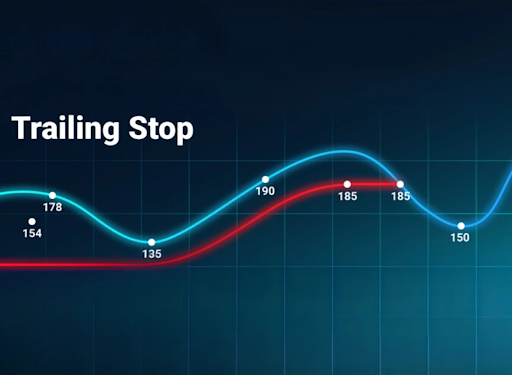
Trailing Stop Loss is a type of dynamic stop loss that automatically moves with the price as it moves in the direction of profit, following at a certain price distance, and in case of a price reversal, it stops the trade at the last recorded level. For example, in a long position, whenever the price rises, the trailing stop also rises along with it. But if the price changes direction and falls, the trailing stop remains locked at its last recorded level. Therefore, this tool helps us to save our floating profits step-by-step without tying our hands.
A very important technical note for traders is that in most trading platforms like MetaTrader 4 and MetaTrader 5, the trailing stop command is a client-side instruction. This means that for this stop loss to move automatically, our trading platform must be open and connected to the internet. If you close the platform or lose the internet connection, this instruction stops and our stop loss turns into a regular static stop loss, unless we use a Virtual Private Server (VPS).
Static Stop Loss
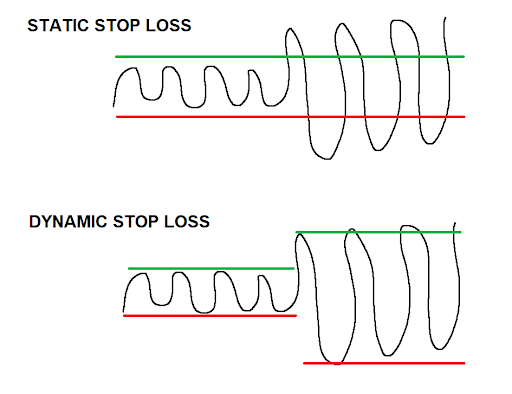
Static Stop Loss is the simplest form of defining a stop loss, where the trader sets a specific price as the final exit point and does not make changes to it. It is clear that this type of stop loss does not have enough flexibility to face various sudden fluctuations. However, it provides us with peace of mind that it will stop the order if the price reaches our specified level.
Although this type of stop loss lacks the dynamism of methods like Trailing Stop Loss and does not move with price movement, it brings the highest level of personal discipline and order to our trading strategy. The fixed nature of this order ensures that the final risk of the account is completely limited and isolated. As a result, even in the event of sudden and extreme fluctuations in financial markets, our emotions will not prevent us from manually moving the stop loss, and the trading position will be closed exactly when the specified level is touched, preventing further losses.
What is the Difference Between Stop Loss, Stop Out, and Stop Limit?
Many of us struggle to distinguish between the concepts of Stop Loss, Stop Out, and Stop Limit. In this section of the article, we will address the differences between each of them.
- Stop Loss: An optional condition set by the trader based on capital management calculations so that in case of market movement against their prediction and analysis, their trading position is closed with a specific loss.
- Stop Out: A completely mandatory process executed by the broker or exchange. When the account's Margin Level reaches a critical threshold due to large losses, the broker or exchange automatically liquidates open positions, starting from the most loss-making ones, to prevent the account balance from becoming negative.
- Stop Limit: A type of two-stage conditional order in which the user sets a Stop Price as the trigger condition for activating the order and a Limit Price as the trade price boundary. Once the market touches the stop price, the limit order is activated and is filled only if the market price is within the specified limit range or better.
The Importance of Setting a Stop Loss in Financial Markets Trading
Financial markets are inherently unpredictable, and no analysis or technical algorithm can fully guarantee the future price. The importance of setting a stop loss is that it helps us manage our losses instead of stressing over losing capital. Without using a stop loss, a trader effectively puts their entire assets at high risk.
As mentioned, every financial market has its own unique behaviors. For example, in the currency pair market (Forex), the combination of high liquidity and leveraged trades requires us to use the stop loss mechanism to ensure account and capital survival. In the cryptocurrency market, due to price step fluctuations and the possibility of "Stop Hunting," we must determine the location of our stop loss very intelligently and beyond obvious liquidity levels (technically, behind whale magnets) so as not to fall victim to fake shadows and premature exits from trades.
Training on Setting Stop Loss and Calculating It
In financial markets, learning how to set and calculate a stop loss, whether in the spot market or in leveraged futures markets, has special importance. Below, we address the factors, key strategies, and potential errors of traders in setting stop losses.
Factors Affecting Stop Loss Determination
The calculation and method of determining a stop loss should not be based on guesswork, but should be a function of the following structural variables:
1. Financial Risk Level: We must first determine how much of our total account balance we are willing to put at risk in a trade.
2. Asset Volatility: Highly volatile assets in financial markets require larger stop losses.
3. Chart Technical Structure: Key supports and resistances, candle patterns, and trend lines determine the boundaries for us to place the stop loss.
4. Timing and Timeframe: Short-term trades (scalping) have much smaller stop losses compared to medium-term trades (swing).
Key Strategies for Placing a Stop Loss
For a stop loss to truly work for us, we must determine it based on market logic and risk management. Choosing the right place for the stop loss helps us control potential losses and allow the trader to stay in the market with more peace of mind.
Stop Loss Based on Support and Resistance
Place the stop slightly below the support in a buy and slightly above the resistance in a sell so that normal market fluctuations do not cause us to exit prematurely.
Stop Loss Based on Fixed Risk Percentage
In every trade, we first determine how much of our capital we are willing to put at risk; for example, 1 to 2 percent. Then, based on this allowable risk, we determine the location of the stop loss and subsequently adjust the trade volume accordingly. Of course, this is not a strategy, but rather all methods of determining a stop loss are a function of the permissible loss amount. In other words, we first determine how much we are willing to risk on our capital, and then based on our strategy, we determine the stop loss location and subsequently the trade volume.
Stop Loss Based on Market Volatility
When the market is volatile, the stop loss should be wider, and in a market with low volatility, the stop loss can be closer to the price trend. This makes the stop loss consistent with actual price behavior. In this regard, the ATR indicator can be a useful tool for measuring market volatility. By using this indicator, we can set the stop loss consistent with the intensity of price movement so that the stop loss is neither too close nor too far from the trading position.
Stop Loss Behind the Last Valid High or Low
Placing a stop behind important price structures, such as the last low in a buy or the last high in a sell, gives the trade technical logic.
Trailing Stop Loss
As mentioned, as the price moves in the direction of profit, the stop also moves to preserve part of the profit.
Errors to Avoid When Setting a Stop Loss
Traders make repetitive mistakes along the way when using a stop loss that negatively affect their final results. Below, we point out these items to avoid repeating potential errors:
1. Placing Stops Too Close
Traders often place their stop loss very close to the entry price to reduce dollar risk. This causes some normal fluctuations and market noise to quickly trigger our stop loss and stop the trade.
2. Moving or Widening the Stop Loss During a Trade
The worst trading error is when the price approaches the stop loss, and the trader moves their stop loss further back due to emotional market influence and failure to accept defeat. The existence of this behavior in our strategy acts like a virus and ultimately leads us to endure much larger losses.
3. Setting Stop Loss Based on Hypothetical and Mental Numbers
The stop loss price should only be based on precise technical analysis, chart structure, or indicators like the ATR indicator that measure volatility. Placing a stop loss based on hypothetical mental numbers or fixed formulas without basis, such as saying our stop loss should always be 50 pips or 3% below the entry price, is completely wrong; because the market has no obligation to our mental numbers, and the stop loss should be at a point that officially invalidates the analysis structure.
Frequently Asked Questions About Stop Loss in Financial Markets
What is a Floating Stop Loss?
A floating stop loss or moving stop loss (Trailing Stop Loss) is a type of stop loss that, unlike a fixed stop loss, moves with the price as it moves in the direction of profit. This tool allows the trader, without losing larger profits, to preserve capital and stop the order at the last recorded level if the trend moves against them.
What is the formula for calculating stop loss with ATR?
The ATR indicator measures market volatility and can be used to determine the stop loss distance. In a buy trade, the stop loss is usually equal to the entry price minus ATR multiplied by a specific coefficient, and in a sell trade, the entry price plus that same amount. This method helps the stop loss stay consistent with actual market volatility but does not guarantee success or prevent the stop from being triggered entirely.
$$\text{Stop Loss (Long Position)} = \text{Entry Price} - (\text{ATR} \times \text{Multiplier}) [8, 24]$$
$$\text{Stop Loss (Short Position)} = \text{Entry Price} + (\text{ATR} \times \text{Multiplier}) [6, 24]$$
In this mathematical formula, the Multiplier is usually a number between 1.5 and 2.5 based on the trader's risk appetite. For example, if the entry price to an asset is 1000 Toman, the current ATR value is 20 Toman, and a multiplier of 2 is chosen, the stop loss for the buy trade is set at 960 Toman:
$$1000 - (20 \times 2) = 960 [24]$$
This scientific method ensures that the stop loss is adjusted according to the inherent fluctuations of the stock or currency pair and is not triggered by the smallest normal market tremor.
How to set a stop loss with Fibonacci in Forex trading?
Determining the stop loss with Fibonacci in Forex is usually done by placing the stop loss slightly behind important retracement levels so that normal price fluctuations do not cause an premature exit from the order and stop it. For example, if the entry is at levels like 50 percent, the stop loss is usually placed after the next level, like 61.8 or 78.6 percent, so that a valid break of the level is the exit signal. This approach is useful for risk management and capital protection, but the source itself emphasizes that it is better to use Fibonacci alongside other analyses and with care at the entry point.
For further and more operational explanation, setting a stop loss with the Fibonacci Retracement tool is based on placing the stop loss at a safe distance behind the key levels of this tool so that normal price fluctuations and corrections do not cause our premature exit from the market. To implement this strategy correctly, the location of the stop loss must be fully aligned with the entry point to maintain a reasonable risk-to-reward ratio:
First Scenario (Entry at Middle Levels)
If the entry into the trade is made at the 50% Fibonacci level, the stop loss should be placed with some distance, exactly behind the next level, which is 61.8%; because a valid break of the 61.8% level means the scenario of price reversal from the 50% level is invalidated.
Second Scenario (Entry at Golden Levels)
If the trader enters at deeper levels like 61.8 or 78.6 percent, the stop loss is set with more confidence behind the 100% level (the starting point of the wave movement). Price passing the 100% level means the previous trend is completely broken.
This geometric approach is very effective for containing risk, but we always recommend not to rely on Fibonacci levels alone and to place your stop loss where it overlaps (confluence) with trend lines, order blocks, or classic support and resistance chart levels.
Why doesn't the stop loss work?
Many traders think the stop loss doesn't work; but in reality, its function is to prevent larger losses, not to guarantee profit. In most cases, our problem is placing the stop loss too close to the entry point, not monitoring market volatility, or trading during important news that causes sudden price jumps. Therefore, if a stop loss is not set based on correct analysis and at a reasonable distance from the market structure, it can be said that in fact, the stop loss will not work.

Similar Articles

'%3e%3cpath%20d='M5.78443%206.25391H4.96875V7.16435H5.78443V6.25391Z'%20fill='%23666666'/%3e%3cpath%20d='M8.14771%206.25391H7.33203V7.16435H8.14771V6.25391Z'%20fill='%23666666'/%3e%3cpath%20d='M2.60229%207.16602H3.41797V6.25557H2.60229V7.16602Z'%20fill='%23666666'/%3e%3cpath%20d='M5.78443%208.36719H4.96875V9.27763H5.78443V8.36719Z'%20fill='%23666666'/%3e%3cpath%20d='M8.14771%208.36719H7.33203V9.27763H8.14771V8.36719Z'%20fill='%23666666'/%3e%3cpath%20d='M2.60229%209.27734H3.41797V8.3669H2.60229V9.27734Z'%20fill='%23666666'/%3e%3cpath%20d='M0%200V11.9997H10.7507V0H0ZM9.935%2010.1788C9.935%2010.6795%209.56794%2011.0892%209.11932%2011.0892H1.63136C1.18274%2011.0892%200.815681%2010.6795%200.815681%2010.1788V1.82089C0.815681%201.32015%201.18274%200.910447%201.63136%200.910447H1.86791C2.27575%200.910447%202.60202%201.27463%202.60202%201.72985V2.94074H3.4177V1.72985C3.4177%201.27463%203.74398%200.910447%204.15182%200.910447H6.5907C6.99855%200.910447%207.32482%201.27463%207.32482%201.72985V2.94074H8.1405V1.72985C8.1405%201.27463%208.46677%200.910447%208.87461%200.910447C9.45375%200.910447%209.92684%201.43851%209.92684%202.08492V10.1788H9.935Z'%20fill='%23666666'/%3e%3c/g%3e%3cdefs%3e%3cclipPath%20id='clip0_2059_2869'%3e%3crect%20width='10.7507'%20height='11.9997'%20fill='white'/%3e%3c/clipPath%3e%3c/defs%3e%3c/svg%3e)

.webp)
.webp)
User Comments
'%3e%3cpath%20d='M17%200H0V1.05566H17V0Z'%20fill='%234B4B4B'/%3e%3cpath%20d='M8.43767%206.55469H0V7.61035H8.43767V6.55469Z'%20fill='%234B4B4B'/%3e%3cpath%20d='M8.43767%203.27734H0V4.33301H8.43767V3.27734Z'%20fill='%234B4B4B'/%3e%3cpath%20d='M8.43767%209.83398H0V10.8896H8.43767V9.83398Z'%20fill='%234B4B4B'/%3e%3cpath%20d='M12.7445%206.71353L9.85449%204.02685L10.6591%203.27734L11.9455%204.47553C12.1578%204.67215%2012.4451%204.78249%2012.7445%204.78249C13.0439%204.78249%2013.3311%204.67215%2013.5435%204.47553L14.8298%203.27734L15.6345%204.02685L12.7445%206.71353Z'%20fill='%234B4B4B'/%3e%3cpath%20d='M12.7445%2011.0006L9.85449%208.30871L10.6591%207.56445L11.9455%208.76264C12.1578%208.95926%2012.4451%209.06963%2012.7445%209.06963C13.0439%209.06963%2013.3311%208.95926%2013.5435%208.76264L14.8298%207.56445L15.6345%208.30871L12.7445%2011.0006Z'%20fill='%234B4B4B'/%3e%3c/g%3e%3cdefs%3e%3cclipPath%20id='clip0_9931_2952'%3e%3crect%20width='17'%20height='11'%20fill='white'/%3e%3c/clipPath%3e%3c/defs%3e%3c/svg%3e)
Newest
Specify the sections to submit a comment:
 Upload Image
.png)


.png)



Disclaimer
All articles, training materials, analyses, and content provided by Tiggle do not constitute any trading recommendation and are solely for study and informational purposes. This website accepts no responsibility for any potential losses or damages incurred by users. Financial markets (Forex, options, stocks, cryptocurrencies, or any other trading market) inherently carry many risks, and individuals must ensure they have sufficient experience and knowledge before undertaking any investment.