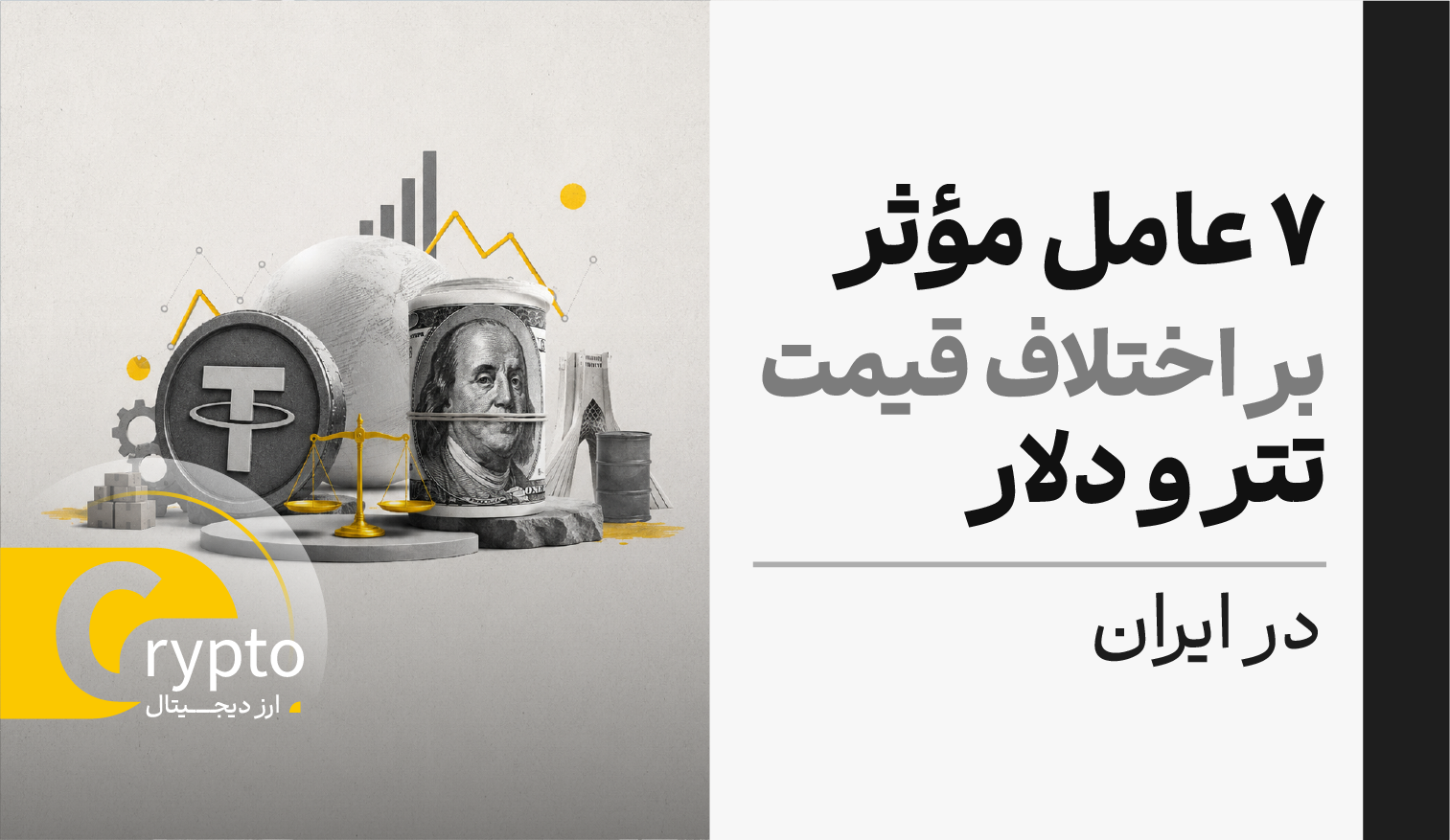
A Look at 7 Factors Behind the Gap Between Tether and Dollar Prices in Iran

Author
Hossein Haghshenas
Published
 2026/07/28
Updated
2026/10/25
Reading time
5 دقیقه


If you have ever bought Tether (USDT), you have probably faced this question: why is the price of Tether not always the same as the open-market dollar? Sometimes Tether trades a few hundred Toman higher than the dollar, and sometimes even lower. For many users, this price gap seems strange, since Tether is a stablecoin worth roughly one US dollar.
But the reality is that Tether's global parity with the dollar does not necessarily mean price parity in Iran's market. Besides being a dollar-based asset, Tether is also a digital asset, and it is affected at the same time by factors in the currency market, the crypto market, Iran's economic conditions and even traders' sentiment.
In this article, we look at how the price gap between Tether and the dollar forms, what factors widen or narrow it, and how you can better analyze Tether's real rate.
What Is Tether (USDT) and How Is It Different from Cash Dollars?
Tether (USDT) is the largest stablecoin in the crypto market, issued by Tether Limited. The goal of this asset is to keep its value close to one US dollar; that is, under normal conditions, each unit of Tether should be roughly equal to 1 US dollar.
But the important point is that Tether is not the dollar itself.
The dollar is a fiat currency issued by the US central bank, while Tether is a digital token transferred on blockchains such as TRON, Ethereum, Solana and several other networks.
Put simply:
- Dollars can be held as cash or as a bank balance.
- Tether exists only inside crypto wallets.
- Transferring dollars usually requires the banking system.
- Transferring Tether only needs the internet and a blockchain network.
These structural differences are why the prices of these two assets are not exactly the same in some countries, especially Iran.
|
Feature |
Tether (USDT) |
US dollar |
|
Asset type |
Stablecoin |
Official US currency |
|
Where it is held |
Crypto wallet |
Bank or paper cash |
|
Transfer method |
Blockchain |
Banking system |
|
Transfer restrictions |
Very few |
Dependent on banks |
|
Transfer speed |
A few minutes |
From a few hours to a few days |
|
Access for Iranians |
Relatively easy |
Limited due to sanctions |
|
Bank account required |
No |
Yes |
Why Are Tether and Dollar Prices Different in Iran?
In international markets, the price difference between Tether and the dollar is usually very small, because professional traders, through arbitrage (Arbitrage), quickly eliminate the price gap.
But in Iran, conditions are completely different.
The currency market and the crypto market are two independent markets, each with its own supply and demand mechanism. In addition, banking restrictions, international sanctions, asset transfer costs, liquidity, domestic regulations and even market sentiment mean that the price of Tether is not necessarily equal to the open-market dollar price.
That is why we sometimes see a Tether premium (Premium) or discount (Discount); that is, Tether trades at a price higher or lower than the dollar.
Factors Affecting the Price Gap Between Tether and the Dollar in Iran
For many Iranians, both Tether and the dollar act as a safe haven against the falling value of the rial, but their paths do not always move in lockstep. Behind every price gap between these two assets lies a set of economic, technological and behavioral factors, ranging from banking restrictions and sanctions to the level of demand in the crypto market.
Put simply, the price of Tether reflects the real-time conditions of Iran's market, transfer costs, users' level of access and even traders' expectations about the future of the economy. Below, we look at the most important factors that create a gap between the prices of Tether and the dollar in Iran's market.
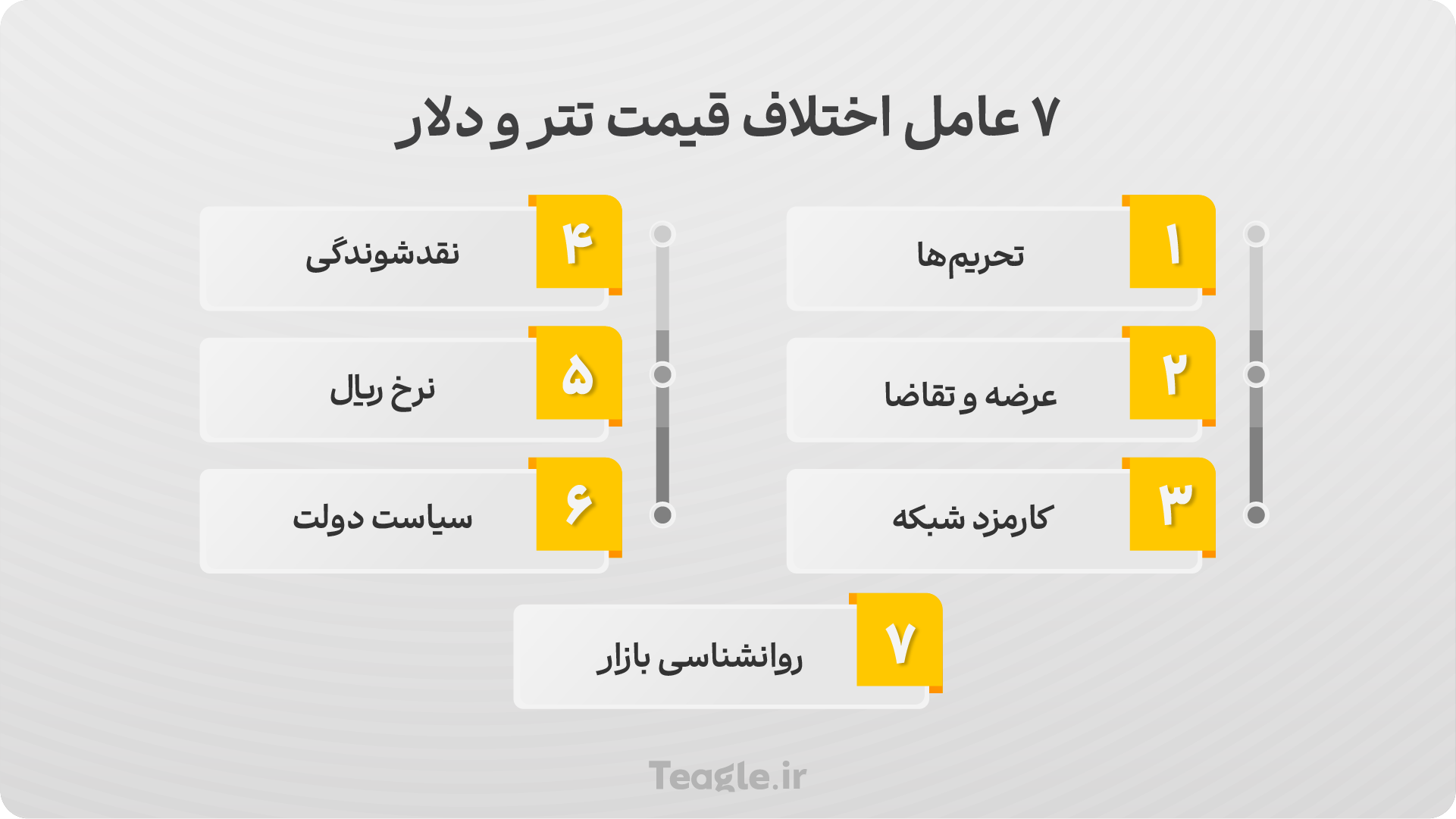
1- Sanctions and limited access to official banking channels
The most important reason for the price difference between Tether and the dollar in Iran is the lack of a direct connection to the international banking system. In many countries, people can convert bank dollars into Tether or vice versa. But because of sanctions, Iranian users effectively have no access to this cycle. As a result:
- Tether supply becomes more limited.
- The cost of bringing Tether in increases.
- The domestic market drifts away from the global market.
The harder it is for foreign capital to come in, the more likely a price gap becomes.
2- Supply and demand in the domestic crypto market
Like any other asset, the price of Tether follows a simple economic rule: whenever demand exceeds supply, the price rises. When the crypto market is bullish, many investors first buy Tether in order to buy Bitcoin or other cryptocurrencies. This rise in demand can push the price of Tether even above the open-market dollar.
Conversely, when capital leaves the crypto market, Tether supply increases and the price gap narrows.
3- Blockchain network fees and transfer costs
Tether does not move for free. Transferring USDT requires paying a network fee, which varies by blockchain. These costs ultimately affect the final buy and sell price of Tether, especially when exchanges have to move their balances between wallets or foreign exchanges.
4- Tether's liquidity versus cash dollars
Liquidity means how quickly and easily an asset can be converted into money. In Iran, Tether is in many ways more liquid than physical dollars:
- No need to carry cash
- 24-hour transfers
- Online buying and selling
- Can be sent anywhere in the world
These advantages make some traders willing to pay more to buy Tether. In fact, part of the price gap is the price of this digital asset's speed, accessibility and flexibility.
5- Fluctuations in the rial's value on the open market
When the currency market is hit by a shock, the Tether market usually reacts faster. That is why, during hours when the currency market is closed, Tether can be the first market to reflect traders' expectations. In many cases, a rise in the price of Tether is seen even before the dollar goes up.
6- Government fiscal and currency policies
Decisions by the government and the central bank also play an important role in the price gap. For example:
- Changes to currency regulations
- Restrictions on buying and selling currency
- Control of the open market
- Changes in remittance rates
- Trade policies
All of these can affect dollar supply, while the Tether market may take a different path. As a result, the gap between these two markets widens or narrows.
7- Market psychology, news and rumors
Financial markets don't always move on logic alone. Sometimes a political headline, a rumor about negotiations, regional tensions or even the release of an important economic report sends traders rushing to buy Tether.
This emotional behavior creates momentary demand and pushes up the price of Tether, even if the open-market dollar hasn't changed noticeably yet. In fact, market expectations are sometimes more important than economic realities.
How is the Tether rate calculated in Iran?
In practice, the price of Tether can't be calculated from the dollar rate alone, because many factors affect it. Still, a simple model can be offered to understand how the price works:
|
Tether price ≈ open-market dollar rate + sourcing cost + transfer fee + supply and demand margin ± market premium or discount |
Where:
Open-market dollar rate: the initial basis for valuation;
Sourcing cost: the cost an exchange or supplier pays to obtain Tether from international markets;
Transfer fee: the cost of moving USDT on blockchain networks;
Supply and demand margin: the difference caused by the volume of buying and selling in the domestic market;
and Premium or discount: positive or negative differences caused by market expectations, risks and specific economic conditions.
The gap between Tether and the dollar: a natural gap in Iran's market
The price gap between Tether and the dollar in Iran is not a random phenomenon or the result of a single factor; it is the outcome of the interaction of economic variables, the structure of the crypto market, international restrictions and trader behavior. Where there is no direct access to the global banking system, Tether, beyond serving as a digital equivalent of the dollar, has become a tool for transferring capital, preserving asset value and carrying out international transactions.
These same features cause its trading value to drift away from the cash dollar at certain times.
For investors, the most important point is not to compare the price of Tether solely with the open-market dollar rate. Looking at factors such as supply and demand conditions, blockchain network fees, political and economic news, and currency policies all together can give a more accurate picture of market conditions. The better you understand these variables, the more informed and lower-risk your decisions in buying and selling Tether will be.
Contents of this article


Related articles

User reviews

Newest
 Upload image