What Is the MetaMask Wallet and How Secure Is It?
Author
Arezoo Ghoochani
Expert review
Mohammadreza Minaei
Published
 2026/10/03
Updated
2026/10/25
Reading time
10 دقیقه


MetaMask is one of the best-known crypto wallets for interacting with decentralized applications (DApps). The wallet was initially known mainly for Ethereum and EVM-compatible networks, but newer versions also support Bitcoin, Solana and Tron. In this article, we look at how MetaMask works, its custody model, supported networks, features, fees and, most importantly, its security risks.
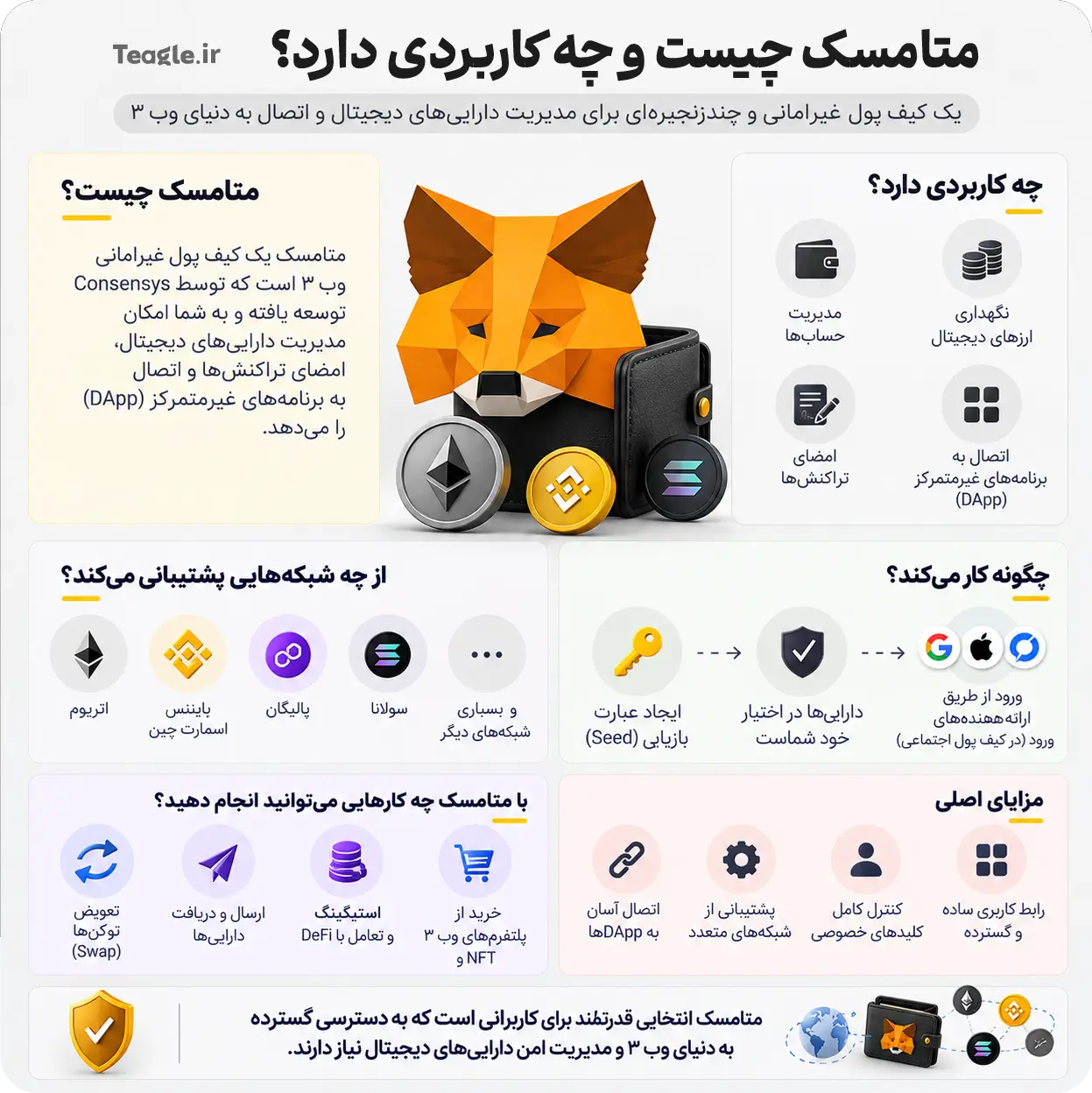
What is MetaMask and what is it used for?
MetaMask is a self-custody software wallet used to manage blockchain accounts, store and transfer digital assets, and connect to decentralized applications. The wallet is developed by Consensys and launched in 2016 with a focus on the Ethereum ecosystem.
MetaMask is not just for storing crypto. Users can use it to connect to DApps, perform swaps, interact with smart contracts, staking and some on-chain financial and payment services. Access to some of these services depends on the network, country of residence and the terms of service.
How does MetaMask work? The self-custody model
MetaMask is a self-custody wallet, meaning Consensys does not normally hold the wallet's assets, and the authority to sign transactions rests with the user. In MetaMask's traditional model, the Secret Recovery Phrase (SRP) plays a key role in recovering the wallet.
The recovery phrase should be treated as the master key to the wallet. Anyone who gains access to it can, under the right conditions, restore the wallet on another device. Losing or exposing it can therefore have serious consequences. MetaMask's local password is also not the same as the private key or the recovery phrase.
Which networks and assets does MetaMask support?
MetaMask's network support has become broader than in older versions. Ethereum and EVM networks remain the core of its ecosystem, but the current version also offers native Bitcoin, Solana and Tron accounts. Snaps also make it possible to extend this support to other networks and features.
|
Main features |
Native or extended? |
Examples |
Network type |
|
Tokens, NFTs, DApps, smart contracts |
Native EVM support |
Ethereum, Arbitrum, Base, Optimism, Polygon, BNB Smart Chain |
EVM |
|
BTC accounts, send, receive, buy and swap |
Native |
Bitcoin |
Bitcoin |
|
SOL, SPL tokens, DApps and swaps |
Native |
Solana |
Solana |
|
TRX, TRC-20 assets, swaps and staking |
Native |
Tron |
Tron |
|
Features depend on the Snap |
Extended |
XRP Ledger, Cosmos, Polkadot, Sui and others |
Snap networks |
Ethereum and EVM networks
Ethereum is still MetaMask's most important ecosystem. The wallet supports ETH, ERC-20 tokens, ERC-721 and ERC-1155 NFTs, and EVM-based smart contracts. Networks such as Arbitrum, Base, Optimism, Polygon and BNB Smart Chain can also be used within MetaMask.
Advanced users can use a custom RPC to add other compatible networks. However, changing the RPC infrastructure may affect some MetaMask features, such as Smart Transactions.
Native support for Bitcoin, Solana and Tron
In the current version, MetaMask creates a native account and address for Bitcoin, and users can use the supported routes to send, receive, buy and swap BTC. Solana also has native support, allowing users to manage SOL and SPL tokens and use some DApps and swap services.
Native Tron support includes TRX and TRC-20 assets such as USDT. However, supporting a network's assets does not necessarily mean having all of that network's DApp features. Addresses, fee systems and DApp features on these networks also differ from EVM.
What are MetaMask Snaps?
Snaps are modules that extend MetaMask's features to other networks or use cases. Through Snaps, you can access ecosystems such as XRP Ledger, Cosmos, Polkadot and Sui, as well as some other networks. Some of these modules are built by third-party developers, so it is important to check the source and the requested permissions before installing.
Is MetaMask safe?
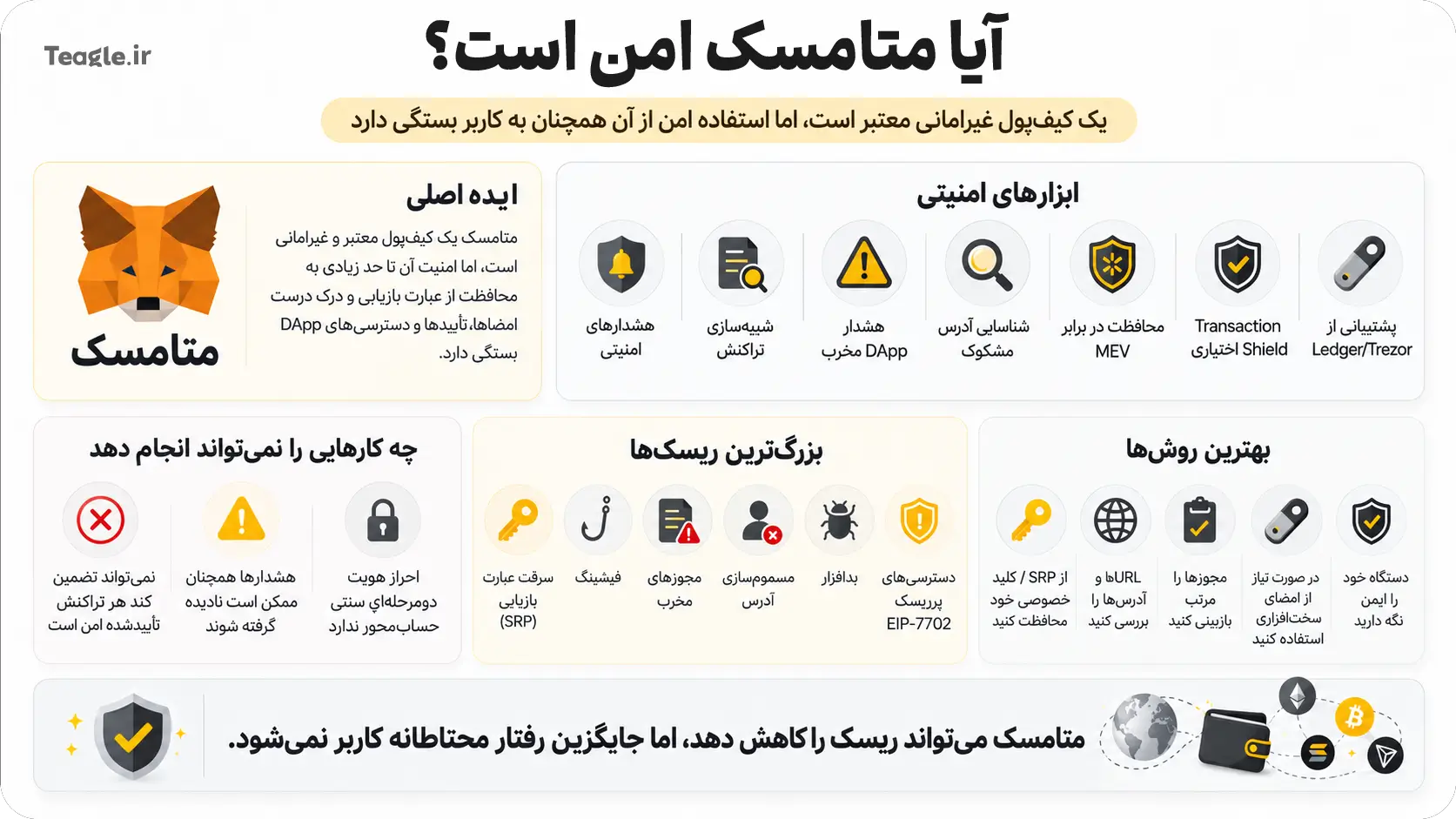
The answer to this question cannot simply be «yes» or «no». MetaMask is a reputable self-custody wallet and offers tools such as transaction alerts, transaction simulation, detection of some suspicious addresses and connection to hardware wallets. However, a large part of security still depends on how the user uses the wallet.
If the recovery phrase or private key is exposed, MetaMask's security tools cannot fully protect the assets. The user may also approve a malicious transaction or permission themselves; a valid blockchain signature does not mean the transaction is safe.
Private key, recovery phrase and account security
In traditional MetaMask wallets, the Secret Recovery Phrase is the most important backup and recovery tool. Storing it on an internet-connected device, sending it to others or entering it on unknown sites can increase the risk of asset theft. Alongside the traditional method, MetaMask also offers wallet creation with Google, Apple or Telegram; this method changes the setup and recovery model, but does not make the wallet custodial.
Security alerts and transaction simulation
MetaMask uses a security alert system to identify some suspicious DApps, addresses, signatures and permissions. Transaction simulation can also provide more information about a transaction's likely outcome before signing. These tools reduce some risks, but do not guarantee that every approved transaction is safe.
Transaction Shield and hardware wallets
Transaction Shield is an optional, paid service for certain transactions. According to source information as of 26 August 2026, it cost $9.99 per month or $99 per year and offered limited coverage for eligible losses. This service is not general crypto insurance and has specific terms and exclusions.
MetaMask also supports hardware wallets such as Ledger and Trezor. In this setup, the private key stays on the hardware device and signing a transaction requires physical confirmation. This feature is not the same as the traditional 2FA of online accounts, and even a hardware wallet does not stop the user from approving a malicious permission.
MetaMask's most important security risks
|
User action |
Can MetaMask help? |
Risk |
|
Move funds to a new wallet |
Limited |
SRP theft (seed recovery phrase) |
|
Verify the URL |
Alerts can help |
Phishing |
|
Review and revoke |
Simulation/alerts can help |
Malicious approval |
|
Verify the full address |
Detection can help |
Address poisoning |
|
Secure the device |
Limited |
Malware |
|
Review and revoke |
Permission controls can help |
Malicious EIP-7702 authorization |
The main risks can be summarized in a few groups: theft of the recovery phrase or private key, phishing, malicious approvals, address poisoning, malware and excessive permissions in Smart Accounts. MetaMask's alerts and simulation can help in some cases, but checking the URL, the full destination address and the requested permissions is still the user's responsibility.
How do MetaMask Smart Accounts work?
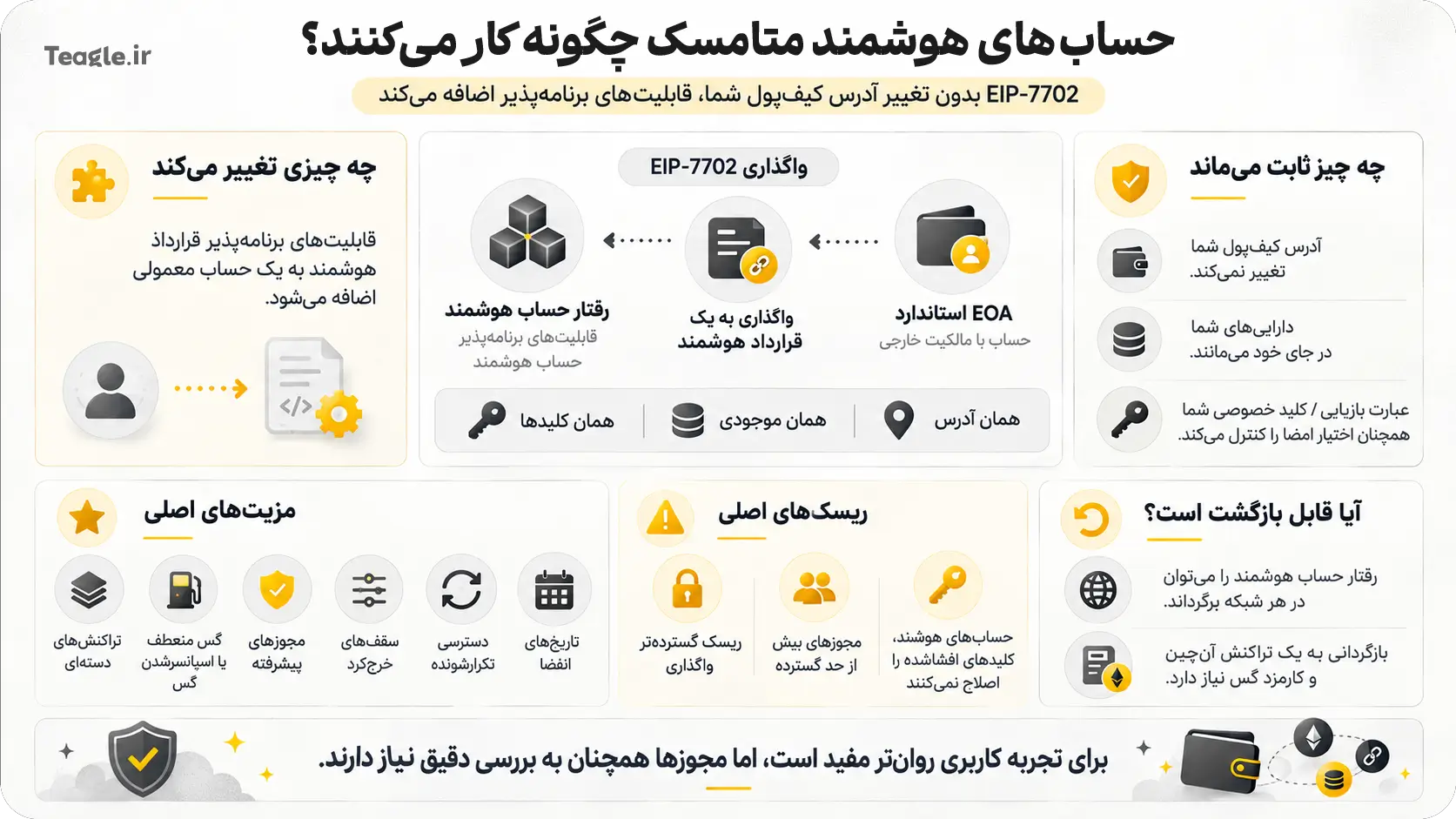
Smart Accounts in MetaMask use EIP-7702 to add capabilities such as batched operations, programmable permissions and some more flexible ways to pay gas to the account, without changing the account's main address.
Transaction batching and advanced permissions
One use of a Smart Account is combining several operations into a single flow; for example, approving a token and executing a swap. Advanced permissions can also let a DApp have limited authority over a specific amount of a token for a specific period of time.
Smart account risks
A Smart Account should not be considered safer than a standard account simply because it has more features. Programmable capabilities bring a new layer of permissions and smart contracts into the process and can create new risk if excessive access is granted.
What can you do with MetaMask?
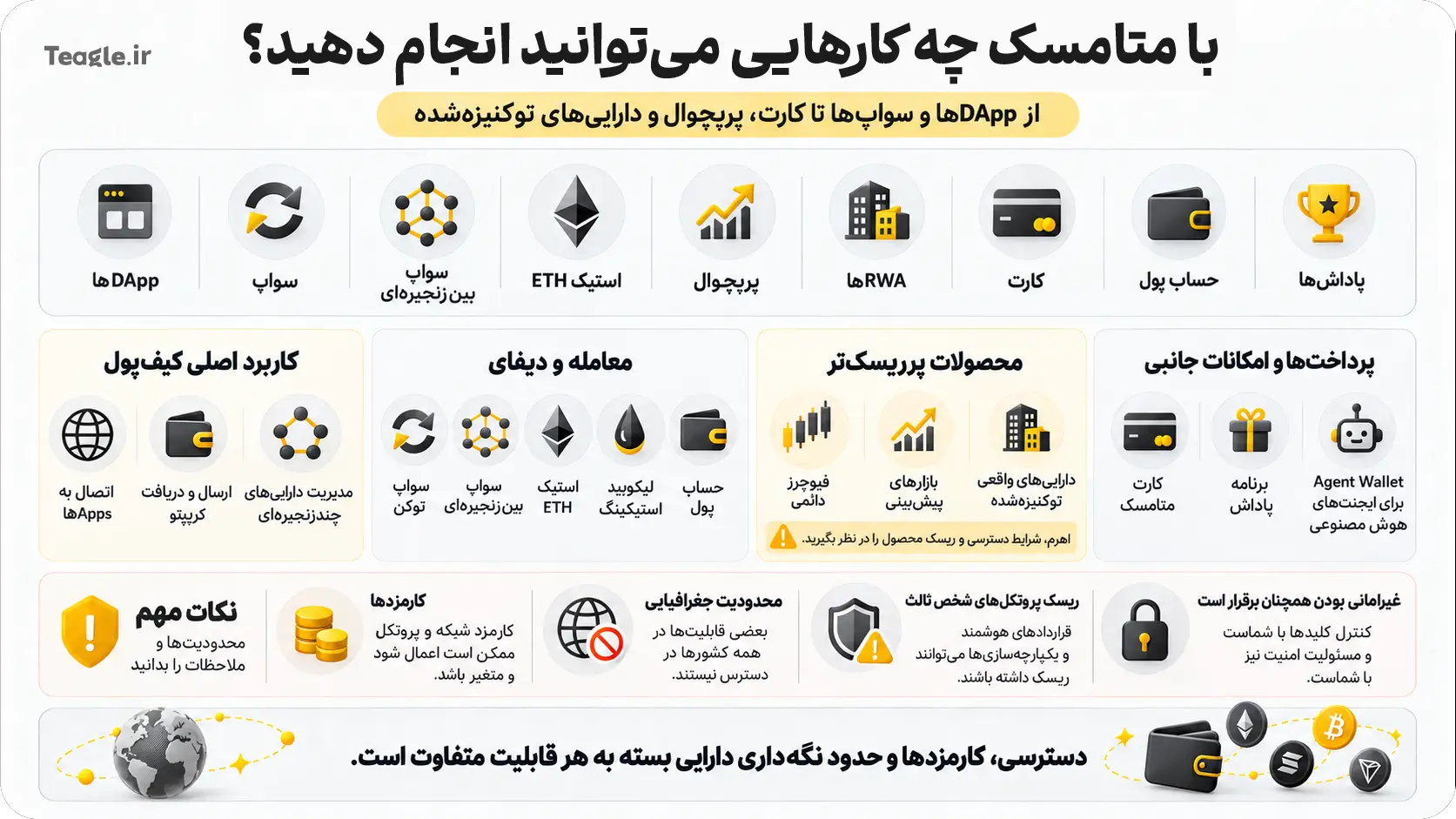
In 2026, MetaMask is used for far more than sending and receiving crypto. Its features include connecting to DApps, swaps, cross-chain swaps, staking, perpetual trading, some prediction markets, tokenized real-world assets and payment products. Access to these services depends on the country, the network and each service's terms
|
Main consideration |
Available? |
Feature |
|
Self-custody risks remain |
Yes |
DApps |
|
MetaMask service fee |
Yes |
Swaps |
|
Depends on route and network |
Yes |
Cross-chain swaps |
|
Fees vary by product |
Yes |
ETH staking |
|
Leveraged trading risk |
Yes |
Perps |
|
Jurisdictional restrictions |
Yes |
RWAs |
|
Regional restrictions and fees |
Yes |
Card |
|
Yield and product risks |
Yes |
Money Account |
|
None |
App available |
Rewards |
Swaps and cross-chain swaps
MetaMask Swaps aggregates prices and trade routes from various decentralized exchanges and liquidity providers. According to the source information as of 26 August 2026, MetaMask's service fee for swaps was 0.875 percent and was calculated separately from gas, pool or DEX fees, slippage and price impact.
For large trades, comparing the final amount received with direct access to DEXs and aggregators can be important, because the convenience of the built-in swap does not necessarily mean the lowest cost.
Staking and MetaMask Money
MetaMask offers Ethereum staking through models such as pooled staking, validator staking and liquid staking with providers such as Lido and Rocket Pool. In the source information, the pooled staking fee was stated as 15 percent of rewards and the validator staking fee as 10 percent of rewards. Liquid staking products also carry their own protocol and smart contract risks.
MetaMask Money is a yield product based on mUSD on Monad, offered in specific regions. Its yield is variable and should not be considered a guaranteed return.
Perpetual trading, prediction markets and tokenized assets
MetaMask provides access to perpetual trading through Hyperliquid. These trades are leveraged and, if the collateral value falls, can lead to the liquidation of the position. Some prediction markets and tokenized real-world assets are also available through MetaMask in eligible regions, each with its own terms and risks.
MetaMask Card, Rewards and Agent Wallet
MetaMask Card is a Mastercard-based payment product that lets eligible users spend certain crypto assets. Rewards is a loyalty program based on tiers and periodic campaigns, and its terms may change.
Agent Wallet is a separate product for AI agents that can carry out blockchain transactions within defined limits. At the time the source was updated, this product was in Early Access and carried risks such as automation errors and excessive permissions.
How much are MetaMask's fees?
Installing the wallet itself is free, but its built-in services have separate fees. As of 26 August 2026, the swap fee was stated as 0.875 percent, ETH pooled staking as 15 percent of rewards, validator staking as 10 percent of rewards, and Transaction Shield as $9.99 per month or $99 per year.
At a rate of 0.875 percent, MetaMask's service fee is about $0.88 for a $100 swap, $8.75 for $1,000 and $87.50 for $10,000; these amounts are calculated before gas, pool and execution costs.
|
Cost (as of 26 August 2026) |
Service |
|
$0 |
Wallet installation |
|
0.875% |
MetaMask Swaps |
|
15% of staking rewards |
ETH pooled staking |
|
10% of staking rewards |
Validator staking |
|
$9.99 per month or $99 per year |
Transaction Shield |
|
$0 per year |
Card free tier |
|
$199 per year |
Card Metal tier |
|
0.875% MetaMask fee |
Tokenized RWA trading |
|
0.1144% maker / 0.1432% taker at base tiers |
Futures (Perps) |
|
4% fixed fee plus variable taker fee |
Predictions |
What is the MetaMask user experience like?
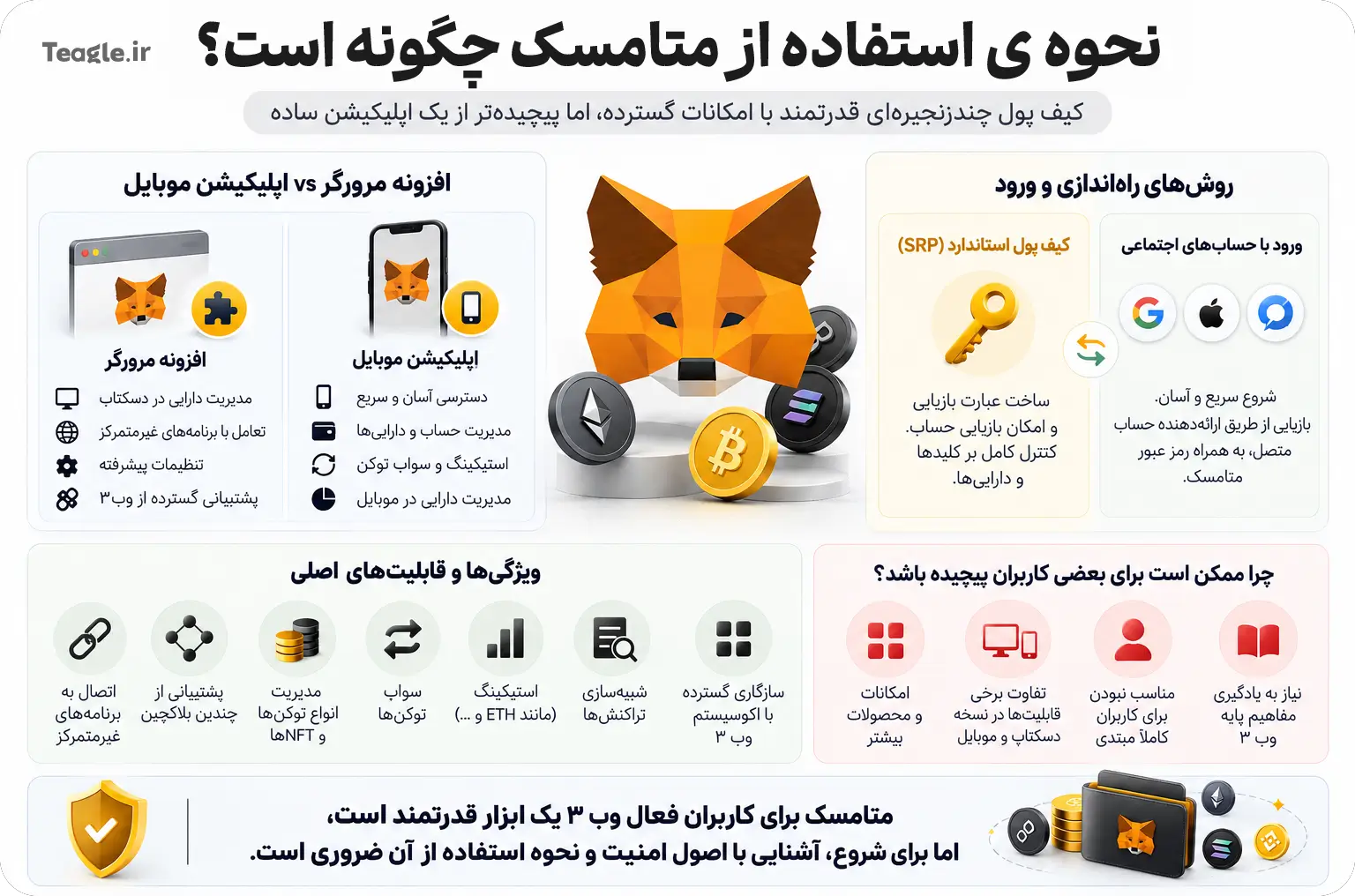
MetaMask is offered as a browser extension and a mobile app. The extension offers more flexibility for desktop DApps, custom RPCs, Snaps and connecting to hardware wallets, while the mobile app covers asset management, NFTs and some newer services such as Money Account and TRX staking.
The growing number of features has made MetaMask's interface more complex than a simple send-and-receive wallet. This breadth can be useful for active Web3 users, but for a user who only needs a simple wallet, some of the menus and services may be unnecessary.
How to set up MetaMask
MetaMask supports two separate paths for setting up a new wallet.
|
Setup method |
Recovery dependency |
Best for |
|
Secret Recovery Phrase |
SRP |
Traditional self-custody users |
|
Sign-in via Google/Apple/Telegram |
Linked login + MetaMask password |
Users who prioritize simpler setup |
To create a new wallet, you can use the traditional setup with a recovery phrase or sign in via Google, Apple or Telegram. With the traditional method, protecting the recovery phrase offline is essential. With social login, recovery depends on MetaMask's encrypted architecture and the linked login credentials.
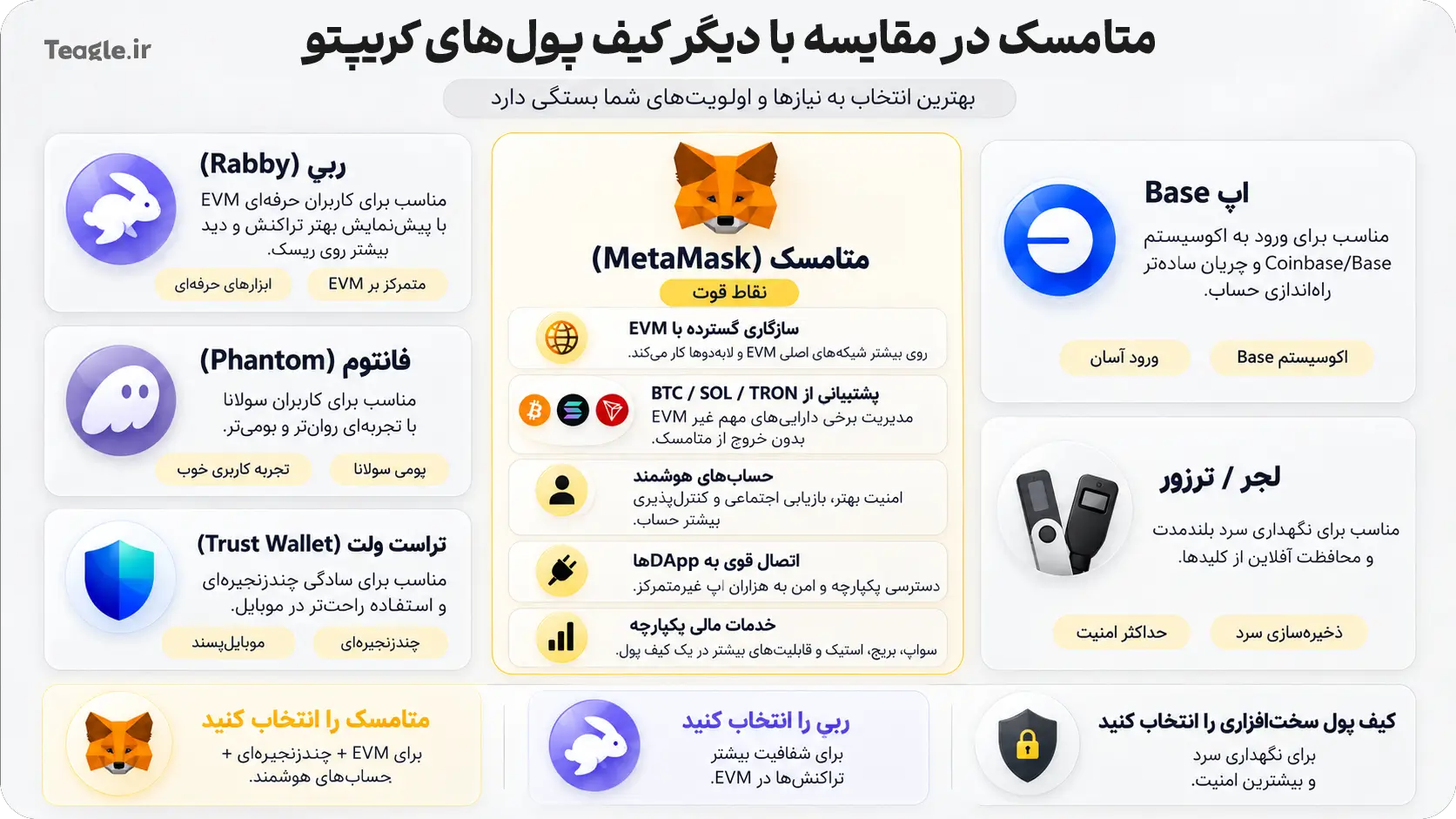
MetaMask compared with other wallets
MetaMask sits alongside more specialized wallets such as Rabby, Phantom and Trust Wallet, as well as hardware wallets such as Ledger and Trezor. The main difference between them comes down mostly to use case: Rabby focuses more on the transaction experience and risk preview on EVM, Phantom is known among Solana users, Trust Wallet focuses on mobile and multichain use, and Ledger and Trezor are designed for offline key storage. In the table below, we give a general comparison of MetaMask with the leading wallets in the crypto market.
|
MetaMask's strengths |
Advantage over MetaMask |
Best for |
Wallet |
|
Ecosystem compatibility and product breadth |
Transaction UX and risk preview |
Advanced EVM users |
Rabby |
|
EVM legacy and smart account ecosystem |
Solana-native UX |
Solana-first users |
Phantom |
|
DApp and EVM tooling |
Chain breadth and mobile ease of use |
Broad multichain simplicity |
Trust Wallet |
|
Advanced EVM flexibility |
Easy onboarding and ecosystem integration |
Coinbase/Base ecosystem |
Base App |
|
Everyday DApp usability |
Offline key protection |
Long-term storage |
Ledger / Trezor |
Which users is MetaMask best suited for?
MetaMask is most useful for users who regularly work with Ethereum, EVM networks and DApps, want to manage BTC, SOL and TRX in one place, use a hardware wallet, or need features such as Smart Accounts and programmable permissions.
Is MetaMask worth using in 2026?
MetaMask remains one of the strongest options for active self-custody users who need broad DApp compatibility and growing multichain support. It is less appealing for users who are mainly looking for cold storage, the lowest possible trading fees, or an ultra-simple wallet.
Native Bitcoin, Solana and Tron accounts have closed several important network gaps, while transaction alerts and smart accounts have improved how permissions and complex transactions are handled. These improvements come alongside a larger set of trading and financial services that users should evaluate separately, rather than assuming every feature carries the same risk.
Who is MetaMask the best choice for?
Active Ethereum and EVM users: Ethereum, layer 2 networks, custom RPCs and EVM smart contracts remain among MetaMask's strongest areas.
Users who frequently interact with DApps: DeFi, NFT, governance and other on-chain applications are widely compatible with MetaMask.
Multichain users holding Bitcoin (BTC), Solana (SOL) and Tron (TRON): native support for non-EVM networks reduces the need for separate wallets for basic asset management.
Users pairing software with hardware signing: Ledger and Trezor can keep keys on dedicated hardware while MetaMask provides the DApp interface.
Advanced users exploring smart accounts: EIP-7702 batching and restrictive permissions provide programmable account functions without changing the main address.
Conclusion: Is MetaMask safe and what are its limitations?
MetaMask is a self-custodial software wallet that has evolved from a mainly Ethereum-focused tool into a multichain wallet with broader features. Support for EVM, Bitcoin, Solana and Tron, broad DApp connectivity, security alerts, transaction simulation and the ability to use it alongside hardware wallets are among its key features.
On the other hand, MetaMask is still a hot wallet, and its security depends largely on how recovery information is stored and how carefully the user approves transactions and permissions. The added features have also made the product more complex than a simple wallet, and its built-in services carry separate fees.
As a result, MetaMask's security should be assessed within the framework of its self-custody model. MetaMask provides tools to reduce some risks, but it is no substitute for safe user behavior. Protecting the recovery phrase and private key, carefully checking sites and DApps, paying attention to requested permissions and comparing costs before transacting remain the core of wallet security.
Article source: Coin Bureau — MetaMask Review 2026: Fees, Security, Features & Verdict
Contents of this article


Related articles

User reviews

Newest
 Upload image