
Everything About Crypto Staking and a Guide to It

Author
Hossein Haghshenas

Expert review
Mohammadreza Minaei
Published
 2026/03/04
Updated
2026/11/02
Reading time
9 دقیقه


Staking (Staking) is one of the ways to earn passive income in the world of cryptocurrencies. This process lets you support a network's security and operations by holding your digital assets in it and receive rewards in return. In this article, we try to comprehensively cover this concept, how it works and the essential points for getting started.
What is staking (Staking) and what is it used for in the crypto world?
Staking in the world of cryptocurrencies is one of the popular ways to earn passive income. When a trader stakes a cryptocurrency, they lock their assets in the network and, in exchange for taking part in the transaction validation process, receive staking rewards .
To put it more simply, staking means depositing crypto in blockchain types that use the Proof of Stake consensus mechanism (Proof of Stake). Validators (Validators) take part in the consensus process by setting up and running a node on the network and locking a certain amount of that blockchain's native token, and they are responsible for validating transactions and producing blocks.
In crypto, staking has several main uses: increasing blockchain network security, earning profit without the need to trade, reducing market volatility through long-term holding of coins, and supporting cryptocurrency projects such as Ethereum, Cardano and Polkadot. Some examples of stakeable coins are: Ethereum, Polkadot, Cardano, Solana and ...
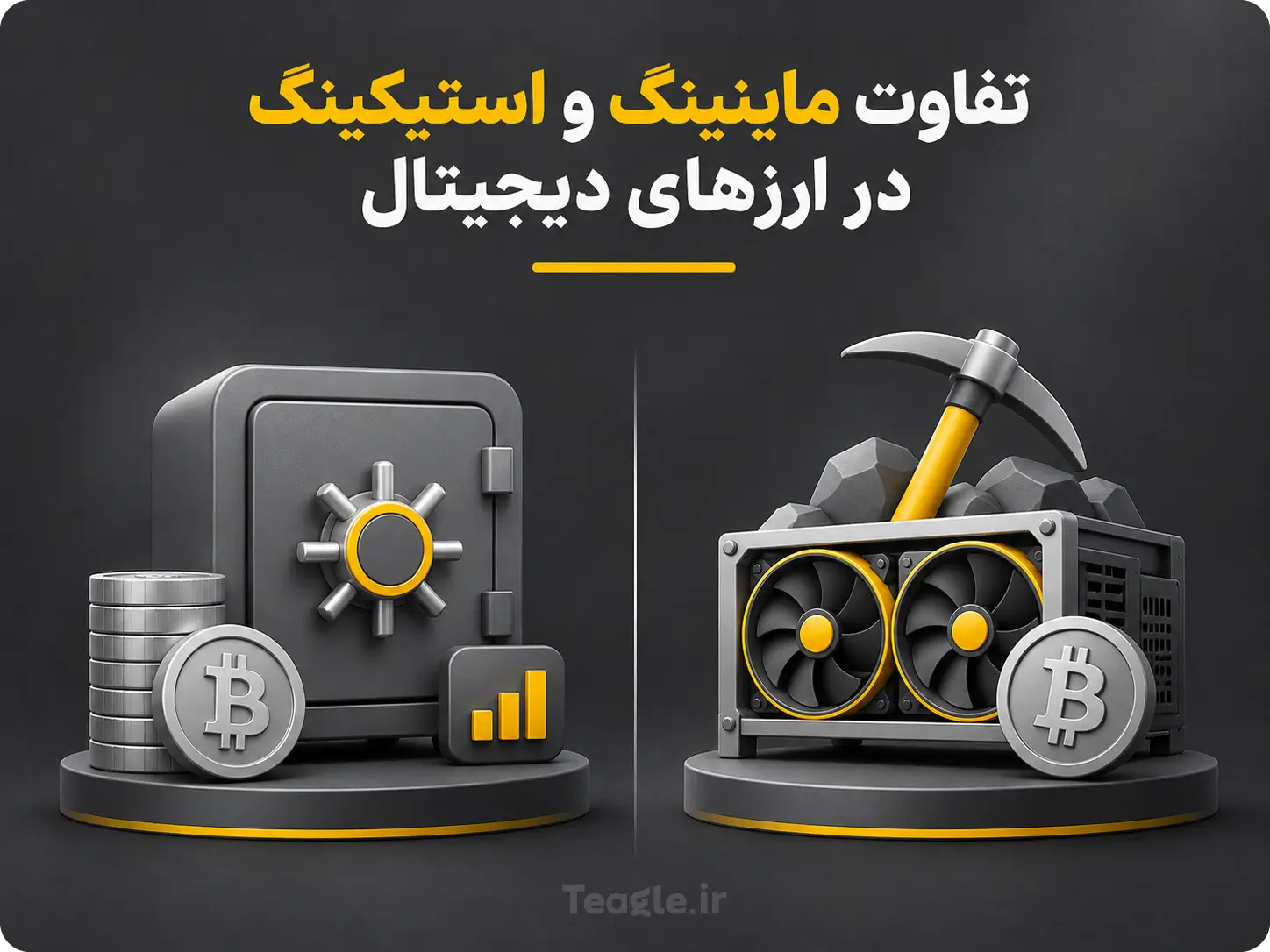
The difference between mining and staking in cryptocurrencies
Mining is based on the Proof of Work algorithm, in which miners record transactions using high processing power and heavy electricity consumption. Crypto staking, however, takes place under the Proof of Stake algorithm, which does not require mining rigs. For this reason, staking has emerged as a more suitable, more economical and more accessible alternative for ordinary users.
|
Feature |
Mining |
Staking |
|
Energy consumption |
Very high |
Very low |
|
Initial capital |
Buying expensive equipment |
Buying a stakeable coin |
|
Technical complexity |
High |
Lower and user-friendly |
|
Required environment |
A cool room with stable power |
Just a connection to a wallet or exchange |
|
Reward |
Block rewards and transaction fees |
Validation/staking rewards and sometimes fees |
How does the staking process work?
The assets you stake act as collateral: in many Proof of Stake networks, the larger the amount of staked assets, the higher the chance that the validator will take part in the block validation process and receive rewards. In this part of the Teagle article, we describe the staking process in a few steps:
- Choosing the right coin: It is important to know which coins support staking.
- Choosing a wallet or exchange: There are various platforms, such as Nobitex, Wallex and Binance exchanges, or the Trust Wallet wallet, which offer staking or crypto deposit options.
- Locking the assets: After choosing the desired coin, you commit a certain amount of the asset, which, depending on the network and platform, may be locked or made inactive.
- Receiving rewards: After the period ends or according to the network's schedule, staking rewards are deposited into your account automatically on some platforms, and on others after confirmation and Claim, are credited to your account.
The initial capital required to stake cryptocurrency
The initial capital required to stake cryptocurrency depends on the type of coin and the method or platform used. For example, on the Ethereum network, if you want to run a validator (Validator) directly, you must deposit at least 32 units ETH into the staking contract. However, users can also take part in staking with much smaller amounts through staking pools or some exchanges and wallets. Also, in methods such as liquid staking (Liquid Staking), participation with smaller assets becomes possible, and users receive a representative token in exchange for their staked assets.
How long assets stay locked in the network
How long assets stay locked for staking varies with the network and the participation method and can range from a few days to several weeks or even months. For example, on the Solana network, the time to release assets after unstaking usually depends on network cycles (Epoch) and usually takes a few days. On the Polkadot network, the Unbonding period is about 28 days, after which the assets become withdrawable. Also, some exchanges and platforms offer «flexible staking» plans in which users can withdraw their assets with fewer time restrictions or without a long lock period.
How to release and withdraw staked assets
Withdrawing staked assets depends on the type of network. In wallets such as Trust Wallet (Trust Wallet), you need to select the Unstake option so that the assets are released after a set time. On exchanges such as Nobitex or Tabdeal, the withdrawal process is usually faster and profit is calculated up to the moment staking is canceled.
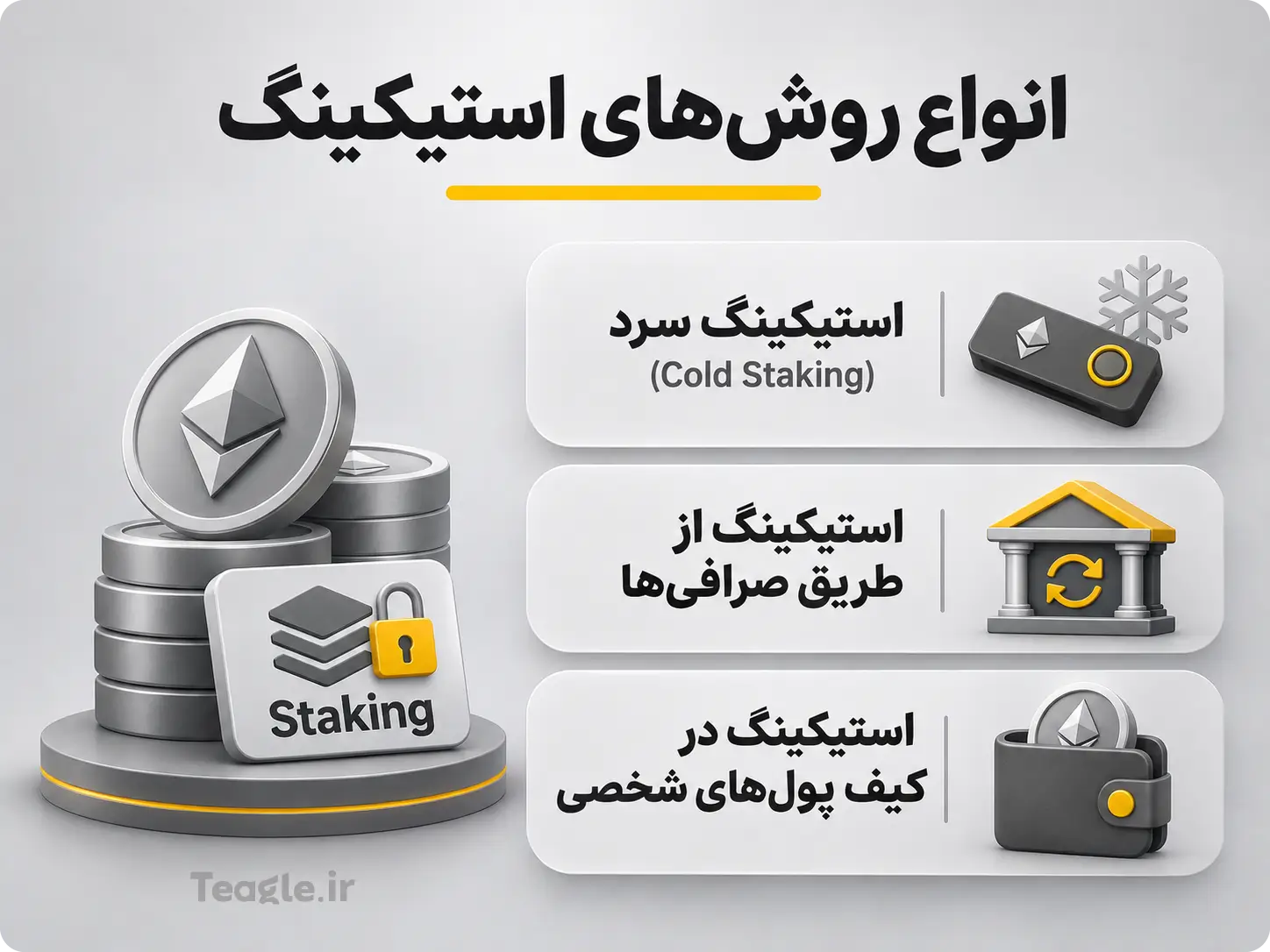
Types of staking methods
Staking methods are a set of solutions and mechanisms for taking part in validating transactions and maintaining the security of networks based on the Proof of Stake algorithm (PoS). Each method involves a different level of technical involvement, risk and profit, and is chosen based on the type of network and the trader's resources.
In general, these methods differ in the level of control over assets, how validation responsibility is delegated, and the type of participation in the network. Some of them are fully technical and independent, while others are carried out more simply through intermediaries or collective pools.
Cold staking (Cold Staking)
Cold staking (Cold Staking) is a method in which the user's assets are kept in a secure wallet, usually a hardware wallet, and the private keys remain offline. In this setup, the user can delegate their assets to a validator on the network and take part in the staking process without the wallet having to stay online all the time.
For example, some users use hardware wallets such as Ledger for staking, which offer a high level of security because the private key is stored offline. The advantages of cold staking include greater security and suitability for holding assets long term. On the other hand, setting it up and managing it can be somewhat more complicated for beginners and requires more familiarity with wallet settings and choosing a validator.
Staking through exchanges
This method is the best option for beginners. Users can easily activate staking on exchanges such as Nobitex, Wallex, Bitpin or Coinex. Nobitex's Tether earning plan, which pays 3.8 percent annually at the time of writing, as well as Ethereum staking rewards on Binance, are calculated daily. The advantage of this type of staking is a simple user interface suitable for beginners, and the drawback seen in this method is that full control of the assets lies with the exchange, not the user.
Staking in personal wallets
In wallets such as Trust Wallet and MetaMask, the user interacts directly with the blockchain. For example, the Trust Wallet staking calculator helps you estimate your potential rewards before locking your assets. Staking in a personal wallet usually offers higher returns but carries more technical risk.
What is liquid staking (Liquid Staking) and what are its advantages?
Liquid staking is one of the newest innovations in crypto. In this model, when you stake a cryptocurrency, you receive an equivalent token (for example stETH on Ethereum) that can be traded and used. The advantages of liquid staking include the following:
High flexibility, the ability to use staked assets in other projects, earning rewards without losing liquidity
How are crypto staking rewards calculated?
Staking rewards are usually expressed in two forms: annual (APR or APY). This figure varies depending on the coin, the network and the lock-up period. It is lower than the returns on Ethereum or Solana, because Tether is a stablecoin. For an accurate calculation, use crypto staking calculators.
Crypto staking rewards are usually shown on an annual basis using metrics such as APR or APY . APR shows the annual rate of return without taking compounding into account, while APY calculates the annual return including the compounding of rewards.
The amount of staking rewards depends on various factors such as the type of cryptocurrency, the structure of the blockchain network, the total amount of assets staked on the network and, in some cases, the lock-up period. For example,, networks such as Ethereum or Solana that use the proof-of-stake algorithm make it possible to earn rewards through staking.
To estimate potential rewards, you can use crypto staking calculators, which provide an estimate of potential earnings based on the network's current rates.
|
Coin |
Approximate annual return |
Recommended platform |
|
Ethereum |
4–7% |
Trust Wallet, Binance |
|
Polkadot |
10–14% |
Trust Wallet, Coinex |
|
Cardano |
3–5% |
Wallet Yoroi, Trust Wallet |
Staking calculators
Useful tools for calculating rewards:
- Nobitex reward calculator: for estimating monthly and daily returns
- CoinMarketCap Staking Calculator: Calculates rewards for more than 100 cryptocurrencies
Pros and cons of staking in the crypto market
As a yield-earning strategy in the crypto market, staking brings both significant income opportunities and risks such as locked capital and market volatility. Understanding both sides of the coin clearly is essential for making informed decisions.
Advantages of staking in the crypto market
Earning passive income from crypto, lower energy consumption than mining, improved network security, holding assets long term
Disadvantages of staking in the crypto market
Assets locked for a set period, risk of the coin's price falling, vulnerability if an untrustworthy platform is chosen
The difference between staking, yield farming and pools
For Iranian users, staking is usually better than pools, because it is simpler and carries less risk.
|
Feature |
Staking |
Yield farming |
Pool |
|
Type of activity |
Locking coins on the network |
Providing liquidity on an exchange |
Participating in mining or transaction validation |
|
Risk |
Low to medium |
Medium |
Variable |
|
Reward |
Variable return |
Variable return |
Depends on network performance |
|
Example |
Ethereum staking |
Farming on PancakeSwap |
Participating in Wallex's internal pool service |
Frequently asked questions about crypto staking
What do APR and APY mean in staking?
APR shows the annual percentage return without compounding, while APY includes the added returns in each period (daily or monthly). Typically, on exchanges such as Nobitex or OKX, staking rewards are shown as APR .
What is the best exchange and wallet for staking for Iranians?
You can't name a single best crypto exchange for staking, as it depends on various factors. Iranian users can use some domestic exchanges such as Nobitex, Wallex, Bitpin, Tabdeal and others for staking services. In some cases, these platforms let you earn rewards from holding or staking certain cryptocurrencies. However, the range of coins and staking terms differ from one exchange to another.
Among wallets, options such as Trust Wallet and MetaMask are popular. Trust Wallet offers direct staking or delegation (Delegation) for some coins. MetaMask is mostly used as a gateway for connecting to decentralized applications and staking platforms in the DeFi ecosystem.
Is staking risky?
Yes, despite being relatively safe, staking carries technical and financial risks. Technically, a node error or loss of network connection can lead to a penalty or the loss of part of your assets (slashing). Financially, locking up crypto for a set period reduces liquidity and exposes you to market price swings, which may affect the value of your total capital.
Contents of this article


Related articles


User reviews

Newest
 Upload image