What Are B-book and A-book Brokers?

Author
Admin
Published
 2026/03/06
Updated
2026/10/25
Reading time
5 دقیقه


Understanding the concepts and execution models brokers use for trades is a technical necessity for traders and a guarantee of transparency. We use the two terms “A-Book broker” and “B-Book broker” when looking at how brokers execute traders’ orders. This classification determines the path a trade’s liquidity takes, how the broker earns its income, and whether there is a potential conflict of interest between the trader and the broker. Naturally, with the advance of modern technologies and the emergence of Electronic Communication Networks (ECN), understanding the line between B-Book and A-Book brokers has become more important than ever, and understanding them is also essential for Iranian traders, who operate in an environment of international restrictions and regulation challenges.
What Is an A-Book Broker?
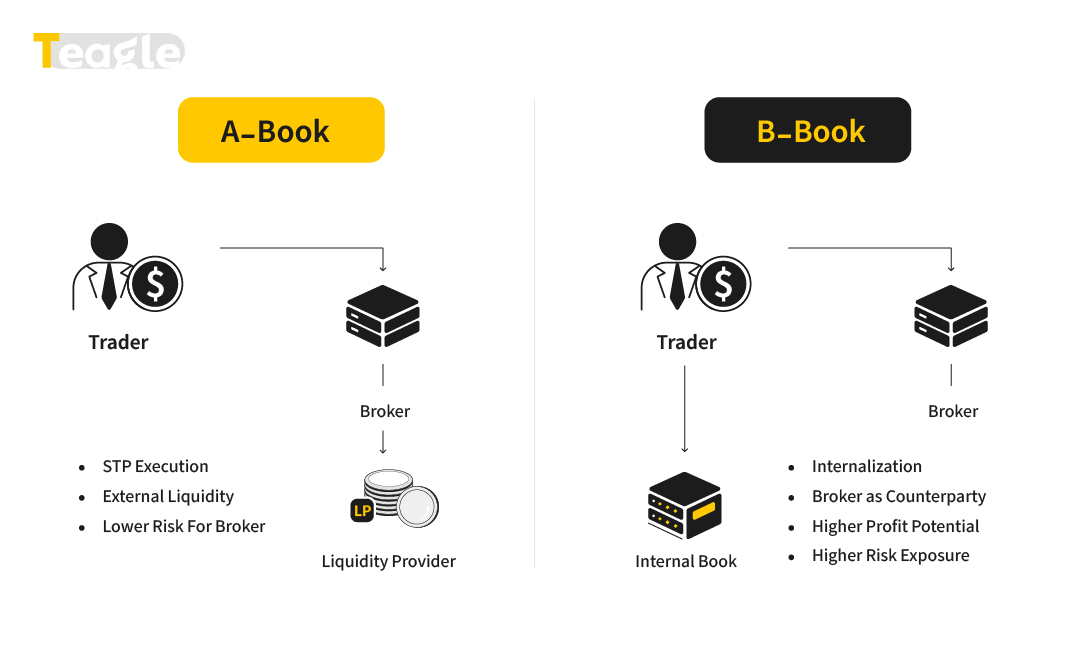
Put simply, an A-Book broker is an intermediary that connects buyers and sellers to the forex market, without the broker itself intervening in the trade. Technically speaking, an A-Book broker, as a technological intermediary for forex trading, connects the trader to liquidity providers; that is, the broker receives our buy or sell order and sends it unchanged to Liquidity Providers. Liquidity providers usually include major banks, important financial institutions, tier-one brokers and so on.
The execution method of an A-Book broker is based on the “straight-through processing” protocol, or STP , short for Straight-Through Processing; that is, from the moment the trader places an order (buy or sell) until the trade is executed in the market, the broker does not intervene in any way as a Dealing Desk. More important than STP is the use of an “Electronic Communication Network”, or ECN (short for Electronic Communication Network), which gives traders direct access to liquidity providers.
For example, suppose we want to buy 5 lots of the EUR/USD currency pair. Within a few milliseconds, the broker’s system scans and reviews the liquidity providers’ offers and places our trade at the best offered price. This method shows us, on the broker’s trading platform, an accurate, real-time reflection of the liquidity available in the global market, without interference. Clearly, with an A-Book broker no conflict of interest is conceivable, and the broker does not profit from our losses; instead, it earns income by charging a commission or adding a markup to our trades.
Technical Characteristics and Features of an A-Book Broker
A-Book brokers have features that affect the quality of trade execution and our profit strategies; below we look at some of them:
- No Dealing Desk (NDD): Our orders are routed directly to the market without stopping at the broker’s internal layers; in other words, the broker simply acts as an intermediary (agent) between buyer and seller.
- Connection to an Electronic Communication Network (ECN): Most A-Book brokers use an ECN to aggregate prices from different providers and offer the best price for buying or selling.
- Floating spreads: Because this model depends entirely on the real supply and demand for assets, spreads float. For example, at times of high liquidity, the spread is close to zero, and it widens when important economic news is released.
- Transparent revenue model: We get full transparency. An A-Book broker’s income essentially comes from commissions and spreads, not from causing losses to the client.
- Market execution: Trades are executed at the available market price, and we may experience slippage when news is released.
- Support for various strategies: Because there is no conflict of interest, these brokers place no particular restrictions on strategies such as scalping, high-volume trading or the use of Expert Advisors (EAs).
What Is a B-Book Broker?
Put simply, with a B-Book broker, the broker itself becomes our counterparty and does not send the order to the market. Technically speaking, a B-Book broker, whose model is also called a “Market Maker” or “Dealing Desk”, does not send buy or sell orders to liquidity providers in the global market; instead, it keeps them in its internal book and ultimately confirms and executes the order itself as the counterparty.
For example, suppose we open a 1-lot buy position on EUR/USD at 1.0800. Then someone else (in our example, the broker itself) opens a 0.7-lot sell position on the same currency pair at 1.0801 as the seller. In the B-Book model, both positions are recorded in the broker’s internal database (internal book), and without going to the market, the broker matches our buy position against its own sell position; ultimately, the trade is executed automatically on 0.7 lots at the broker’s sell price, and our remaining 0.3 lots stay unfilled. Clearly, in this situation, there is always a conflict of interest with a B-Book broker.
Of course, we should not assume that trading with a B-Book broker always works against us. Some B-Book brokers try to act transparently even as Market Makers, which can be suitable for small trades in the financial markets.
Technical Characteristics and Features of a B-Book Broker
To attract retail traders and manage the risks arising from internalizing trades, B-Book brokers use specific features that can be attractive to certain groups of traders:
- Instant execution: Since trades are confirmed on the broker’s own servers, orders are generally confirmed and executed very quickly.
- Controlled spreads: These brokers often offer fixed spreads that are not affected by sharp volatility in the global market and suit beginners’ risk management calculations; although these spreads are sometimes also used to make the trader lose.
- No separate commission: The broker’s main income comes from the price difference and the trader’s losses, so they often offer commission-free accounts.
- Low-deposit accounts: You don’t need much capital to open an account; we can open an account with a B-Book broker with very small amounts, such as $1.
- Restrictions on certain strategies: B-Book brokers generally do not allow scalping or trading during news (or they widen spreads during news) to prevent clients from making a profit.
What Is the Difference Between A-Book and B-Book Brokers? + Comparison Table
The fundamental difference between A-Book and B-Book brokers lies in how they deal with the market. An A-Book broker transfers trading risk to the market and profits from the client’s ongoing activity, whereas a B-Book broker keeps the risk within its own network and profits from the losses on our trades.
However, the difference between A-Book and B-Book brokers is not so black and white. Today, most leading brokers use a combination of both models, known as Hybrid. In this model, the broker classifies traders:
- Losing and small traders, who are kept in the B-Book model.
- Profitable, professional and high-volume traders, who are moved to the A-Book model so the broker is protected from the risk of paying out large profits
The table below sets out the key differences and the pros/cons of both models in a structured way:
|
Feature |
A-Book Broker |
B-Book Broker |
|
Model type |
Straight-Through Processing (STP) |
Market Maker / Dealing Desk |
|
Order path |
Directly through the global market |
Broker’s internal network (internal book) |
|
Source of income |
Commission and spread markup |
Trader losses and bid/ask difference |
|
Conflict of interest |
No |
Yes |
|
Execution speed |
High |
Very high and instant |
|
Slippage |
Possible (positive and negative) |
Rarely |
|
Pros |
Transparency, security, most strategies allowed |
Account opening with small capital Fixed spreads |
|
Cons |
Separate commission, variable spreads during news |
Risk of manipulation, conflict of interest, restrictions on some strategies |
|
Suitable for |
Professionals, scalpers, bots (EA) |
Beginners, small capital, strategy testing |
List of the best A-Book brokers for Iranians
Today, most active brokers operate on a hybrid basis, and we cannot recommend a broker that is purely A book for Iranians. Also, for most brokers that lack tier-1 regulation worldwide, what they state in their documents differs from how they actually operate. So for traders based in Iran, choosing a genuine A-Book broker comes with particular complications due to international restrictions. Below is a list of the best hybrid brokers that also offer the A-Book model and serve Iranians:
3. LiteFinance broker (LiteFinance)
4. Moneta Markets broker (Moneta Markets)
List of B-Book brokers
As mentioned, most brokers operate on a hybrid basis and also offer the B-Book model. B-Book brokers, or market makers, mainly handle retail trades. Almost all brokers that offer «Nano» or «Cent» accounts use the B-Book model in that segment, because routing trades worth a few cents to the interbank market makes no economic sense.
Examples of well-known brokers that use the B-Book (market maker) model or apply it in their basic accounts:
1. xChief broker (xChief)
2. Errante broker (Errante)
4. Opofinance broker (Opofinance)
It should be stressed that in the B-Book model, the broker's reputation and regulation matter most, because without oversight the broker can easily cancel a client's profitable trades or manipulate prices.
Which suits Iranian traders? An A-Book broker or a B-Book broker
Given Iran's particular economic conditions, the answer depends on the Iranian trader's capital and level of professionalism.
We recommend that beginner traders entering the market with small amounts trade with B-Book brokers or under the B-Book model at hybrid brokers, although hybrid brokers do this automatically. But for traders who have reached a professional level and want to use strategies such as scalping, etc., using the A-Book model (ECN/STP accounts) is essential. Iranian traders who aim to achieve consistent profits in the forex market should make trading in an A-Book or transparent hybrid environment their ultimate goal, so they are protected from the structural risks of the B-Book model.
FAQ about A-Book and B-Book brokers
How can I tell whether a broker is A-Book or B-Book?
Determining a broker's model precisely from its promotional website is difficult, but there are a few technical signs:
First, read the broker's legal documents, such as the Client Agreement. There you can find signs of whether it is B-Book or A-Book.
Second, check the type of spread during news releases. If the broker's spread stays fixed when news is announced, it is probably operating under the B-Book model, because in the real market spreads widen sharply at these times.
Do I need a particular strategy to trade with an A-Book or B-Book broker?
Yes, each model fits a particular trading style better. Thanks to very low spreads and market execution, the A-Book model suits scalping strategies and trading robots (EAs) that focus on small price differences. By contrast, in the B-Book model, because of restrictions on strategies such as scalping, etc., it is better to use swing or day trading strategies.
Which A-Book broker charges Iranian traders the lowest commission?
Given the explanations in this article, there is no definitive answer to this question, because it is never clear that a broker is fully A-Book; this issue arises especially with brokers that serve Iranian traders.
Contents of this article


Related articles



User reviews

Newest
 Upload image