The best foreign crypto exchanges that need no verification
Author
Hossein Haghshenas

Expert review
Mohammadreza Minaei
Published
 2026/10/17
Updated
2026/11/02
Reading time
15 دقیقه


One of the key considerations for us Iranians when working with exchanges is which foreign crypto exchange to use that is not subject to international sanctions. This is where decentralized exchanges become important. For Iranian users, if identity verification is required, their documents may not be accepted, and this difference can be decisive.
To choose the best foreign crypto exchanges without identity verification, 3 issues need to be examined separately: the ability to trade without documents, withdrawal conditions, and whether Iranian users are permitted to use the services. On decentralized exchanges, connecting a wallet does not mean complete anonymity either; transactions are usually recorded on the public blockchain and can be examined.
Why foreign exchanges without identity verification are popular in Iran
Privacy, a wide range of cryptocurrencies and fast transactions are among the reasons foreign exchanges without identity verification are popular with Iranian users. However, not requiring identity verification does not necessarily mean an exchange is decentralized; some centralized exchanges also offer part of their services without identity verification. Sanctions and restrictions on accepting Iranian users have also led many traders to look for no-verification options for swapping cryptocurrencies, moving assets and using services such as staking. Decentralized exchanges are one of these options, although access to their user interfaces may also be restricted. Below, we look at the reasons Iranian users turn to exchanges without identity verification.
Protecting user privacy and data security
Sending images of your identity documents or a video of your face to a foreign platform may not be a small decision. You need to know where this information is stored, who has access to it, and what recourse you would have in the event of a hack or data leak. Although reputable foreign platforms have tried to build highly secure infrastructure to protect their users' data and privacy, using a service that does not require such documents for trading reduces or eliminates the amount of identity information entrusted to it.
That said, privacy is not limited to identity documents. Wallet addresses, transaction history and some technical information can still be recorded. For example, Uniswap's privacy policy mentions collecting public blockchain data and limited information such as device type and browser version. So «no KYC» should not be taken to mean «no data collection».
Bypassing geographic restrictions and sanctions
Restrictions on accepting Iranian traders are one of the main motivations for seeking exchanges without identity verification. When no documents are required to get started, access to trading may seem easier; but we should note that the absence of an initial KYC requirement does not remove an exchange's geographic restrictions.
For example, MEXC and LBank have set restrictions for Iran in their official terms:
Official text from MEXC exchange:
MEXC does not provide Services, nor do we accept registration of Users or trade applications, in the following countries: North Korea, Cuba, Sudan, Iran, Mainland China
Official text from LBank exchange:
This Platform does not accept registration or investment from individuals in the following countries or regions:
Afghanistan, Antigua and Barbuda, Azerbaijan, Bangladesh, Burkina Faso, Burundi, Central African Republic, Crimea, Cuba, Democratic Republic of the Congo, Donetsk, Egypt, Guinea-Bissau, Hong Kong SAR, Iran, Iraq, Kyrgyzstan,
So the website loading, or even being able to create an account, does not change these terms. Changing your IP does not in itself grant permission to use the service either, and if documents are requested, the problem of the user being ineligible remains.
Fast start to trading and no lengthy KYC processes
With services that have no initial identity verification, waiting for document review, photo approval or fixing incomplete files is practically eliminated, and on decentralized exchanges you can start trading as soon as you connect your wallet and fund it. This speed is an advantage only when the conditions for withdrawing assets are also clear. An account that is created quickly but whose withdrawals depend on unforeseen reviews does not necessarily make for a simpler experience. Therefore, before starting with any foreign platform, be sure to read its terms, rules and conditions, and clear up any related questions through support (if available) or by checking the relevant social media channels.
Comparison of centralized (CEX) and decentralized (DEX) exchanges without identity verification
The main difference between these two models is custody of assets and how trades are executed. On a centralized exchange, you entrust your balance to the platform and withdrawals depend on its operation and terms. On a decentralized exchange, trades are carried out through a wallet and smart contracts; as a result, responsibility for checking transactions and keeping keys falls more on you.
|
Criterion |
Centralized exchange without initial KYC |
Decentralized exchange |
|
Getting started |
Account creation required (usually with email or phone number) |
No account creation required (usually by connecting a personal wallet) |
|
Asset custody |
Controlled by the exchange or parent company |
Usually controlled by the user |
|
Identity verification |
Documents may be requested at later stages |
Usually no documents required (additional services may have conditions) |
|
Geographic restrictions |
Subject to the exchange's terms and account review |
The web interface and additional services may be restricted |
|
Trading cost |
Trading and withdrawal fees per the exchange's fee schedule |
Trading fee, network fee and liquidity impact on price |
|
Main risk |
Withdrawal freezes, account restrictions, asset custody issues, etc. |
Vulnerable contracts, fake tokens, etc. |
|
Support |
Ability to submit tickets and follow up on the account |
Technical support may be available |
The best foreign centralized exchanges without mandatory identity verification
Before reviewing the names, one correction is necessary: MEXC, XT and LBank cannot be placed on the list of no-verification exchanges on equal terms. Their official documents on KYC and user eligibility differ. So it should be noted that the following is a review of the qualifications of these options, not necessarily an endorsement of using them without any restrictions.
MEXC exchange
MEXC exchange offers spot and futures services, but to assess whether it can be used without identity verification, you need to refer to its information and documents. The exchange's official table of user levels describes account features for two levels, «basic verification» and «advanced verification», and no row or column for an unverified level appears in that table. This document is not a sound basis for promises of trading and withdrawing without documents.
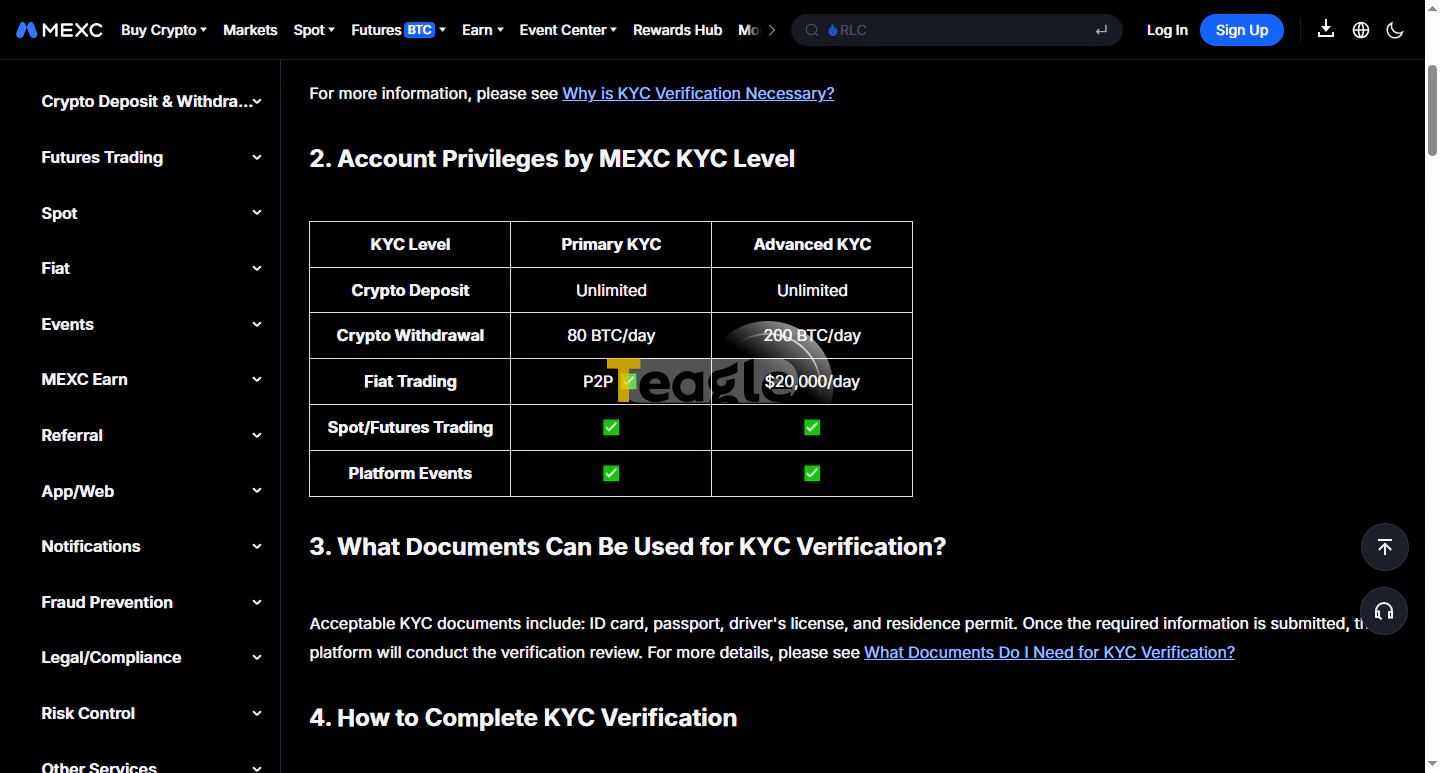
Moreover, the terms and conditions of MEXC require identity information and documents and state that failing to provide them can lead to restricted services, including withdrawals; in addition, Iran is on this exchange's list of prohibited regions. Under these conditions, MEXC cannot be presented as a reliable option for a user residing in Iran who wants to operate without KYC, even if some account features are available at first. Clauses 52 and 53 of this exchange's terms and conditions address providing identity documents:
52) You must provide MEXC with complete and accurate identity information and supporting documents, including, but not limited to, proof of identity, proof of address, contact details, etc.
53) MEXC will undertake due diligence to verify information provided by you, in circumstances where MEXC, in its absolute sole discretion, deems such information may be inaccurate or incomplete, MEXC shall be entitled to request further supporting documents from you in order to ensure the truthfulness and accuracy of User identity. You agree and understand that failure to provide these documents may result in full or partial restrictions on using MEXC Services, including but not limited to the prohibition of withdrawing, transferring out or otherwise removing any digital assets or funds from your Account.
XT exchange (XT.com)
Among these three options, XT has published a document about unverified accounts. Its official withdrawal guide, for the Unverified level, lists a daily limit of 200 thousand Tether and sets a higher limit for verified accounts. The same guide stresses that the usable limit should be checked in the account's identity verification section and that conditions may change with regulatory requirements. So the stated figure is not a withdrawal guarantee for every account and every situation.
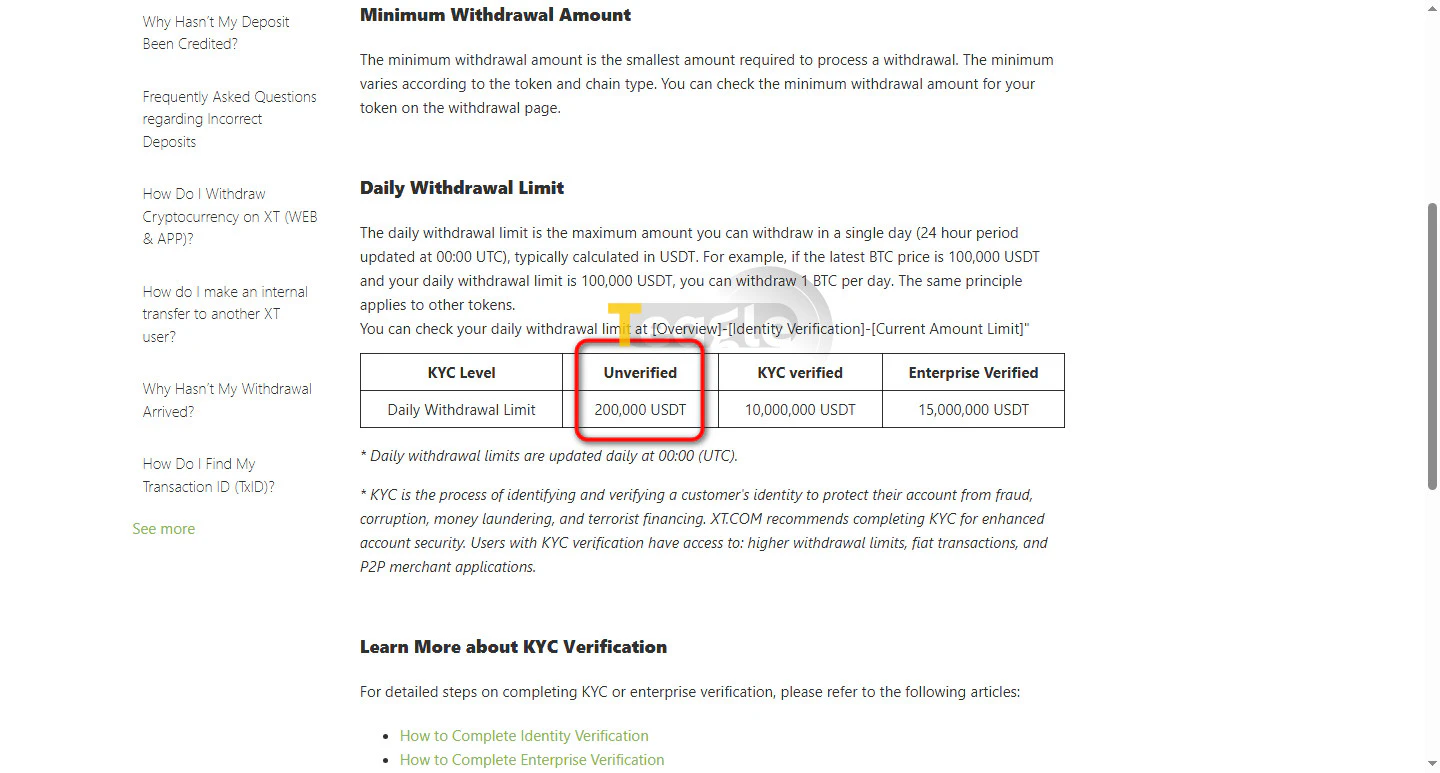
In the reviewed version of the XT user agreement, Iran does not appear in the explicit list in clause 3.3.4; however, the exchange itself describes this list as non-exhaustive and subject to change. The agreement also provides for requesting documents and warns against concealing or misrepresenting residence and nationality. For an Iranian user, the takeaway is that the availability of an account without KYC should be considered separately from official acceptance of their personal circumstances. The text of the mentioned clause follows:
3.3.4 Users located in [United States, Canada, Mainland China, Cuba, North Korea, Singapore, Sudan, Venezuela, Crimea] are prohibited from using the services provided by XT.COM. For the sake of clarification, the Prohibited Countries list is non-exclusive and is subject to change, at any time and from time to time, by XT.com in its absolute sole discretion may decide, taking into account legal and compliance considerations.
LBank exchange (Lbank)
Regarding LBank exchange, the platform's current user agreement says users must provide genuine information from their documents and complete identity verification before trading digital assets:
Following successful registration, the User must provide their true identity document information and complete real-name verification (KYC) prior to conducting any digital asset transactions.
The KYC FAQ page offers another explanation: for accounts or regions subject to mandatory identity verification, deposits, trading and withdrawals will not be available without completing it:
Applies only to regions/accounts required to complete KYC: Without verification, deposits, trading, and withdrawals will be unavailable.
The best decentralized exchanges (DEX) for fully anonymous trading
The phrase «fully anonymous trading» may be misleading. A point worth noting at the outset is that on decentralized exchanges, although identity verification is not needed, this should not be taken to mean that the flow of assets and addresses is also hidden. Below, we will look at 3 of the best decentralized exchanges.
Uniswap exchange
Uniswap decentralized exchange is used to swap tokens through smart contracts, since the exchange model is decentralized. The user connects their wallet and confirms the trade from that same wallet; in this model there is no need to first deposit assets into a centralized exchange's custodial account. However, a distinction should be made between swapping tokens and buying crypto with fiat currency. Purchases through third-party payment providers on Uniswap require identity verification:
Users who use a third-party to buy crypto on Uniswap are required to go through the KYC process.
The Uniswap interface also screens addresses and may restrict access for some wallets; so swaps being KYC-free does not mean there is no control over the interface. Uniswap's FAQ section includes the question «Why is my wallet blocked?», and the exchange answers that your activity may have been flagged as illegal:
Q: Why was my wallet blocked?
If your wallet has been blocked in the Uniswap interface, then it has been flagged with a strong likelihood of being linked to illegal activity.
PancakeSwap exchange
PancakeSwap also allows trading directly from a wallet and operates on several networks, including BNB Chain. For regular token swaps, there is no account opening or document submission process like on centralized exchanges; the user keeps the assets in their wallet and approves the interaction with the contract.
When choosing this platform, network fees and the liquidity of the desired pair matter. Low network fees do not necessarily make a trade cheap; if the liquidity pool is small, your order may move the price and the amount you receive may be lower than expected.
Also, features such as providing liquidity and earning yield should not be seen as a simple extension of buying and selling. Depositing assets into a pool or contract creates a different kind of risk, and the terms of that specific product should be read separately.
dYdX exchange
dYdX exchange is known mostly for perpetual contract trading, and for someone who simply wants to convert one token into another, it is not comparable to a simple swap. Getting started on dYdX Chain relies on connecting a wallet and funding a trading account; but besides fees, the trader also needs to understand how collateral, leverage, funding and liquidation work.
For Iranian users, access restrictions matter more: dYdX's official guide states that the interfaces it manages are not available to users located in Iran. The guide also explains that an account may be restricted to closing positions only and then blocked from the interface. So dYdX being decentralized does not make it an unrestricted option for users inside Iran:
As per the Terms of Use, the frontends operated by dYdX Operations Services Ltd. (DOS) are not available to users in certain restricted jurisdictions, including but not limited to:
• United States
• Canada
• United Kingdom
• Sanctioned countries (e.g., Iran, North Korea)
Risks and challenges of trading on no-KYC exchanges
The risk of exchanges without identity verification is not just price volatility. A trade may be profitable, but the withdrawal may get stuck in an account review; or a token may be bought, but there may not be enough liquidity to sell it. Evaluating an exchange should cover the full path of depositing, trading and withdrawing assets.
The possibility of sudden changes to exchange rules and mandatory identity verification
Not requiring identity verification is not a permanent feature of an exchange. Rules may change for all users, a specific region, or even just a few assets.
A clear example was CoinEx's announcement of 2 Bahman 1402, which made identity verification mandatory for deposits and withdrawals of a number of privacy coins. According to this announcement, deposits of these coins without identity verification would not be credited to the account, and crediting them depended on completing verification. This example concerns a specific group of assets and should not be generalized to mean identity verification became mandatory for all CoinEx services. It should be noted, however, that at the time of writing this article, CoinEx exchange has announced the end of its services:
CoinEx will cease operations starting Sep 15, 2026, and gradually discontinue related services.
Security risks and lack of legal protection
On a centralized exchange, the user faces the risk of account restrictions and loss of access to assets. If they are not eligible for services under the platform's rules, pursuing disputes also becomes more complicated. For example, LBank's user agreement both states its restrictions on Iranian users and warns that asset protection may be insufficient in some jurisdictions.
On a decentralized exchange, a significant part of the risk shifts to the user's wallet and signatures. A malicious approval can let an attacker move your tokens, even if your recovery phrase has never been exposed. Connecting to a site and approving its requests should be treated as two separate decisions.
That said, «lack of legal protection» should not be taken as absolute either. The ability to pursue a claim depends on where the company is registered, the type of dispute and the applicable rules. What cannot be assumed is a fast, guaranteed mechanism for compensation; online support also does not mean the assets are insured or that transactions can be reversed.
Comprehensive guide to risk management and safe asset transfer when using exchanges without identity verification
Before choosing a platform, figure out your withdrawal path. Then proceed in this order:
1. Check your own eligibility.
Read the restricted countries page, the user agreement and the KYC rules. If your residence or citizenship status is unclear, get a written answer from support before depositing. Weigh the support answer against the official agreement as well.
2. Check withdrawals without identity verification separately.
Being able to sign up or trade is not enough. Check the withdrawal limit, the services active on the account and the cases in which documents are requested. Fake documents or rented accounts make ownership and account recovery problems worse.
3. Only deposit the balance you need for trading.
For keeping assets off the exchange, a personal wallet is useful only if you can keep the recovery phrase secure. Store it offline and never share it with support, websites or other people.
4. Match the network and the wallet address.
Having the same coin name is not enough; both the source and destination must support the selected network. Also check the minimum deposit and whether that network is active at the destination.
5. For a new destination, make a test transfer first.
The test amount must exceed the destination's minimum deposit. Once the balance is actually credited at the destination, make the main transfer. This test reduces the chance of a transfer error, but it does not guarantee there will be no later account reviews.
6. Secure your account and email.
Unique passwords, two-factor authentication and a withdrawal address whitelist, if the platform supports them, reduce the chance of account abuse. Also keep recovery codes separate from your main device.
7. On a DEX, read the request before signing.
Check the domain name, the destination contract and the token spending allowance. Revoke unnecessary approvals; disconnecting your wallet from a site does not necessarily remove an approval you have already granted on the blockchain.
8. Factor in the cost of exiting as well.
Withdrawal fees, network fees, the bid-ask spread and your order's price impact all affect the outcome of a trade. For later transfers from your wallet, you will also need the network's native coin to pay fees.
9. Keep records and follow announcements.
Transaction IDs, transfer dates, amounts and support correspondence are useful for following up on problems. If a deadline is announced for submitting documents or withdrawing assets, do not leave the decision to the last day.
The best exchange without identity verification is not simply the one that doesn't ask for documents at sign-up. Its user eligibility terms, the ability to withdraw and how well its trading tools fit your needs matter more. If these three points are not clear, a quick start to trading is an advantage that may lose its value when it is time to withdraw your assets.
Contents of this article


Related articles


User reviews

Newest
 Upload image