
What Is a Merkle Tree in a Blockchain Network?

Author
Hossein Haghshenas
Published
 2026/08/29
Updated
2026/10/25
Reading time
5 دقیقه


A Merkle tree is a data structure in blockchain technology that plays a fundamental role in ensuring the security, integrity and efficiency of blockchain transactions. This tree structure of hashes makes it possible to verify data efficiently without having to process huge amounts of information, and it has become the backbone of blockchains such as Bitcoin and Ethereum. In this article, we take a comprehensive look at the Merkle tree in blockchain networks to gain a thorough understanding of its structure.
What Is a Merkle Tree?
Simply put, a Merkle tree is a way to quickly and reliably check that information is correct. In a Merkle tree, the information is split into smaller parts, a «digital fingerprint» or hash is created for each part, and these hashes are combined until a single final hash is obtained.
For example, suppose a block (a set of transactions) on the blockchain network contains 4 transactions. The system creates a hash, which we called a digital fingerprint, for each transaction and, by combining them, eventually arrives at a single final hash; if even one of the transactions changes, the final hash changes too.
In technical terms, a Merkle tree is a tree data structure, usually binary, made up of multiple hashes. In this structure, each leaf node contains the hash of a block of data, for example a transaction, and each parent node contains the hash obtained by concatenating and hashing the hashes of its child nodes. This design is used especially for efficiently verifying the contents of large data structures.
History and Inventor of the Hash Tree (Ralph Merkle)
The concept of the Merkle tree was introduced and patented by Ralph Merkle in 1979 as part of his research on public-key cryptography and digital signatures. This idea became the foundation for modern digital security systems and paved the way for large-scale data verification.
The Hierarchical, Binary Data Structure in Simple Terms
A Merkle tree is essentially made up of «hashes of hashes». Simply put, all data that has been turned into hashes is hashed again by the Merkle tree. In other words, the process starts by hashing each piece of data, then pairs of these hashes are combined and hashed again. This operation continues hierarchically, usually in a binary tree structure, until a single hash is finally obtained at the top level of the tree.
For example, say a block contains 4 transactions. First, a hash is created for each transaction. Then the hashes of the first and second transactions are combined and hashed again, and the same is done for the third and fourth transactions. In the next step, the two resulting hashes are combined again to finally produce a single final hash.
How a Merkle Tree Differs from Ordinary Data Structures (Lists, Arrays)
The hash tree, or Merkle tree, can be seen as a more advanced version of the «hash list» and the «hash chain». The main difference between a Merkle tree and an ordinary data structure is that with a Merkle tree, verifying a large amount of data does not require checking all of the information. Using intermediate hashes, this structure can determine whether a specific piece of data has changed by checking only a few parts of the information.
For example, suppose a block contains thousands of transactions. With simpler methods, checking one transaction might require examining a large portion of the data; a Merkle tree, however, can verify that same transaction using a few related hashes. That is why this structure is widely used in systems such as blockchain: it makes checking large volumes of data faster and cheaper.
How Does a Merkle Tree Work? (Step by Step)
A Merkle tree is a way to quickly confirm that a large volume of data is correct and has not been tampered with, without having to check each item individually. In practice, a Merkle tree works as follows:
1. For each unit of data, a short, unique code called a «hash» is generated.
2. These codes are combined in pairs and hashed again to produce new codes.
3. This process is repeated layer by layer until only one code remains, which is called the «Merkle root».
4. This root is a compact summary of all the data; the slightest change in any piece of data makes the final root completely different.
5. To prove that a specific piece of data exists in the set, there is no need to present all the data; just a few related codes along the path to the root are enough.
6. By combining these few codes, you can check whether the result matches the known root.
7. If it matches, the data is verified as correct; otherwise, tampering or an error in the data is revealed.
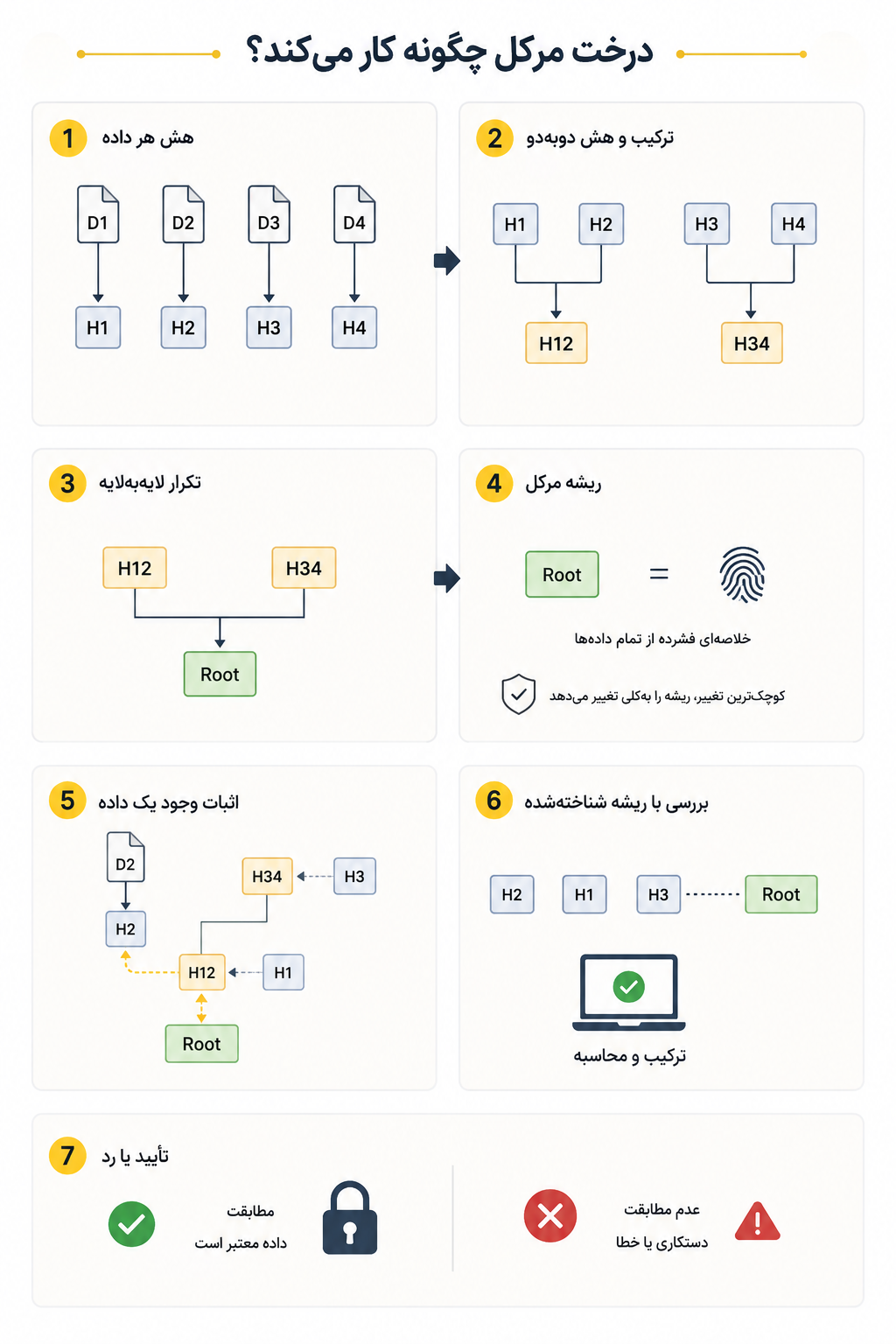
How Leaf Nodes Are Calculated from Transactions
Simply put, the leaf nodes of a Merkle tree are the hashes of the transactions. In Bitcoin, each transaction is turned into a hash code using a cryptographic method called Double-SHA-256, and this code is placed as a leaf node of the tree. These hashes are then placed side by side and combined and hashed again to build the higher parts of the tree.
The Mathematical Formula and Hash Functions (SHA-256)
Simply put, a hash function is like a machine that takes data and turns it into a relatively short, unique code. In Bitcoin, this is usually done with Double-SHA-256, meaning the data is first hashed once with SHA-256 and then the result is hashed again. This process continues on the transaction hashes until the Merkle root is finally obtained. Ethereum uses Keccak-256, which works similarly in producing hashes but is a different algorithm. As a result, the choice of hash function depends on the type of network and its structure, and not all blockchains are meant to use a single method.
Practical Example: Building a Simple Merkle Tree with 4 Transactions
To build a Merkle tree with four transactions (T1, T2, T3, T4), each transaction is first hashed separately (H(T1), H(T2), H(T3), H(T4)). Then the hashes of the first pair (H(T1) and H(T2)) are concatenated and hashed to obtain H_AB. Likewise, H(T3) and H(T4) become H_CD. Finally, H_AB and H_CD are combined and hashed to reach the final Merkle root (ROOT).
What Is the Merkle Root?
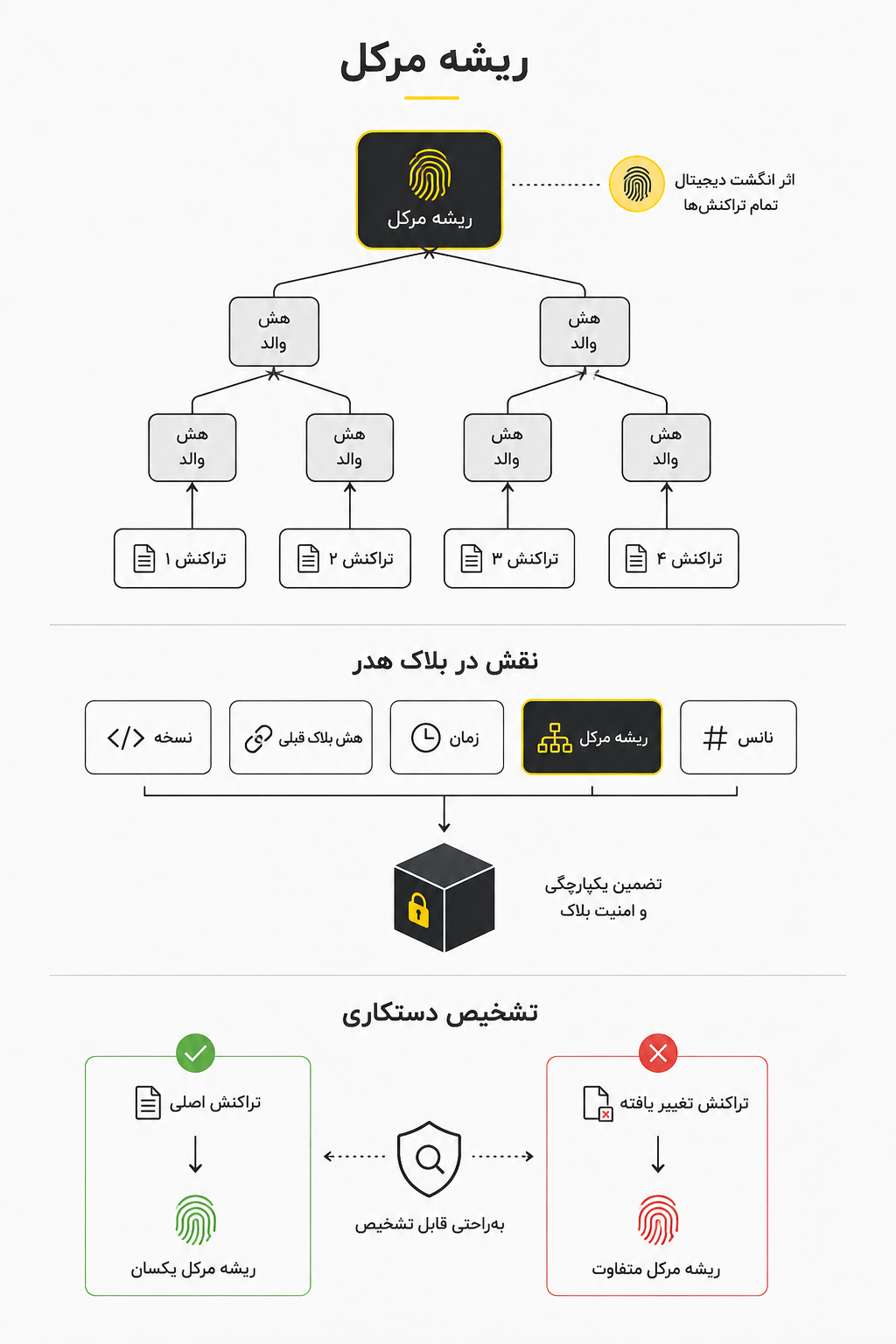
The Merkle root is the single final hash at the top of the Merkle tree. This unique hash acts as a «digital fingerprint» for all the data in the leaf nodes. The Merkle root is stored directly in the block header and serves as a trust anchor for light clients.
The Role of the Merkle Root in the Block Header
In blockchain, the Merkle root plays a vital role and is one of the main components of the "block header". The block header contains important information such as the block version, the previous block's hash, the block creation time, the nonce and the Merkle root. By placing the Merkle root in the block header, all the transactions in that block are indirectly linked to the block header.
This link means that any change to any of the transactions in the block will change the Merkle root and, as a result, the block header's hash. Since the block header's hash is used in the next block as the "Previous Block Hash", any tampering with a block is quickly detected across the entire blockchain, ensuring the security and integrity of the whole system. This mechanism forms the backbone of blockchain security and enables fast, efficient verification of blocks.
The Digital Fingerprint of Data and Tamper Detection
The Merkle root acts as a digital fingerprint for all the data in a block. This means that if even a single bit of the original data (for example, one transaction) in the block changes, the hash of that transaction, then the hashes of its parent nodes, and finally the Merkle root will also change. This change in the Merkle root is easy to detect.
This feature provides a powerful tool for tamper detection. If someone tries to change a transaction in a block, a new Merkle root is produced that does not match the original Merkle root stored in the block header. This mismatch quickly shows that the block has been tampered with. This tamper-detection capability is one of the main reasons for trust in blockchain and its high security, and it ensures that data remains immutable once recorded.
What Is a Merkle Proof and Why Does It Matter?
A Merkle Proof is an efficient way to verify the existence and integrity of a specific piece of data (for example, a transaction) within a larger dataset (for example, a block), without having to process or download the entire dataset. The proof consists of the hash of the leaf node for the data in question and a set of sibling hashes along the path from that leaf node to the Merkle root.
The importance of the Merkle proof lies in its ability to verify quickly and with few resources. Instead of a user or node having to download and process all the data in a block to verify a single transaction, it only needs the transaction in question, the block's Merkle root and a few intermediate hashes. This is especially critical for Light Nodes, which have limited computing and storage resources.
How to Verify a Transaction Without the Whole Block
To verify a transaction using a Merkle proof, the following steps are taken:
1. First, the hash of the transaction in question (the leaf node) is computed.
2. Next, the node or user receives the Merkle proof, which contains the sibling hashes along the path from the leaf node to the Merkle root.
3. Using the transaction hash and the sibling hashes, the node repeatedly rebuilds the hashes from the bottom up (from leaf to root).
4. Finally, the computed hash is compared with the block's original Merkle root (stored in the block header). If the two hashes match, it means the transaction exists in the block and has not been tampered with.
This process lets light nodes verify the validity of transactions without downloading the entire blockchain. This capability greatly increases the scalability and accessibility of blockchain networks.
The Proof Path and O(log n) Logarithmic Complexity
The Proof Path in a Merkle tree refers to the set of sibling hashes needed to rebuild the Merkle root from a specific leaf node. The length of this proof path depends on the height of the Merkle tree. Since the Merkle tree is a binary structure, its height grows logarithmically with the number of leaf nodes (transactions).
Logarithmic Complexity is denoted as `O(log n)`, where `n` is the number of transactions. This means that as the number of transactions grows, the number of hashes required for a Merkle proof increases very slowly. For example, to verify one transaction in a block of 1024 transactions, only `log2(1024) = 10` hashes are needed. This high verification efficiency has made the Merkle proof an essential tool in blockchains, as it enables fast, low-cost transaction verification even on high-volume blockchains.
What Role Does the Merkle Tree Play in Blockchain?
The Merkle tree plays a central role in ensuring the security, integrity and efficiency of a blockchain network. This data structure provides the backbone that enables fast and reliable verification of transactions in a decentralized environment.
Transaction Security and Integrity
The Merkle tree ensures that the data in a block has not been tampered with and can also show whether any data has been lost. Given the chained nature of blockchain data, any change to a transaction changes that transaction's hash, which in turn changes the hashes of the parent nodes and ultimately the Merkle root. Since the Merkle root is stored in the block header and the block header's hash is linked to the next block, any tampering with the data is quickly detected across the entire chain.
This mechanism guarantees data Integrity over time and prevents unauthorized changes. In this way, the Merkle tree adds a powerful layer of security to the blockchain that increases users' trust in the system. The method is fully reliable and secure, a result of the cryptographic hash functions used in this data structure.
Light Nodes (SPV) and No Need to Download the Whole Blockchain
One of the most important uses of the Merkle tree in blockchain is enabling support for "Light Nodes" or "Simplified Payment Verification" (SPV) nodes. Full Nodes download and store the entire blockchain, but light nodes download only the block headers. These block headers contain the Merkle root.
Using a Merkle proof, a light node can verify the validity of a specific transaction without downloading the entire blockchain. This is done by receiving the transaction in question, the Merkle root of the relevant block and the Merkle proof path. The light node can then rebuild the hashes and verify the transaction against the Merkle root. This capability allows users to participate in the network and verify their own transactions with fewer computing and storage resources, which contributes significantly to the network's scalability and accessibility.
Key Benefits and Uses of the Merkle Tree in Cryptocurrencies
Thanks to its unique features, the Merkle tree has brought significant benefits to cryptocurrencies and blockchain technology. These benefits not only support security and integrity but also improve the efficiency and scalability of systems.
Greater Speed and Scalability in Bitcoin and Ethereum
By reducing the amount of data needed to verify transactions, the Merkle tree significantly increases the speed and Scalability of blockchain networks such as Bitcoin and Ethereum. Instead of each node having to process every transaction in a block to verify a specific one, it only needs the Merkle root and a small Merkle proof. This cuts the time needed to verify blocks and lets the network process more transactions per unit of time.
This efficiency is especially critical on high-volume blockchains that process millions of transactions every day. Without the Merkle tree, verifying transactions would be much slower and more costly, and the scalability of these networks would be severely limited. This data structure is a way to accurately check data in a decentralized environment.
Lower Computational Load and Data Storage on the Network
Another key benefit of the Merkle tree is a dramatic reduction in Computational Load and Data Storage requirements on the network. Light Nodes can participate in the network without downloading and storing the entire blockchain history. They download only the block headers, which contain the Merkle root.
This reduced need for resources allows broader participation by users with ordinary hardware and strengthens the network's decentralization. For example, a mobile wallet can act as a light node and verify transactions using Merkle proofs, without needing to download tens or hundreds of gigabytes of blockchain data. This optimization improves the network's overall efficiency and makes it more practical for everyday use.
Use in Non-Blockchain Systems (Git, Distributed Systems, IPFS)
The use of the Merkle tree is not limited to blockchain; it is also widely used in many non-blockchain systems. One of the best-known of these is the Git version control system. Git uses Merkle trees to track changes to files and directories, thereby ensuring the integrity of the project history and enabling changes to be merged (Merge) and reverted (Revert) efficiently.
Besides Git, Merkle trees are used in Distributed Systems to synchronize data and verify its integrity across different nodes. In addition, in IPFS (InterPlanetary File System), a distributed protocol for storing and accessing files, the Merkle tree plays a key role in Content Addressing and verifying data integrity. These uses show the versatility and power of the Merkle tree as a fundamental data structure in computer science.
What Is the Difference Between a Merkle Tree and a Verkle Tree?
Verkle Trees are a newer data structure proposed as an alternative to Merkle trees in some applications, particularly in Ethereum. They are designed to improve efficiency and reduce Proof Size.
Merkle tree problems that Verkle solves
Despite their many advantages, Merkle trees also have limitations. One of them is proof size. To verify that an element belongs to a Merkle tree, the proof size is `33 × ceil(log₂(N))` bytes, where `N` is the number of elements. This proof size can still be significant on blockchains with very high transaction counts. In addition, a Merkle tree cannot be changed (it is not Mutable) once built, and it can only prove that an element is a member, not that it is not.
Verkle trees solve these problems by using "Vector Commitments" instead of simple hashes. This approach lets Verkle trees produce much smaller proofs. This reduction in proof size is especially useful for light nodes and Stateless Clients that aim to minimize the data they store.
The role of Verkle in Ethereum's future (Ethereum Roadmap)
Verkle trees are considered a useful upgrade for Ethereum and play an important role in the blockchain's future Roadmap, especially in "The Verge" phase. The main goal of "The Verge" is to make running an Ethereum node accessible on ordinary hardware, so that nodes can avoid storing large amounts of State Data without losing the ability to validate blocks.
The transition to Verkle trees on Ethereum is underway as of mid-2026, and it reduces the storage requirements for running a full node from hundreds of gigabytes to an amount manageable on a consumer laptop. This change lets Ethereum nodes have smaller Witnesses, meaning less data is needed to verify blocks. As of February 2026, Ethereum testnets have run Verkle-enabled forks on short-lived devnets, and the main client teams (such as Geth, Nethermind, Besu, Erigon) all have active Verkle branches. The EIP formalizing the Verkle transition (EIP-6800 and its successors) is in the final specification stage, although a mainnet activation date has not yet been announced.
Frequently asked questions about the Merkle tree
Can a Merkle tree be hacked?
A Merkle tree by itself cannot be hacked in the traditional sense. Its security rests on the security of Cryptographic Hash Functions. If the hash function used (such as SHA-256) is secure and has Collision Resistance, any change to the underlying data quickly leads to a change in the Merkle root, and tampering becomes detectable. However, if an attacker could create a Hash Collision (that is, two different inputs with the same hash output), they could tamper with the data without changing the Merkle root. But finding such collisions in modern, strong hash functions like SHA-256 is computationally infeasible.
How does the Merkle tree in Bitcoin differ from Ethereum?
The concept and basic structure of the Merkle tree are the same in Bitcoin and Ethereum: both use it to summarize and verify the integrity of transactions in blocks. The main difference lies in the type of data stored in the leaf nodes and how it is used within the overall blockchain structure. In Bitcoin, the Merkle tree is mainly used for transactions. In Ethereum, in addition to transactions, similar tree structures (such as the Patricia Merkle Tree) are also used to manage the network's State and Receipts. Ethereum is also moving toward Verkle Trees, which offer optimizations in proof size and efficiency.
Is the Merkle tree useful for Privacy?
The Merkle tree is not designed directly for privacy. Its main purpose is to verify the integrity and existence of data, not to hide it. In fact, transaction hashes and the Merkle root are public. However, it can indirectly help privacy, because light nodes don't need to download all transaction details and can verify their own transactions using only a Merkle proof. This means they don't have to view or store all the public information on the blockchain, but the transactions themselves remain visible.
What are the main limitations of the Merkle tree?
The main limitations of the Merkle tree include the following:
1. Immutability: A Merkle tree cannot be changed once built. If any data needs to change, a new Merkle tree must be built.
2. Proves membership only (Membership Only): A Merkle tree can prove that an element exists in a data set, but it cannot efficiently prove that an element does not exist in the data set (non-membership).
3. Proof size: Although the proof size is logarithmic, on very large blockchains it can still be significant for some uses (such as stateless clients), a problem that Verkle trees partly solve.
How does the Merkle tree help Decentralization?
The Merkle tree helps decentralization by reducing the computing and storage resources needed to verify transactions. It allows Light Nodes to take part in the network without downloading the entire blockchain. This means more people can run a node and verify transactions, which prevents reliance on a small number of full nodes and makes the network more resistant to centralized attacks.
Contents of this article


Related articles



User reviews

Newest
 Upload image