
An Introduction to Blockchain Networks and Their Types

Author
Admin
Published
 2026/06/06
Updated
2026/10/25
Reading time
8 دقیقه


With new technologies entering the financial markets, concepts have emerged that go beyond simple tools and redefine how we exchange data and assets. Blockchain is one of these concepts. Although many of us associate blockchain technology only with Bitcoin and the cryptocurrency market, this technology actually has much broader reach. A blockchain network provides a distributed, decentralized, highly secure and tamper-resistant platform that, to a very large extent, lets us transfer our information and assets with a very high level of trust, without the need for any intermediary, bank or centralized institution. In this article, we aim to explain blockchain in simple terms and get familiar with its technical structure, how it works, the types of blockchain networks and its applications.
What Is a Blockchain Network? (Simple Definition)
Put simply, a blockchain network is a digital, decentralized and shared ledger that records and stores transactions and various kinds of information in a completely immutable and highly secure way. If we want to explain blockchain simply with an example, we can compare it to a digital notebook whose exact identical copies are stored on different computers around the world; as if there were several different witnesses to a single event.
When a new transaction or piece of data is recorded in the digital ledger, the computers connected to the network, known as nodes, check and verify its validity. After collective approval by the nodes, this transaction is recognized as a new page in the digital notebook and added to it. As a result, changing previous data becomes very difficult and detectable.
The conceptual link between blockchain and cryptocurrencies stems from the fact that this technology was first introduced as the core platform and technical infrastructure of the Bitcoin blockchain network, to solve the problem of trust without the need for centralized intermediaries such as banks or regulatory bodies. However, blockchain technology is recognized beyond the financial markets as a structural revolution in data management, with applications across various industries.
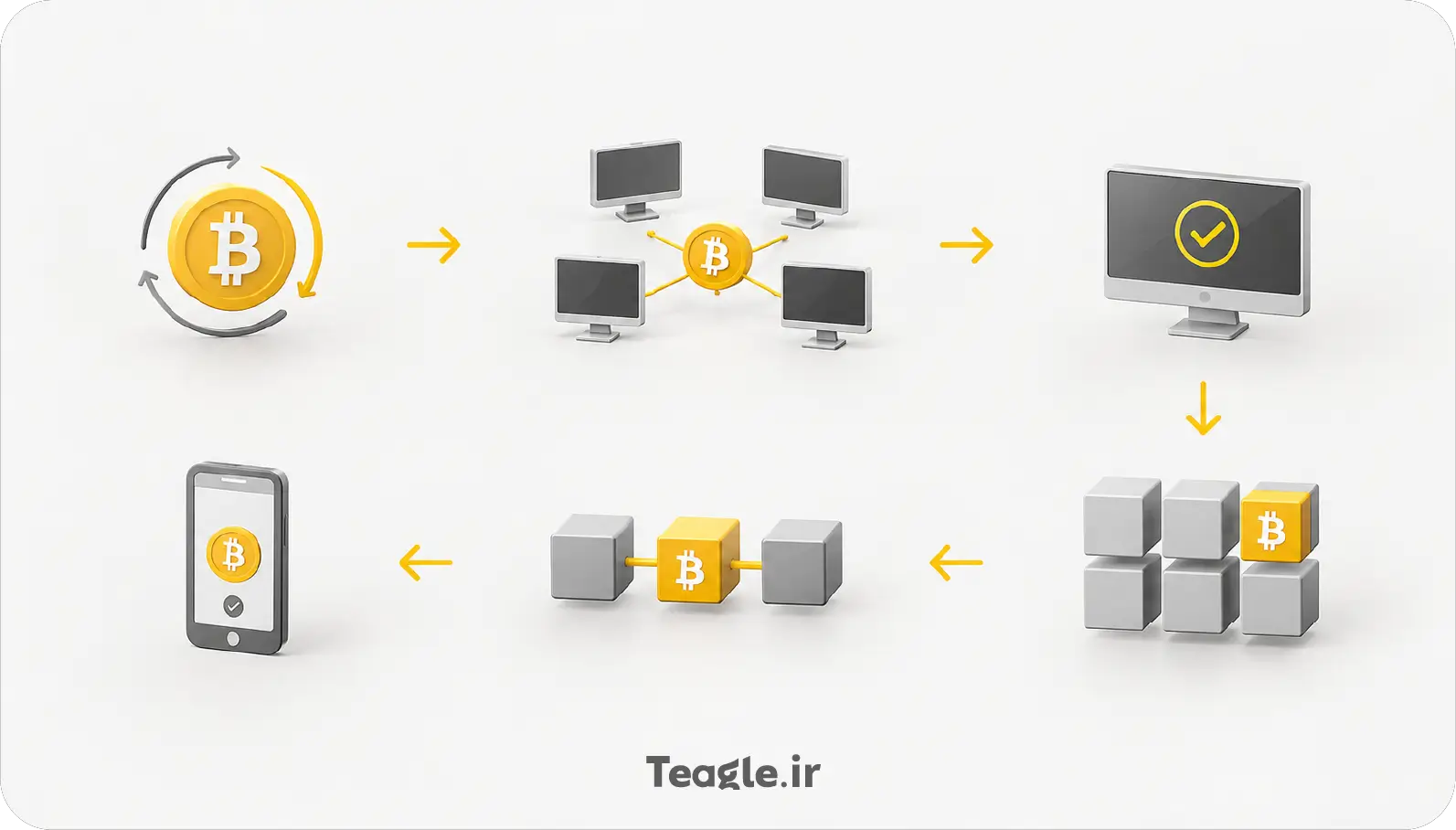
How does blockchain work?
The process in blockchain networks goes through the following steps:
1. It begins with a user sending a transaction request.
2. This request is first authorized with the user's private key and then sent to the network of nodes.
3. Active nodes on the network check and verify the signature, the sender's balance and other details.
4. After initial verification, several transactions are combined and placed into a block.
5. This new block is placed alongside the other blocks and linked to the chain of previous blocks, and the transactions in it become immutable.
6. Finally, the user's transaction is completed.
But what is the difference between blockchain and traditional databases? In a traditional database, the client-server model prevails. In this model, there is a central administrator or organization that oversees all access and has the authority to create, review, edit or delete data. Although this structure is very efficient and practical, concentrating information in one place carries a major risk: if a hacker gains access to the server, or the system's administrators make a mistake or even act in bad faith, the entire data history could easily be manipulated or destroyed. In contrast, a blockchain network is based on DLT, or distributed ledger technology. In this system, there is no central controller or database administrator; instead, an identical copy of the entire database is held by each and every active node.
Another difference is that traditional databases focus on mutability and easy error correction, whereas changing a blockchain is very difficult and costly for individuals. In other words, once data enters the chain, it is mathematically and cryptographically linked to all previous blocks, and any change to one block requires changing all the blocks after it as well as obtaining the agreement of the majority of the blockchain network's nodes at the same time; something that is computationally very difficult and extremely expensive.
Technical Structure of a Blockchain Network
A blockchain network is not just a platform for recording transactions; it has a multi-layered technical structure that makes its security, transparency and decentralization possible. From how data is stored to the role of nodes, consensus and cryptography, each part has a specific function. Below, we look at the different parts of this structure.
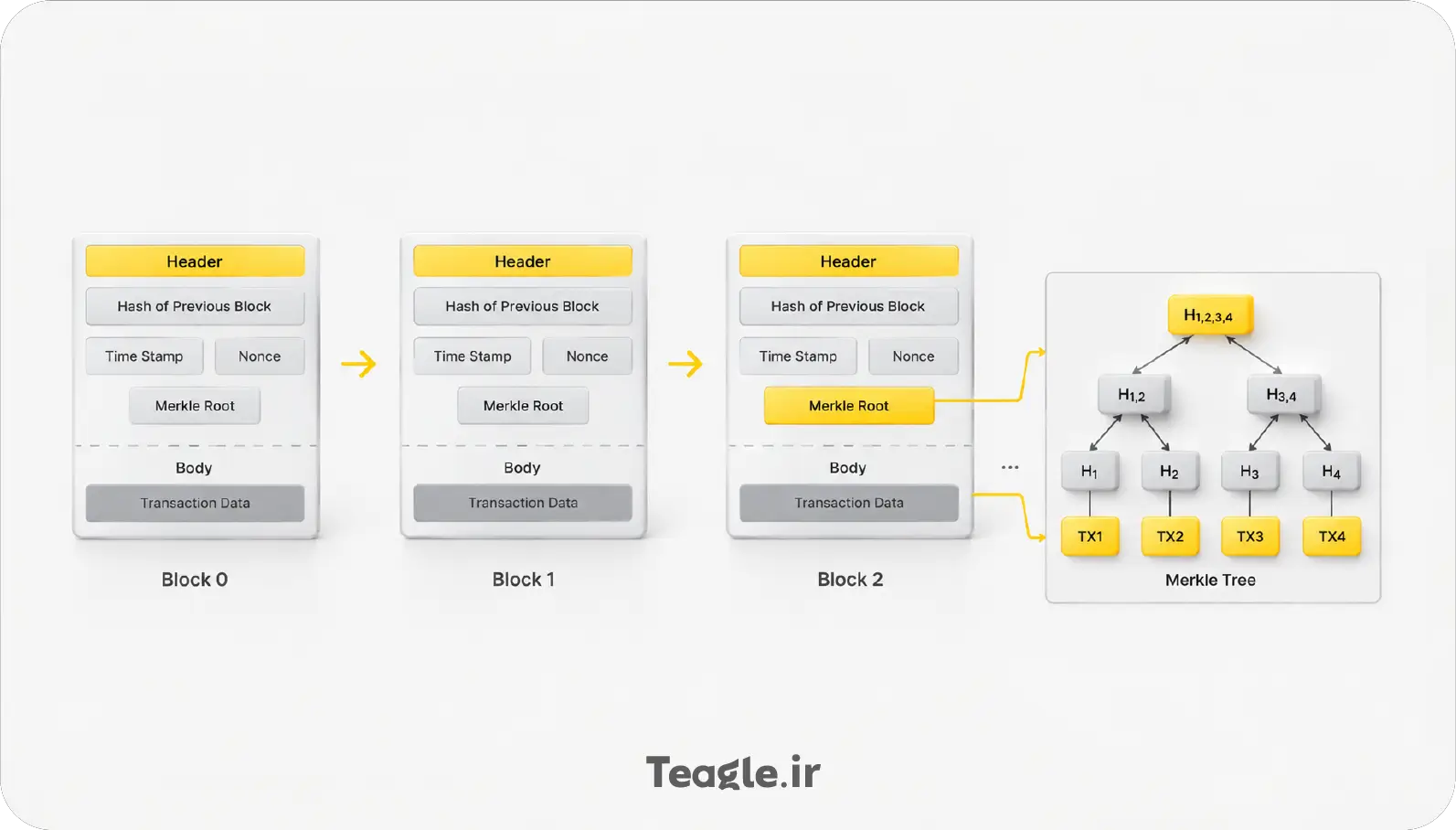
What is a block and what are its components?
In the technical structure of blockchain, each block acts like a digital page of the ledger that holds data. Each block consists of two main, distinct parts: The Block Header and the Block Body:
- Block Header: Contains the block's metadata and security identity. This part includes the protocol version, the previous block hash (which is the link to the past and guarantees the chain's security), the timestamp for precisely recording when the block was created, the nonce (a guessed numeric value that miners use to solve the network's mathematical puzzle), and the Merkle Root (Merkle Root) (a single hash that acts as a fingerprint and summary of all the transactions in the body).
- Block Body: Contains the complete list and data of the confirmed transactions, including information on the sender, recipient, digital signature and amount of the asset transferred.
What Is a Hash and What Role Does It Play in Blockchain?
The hash is the key to survival and the guarantor of blockchain technology's secure operation. A hash acts like a gateway that receives any type of data as input and produces an output combining code, numbers and characters, with a fixed and specific length; something like the following:
e3b0c44298fc1c149afbf4c8996fb92427ae41e4649b934ca495991b7852b855
In a blockchain network, any tiny change in the input will fundamentally change the final hash. The continuity of the chain is ensured by placing each block's hash in the header of the next block; so if someone wants to change the data of a block recorded in the past, that block's hash changes and all subsequent blocks in the chain become invalid.
In the context of mining and Proof of Work (PoW) networks, the concept of hash rate becomes particularly important. As for what hash rate means in a blockchain network, it represents the total computing power and speed that the mining devices connected to the network spend each second solving cryptographic equations. The higher this processing power, the more the security of the blockchain network increases exponentially; because the cost of carrying out a 51% attack to seize the majority of the network's power becomes prohibitively high and practically impossible for attackers.
Nodes and Their Role in the Network
Any person or computer that participates in the blockchain network and is connected to other peer nodes is known as a node in the blockchain network. Nodes are the backbone of the blockchain network and the pillar that allows the network to have no centralized oversight while remaining secure. Depending on their type and the level at which they operate in the network (such as full nodes or light nodes), these computers carry out multiple tasks, including broadcasting new transactions across the network, storing a complete copy of the entire transaction history, and verifying that new blocks comply with the consensus rules.
What Is a Consensus Mechanism? (PoW and PoS)
To ensure the accuracy of the information recorded in the chain of blocks, a blockchain network relies on a protocol called a consensus mechanism. This protocol ensures that all copies of the digital ledger among nodes around the world are exactly identical. The 2 most common and well-known methods in this area are:
- Proof of Work: This method, first used in the Bitcoin blockchain network, essentially requires miners to compete by solving complex mathematical problems using electrical energy and high hardware power. In the PoW model, whichever miner acts faster and reaches the answer can record the new block and claim the block reward along with the network fees. The main drawback of this method is its heavy energy consumption and relatively slow transaction confirmation.
- Proof of Stake: In this more modern algorithm, used in the Ethereum blockchain network, there is no longer any need to buy expensive mining equipment or consume ever-increasing energy. In PoS, users who stake or lock their assets in the cryptocurrency network become validators, and the network, based on certain criteria, selects one of the validators each time to create a block. In other words, in this model there is no race or competition; instead, network security is ensured through depositing assets in the network.
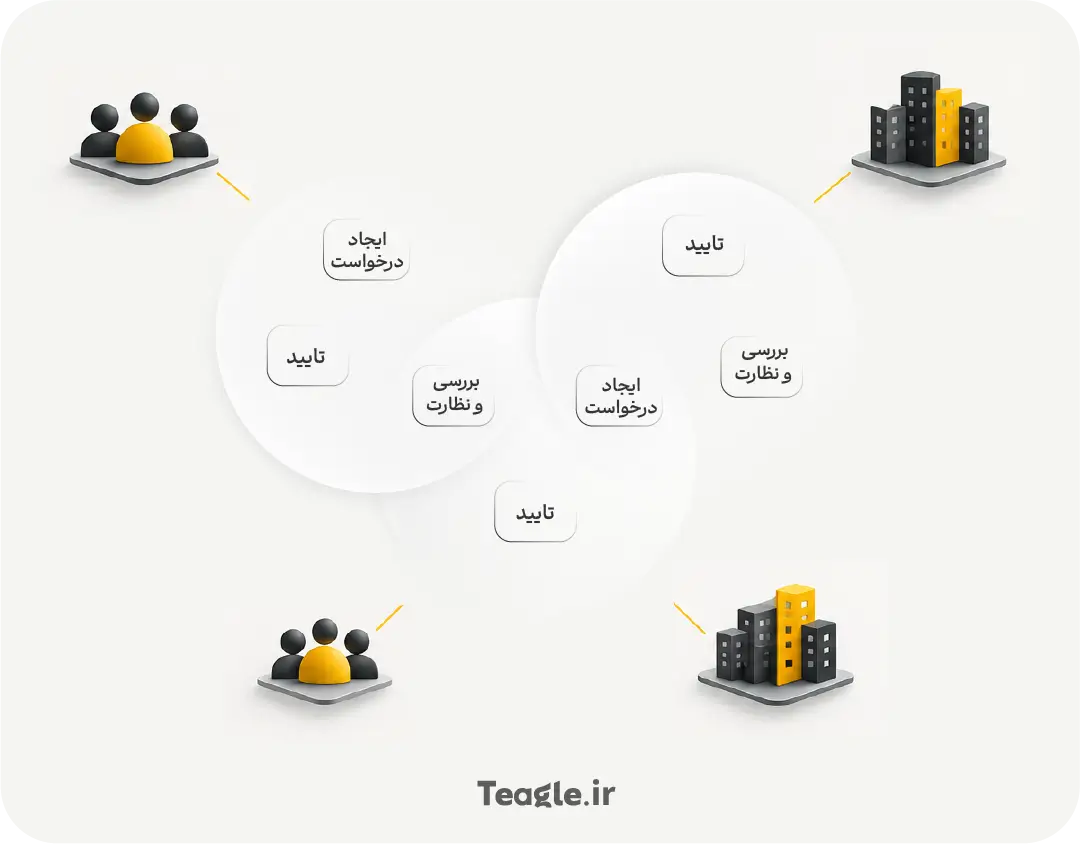
Types of Blockchain Networks
Given this variety and scale of blockchain networks, how many blockchain networks actually exist, or what types of them can be designed? We should know that blockchain networks are basically divided into different categories according to how open access to data and governance is.
Public Blockchain
A public blockchain network is a network in which users transact without needing permission (Permissionless) and no access restrictions are imposed on users. Anyone anywhere in the world can download the relevant software to view transactions, record new data, or take part in securing the network as a node or validator. Bitcoin and Ethereum are the most prominent examples of this category. A public blockchain offers the highest degree of decentralization and exceptional resistance to sanctions and censorship, but it is slower at processing simultaneous transactions.
Private Blockchain
Unlike the public model, a private blockchain is a permission-based (Permissioned) network whose ownership and management are held exclusively by a specific organization or company. Only users who have been identity-verified and approved in advance by the company providing the network are allowed to join, read data, or participate in the network. These networks are mostly used for in-house applications or internal support systems of companies that do not want to make their confidential business information public. IBM's Hyperledger Fabric private blockchain is one of the well-known networks in this field.
Consortium Blockchain
A consortium or federated blockchain is semi-centralized and combines public and private blockchains. In this model, network governance is distributed among several trusted partner organizations rather than a single organization. For example, if several large international banks want to build an integrated system for currency exchange, a consortium blockchain is the best option. Decisions and block approvals are made based on agreement among the selected nodes of these organizations. While maintaining relative data confidentiality, this platform reduces the pure centralization of the private model and makes multilateral economic cooperation smoother.
Comparing Blockchain Types and the Use of Each
For projects that require public trust, blockchain network types that are public are the only practical path. On the other hand, large organizations whose main priority is protecting trade secrets and complying with regulatory rules choose private blockchain networks. For cross-border synergy in industries such as insurance, healthcare and goods transit, consortium platforms deliver the highest efficiency.
|
Criterion |
Public blockchain |
Private blockchain |
Consortium blockchain |
|
Participant identity |
Anonymous |
Known and verified |
Known and verified |
|
Consensus mechanism |
PoW / PoS (heavy and public) |
Voting or direct approval by the organization (Raft / PBFT) |
Collective approval by several organizations |
|
Transaction speed |
Relatively low |
Very high |
High and optimized |
|
Ideal use |
Crypto trading, DeFi platforms |
Corporate data management |
Interbank cooperation, supply chain |
The Most Famous Blockchain Networks
The blockchain space includes a huge variety of networks with different targets. To transfer assets, buy tokens or interact with smart contracts, users are always looking for the best blockchain network or the fastest blockchain network. Below, some of the most famous blockchain networks in the world are reviewed in a structured way in the following table:
|
Blockchain network name |
Token |
Block time |
Average transaction fee |
Main advantage and feature |
|
Bitcoin blockchain |
BTC (Bitcoin) |
About 10 minutes |
Variable; depending on network congestion, usually a few dollars |
Unmatched security, the most decentralized network |
|
Ethereum blockchain |
ETH (Ethereum) |
About 12 |
Sometimes very high (due to network congestion and DeFi activity) eFi) |
Pioneer in smart contracts and DApp development |
|
Tron blockchain |
TRX (Tron) |
About 3 seconds |
Low (free with staking) |
Popular platform for fast and cheap Tether (USDT) transfers |
|
Binance Smart Chain (BSC) |
BNB (Binance Coin) |
About 3 seconds |
Low (a few cents under normal conditions) |
Full compatibility with the Ethereum Virtual Machine (EVM) |
|
Solana blockchain |
SOL (Solana) |
About 400 milliseconds |
Very negligible (a few cents or under one cent under normal conditions) |
The fastest blockchain network with exceptional bandwidth |
Transaction Fees on Blockchain Networks
Every process carried out in the blockchain world, from a simple asset transfer to executing smart contracts, requires paying an execution cost known as the blockchain network fee. Understanding how these fees are calculated and how they fluctuate helps investors manage their financial transactions better. The main difference between the network fee and the exchange fee is that the exchange fee is a charge for the platform's brokerage services, whereas the network transaction fee is paid directly to confirm processing on the blockchain's distributed ledger.
What Is the Purpose of Fees on a Blockchain Network?
You may ask what the main purpose of transaction fees on a blockchain network is, or why users need to be charged these costs at all. The fee plays a role beyond a simple cost in the technical structure of a blockchain. The core purposes of fees can be explained in a few broad dimensions:
- Security and a defense barrier against cyberattacks: The first and most vital reason is to prevent the network from being bombarded with fake and spam transactions. If executing transactions (for example, moving Tether on the Tron network or any other blockchain) were free, hackers could paralyze the processing power and memory of nodes by sending billions of fake, back-to-back transactions. Setting a fee, however small, creates a very effective economic barrier against this type of attack.
- Compensating and rewarding participants: Fees go directly to those who secure the network and record its data. In proof-of-work models, these rewards go to miners who work with expensive equipment. In proof-of-stake models, the fee paid goes to validators who have staked the network's native cryptocurrency to maintain the blockchain's integrity. This financial incentive keeps nodes eager to continue verifying valid transactions.
- A fair prioritization mechanism: Since the capacity of each block is limited, paying a fee acts as a criterion for queuing transactions. Users who want their transactions confirmed and processed more urgently set a higher fee, and validators naturally give these transactions top priority to earn more. Most modern blockchain wallet tools let users manually adjust the fee level to match the speed they need.
The importance of security in the blockchain network
Blockchain network security is the core of users' trust in this ecosystem. Unlike traditional databases, whose security depends on firewalls and the protection policies of centralized organizations, security in the blockchain world comes from a combination of mathematical cryptography, a chained data structure and the decentralized nature of the network. Every transaction is confirmed with an encrypted digital signature to ensure that it was created by the actual sender.
The immutability feature (Immutability) of the chained structure prevents data from being tampered with after final confirmation. Since each block has a direct link to the previous block through a hash function, the slightest change to a block's data immediately invalidates all subsequent blocks in the chain and is rejected by the majority of the network. This cryptographic dynamic minimizes the chances of fraud or hackers breaking in to alter financial history. The high security of blockchain has created a strong incentive for developing decentralized applications, exchanges and reliable financial structures.
Blockchain applications beyond cryptocurrency
Although this technology was initially tied to cryptocurrencies, today the uses and applications of blockchain go far beyond financial systems. Transparency, no need for intermediaries and data immutability have opened up new capabilities in other fields:
- Supply chain tracking: Blockchain is vital in transportation, healthcare and food, and in tracking goods. Using blockchain, factories, suppliers and end customers can monitor every single stage of the production, transportation and warehousing of goods in real time and without any possibility of forgery. This transparency prevents smuggling, the distribution of counterfeit drugs and large-scale logistics fraud.
- Identity management and official document registration: Traditional methods of registering property, academic records or official documents have always carried a high risk of forgery and heavy administrative bureaucracy. With blockchain platforms, identity and ownership documents are recorded in encrypted, tamper-proof form, and their authenticity can be verified in a fraction of a second from anywhere in the world.
- Making industries smarter with smart contracts: These contracts are pieces of code that, once deployed on the Ethereum blockchain or similar networks, automatically finalize a trade or payment as soon as the conditions agreed between the parties are met, without needing approval from any intermediary. This feature sharply reduces legal and administrative costs.
Related articles
Contents of this article


Related articles



User reviews

Newest
 Upload image