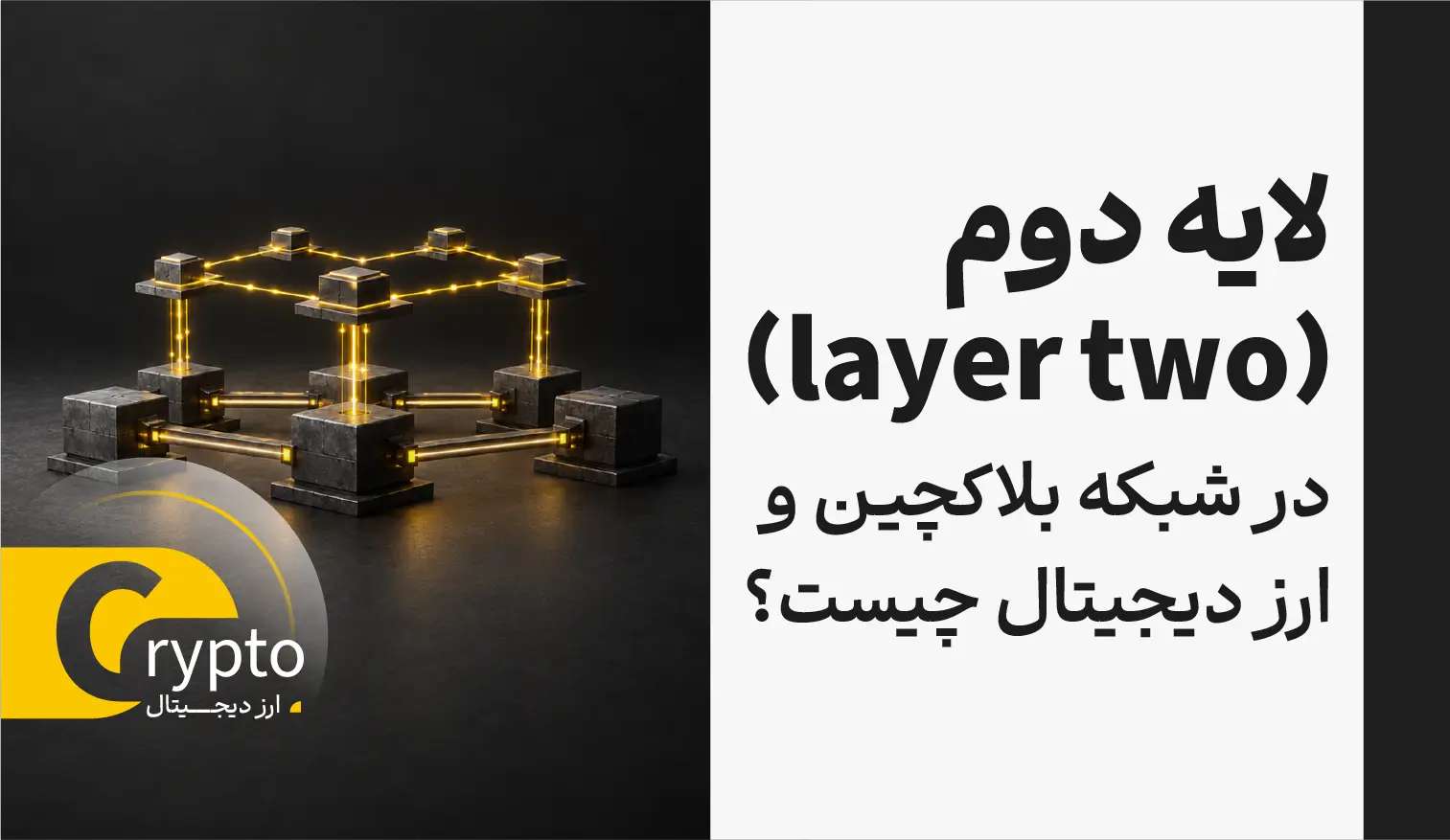
What Is Layer Two in Blockchain and Cryptocurrency?

Author
Arezoo Ghoochani

Expert review
Mohammadreza Minaei
Published
 2026/09/25
Updated
2026/10/25
Reading time
5 دقیقه


Layer 2 (L2) refers to protocols and networks built on top of a base blockchain , or Layer 1, to increase the network's processing capacity and reduce transaction costs, while relying on the main layer for security and data availability. In the Ethereum ecosystem, optimistic rollups and zero-knowledge (ZK) rollups are the most important Layer 2 architectures.
What Is Layer 2 (L2) and How Does It Work?
Layer 2 is a secondary protocol built on top of a base blockchain such as Ethereum. Its main goal is to increase scalability and reduce transaction costs without all processing being done directly on the main network.
Layer 2s usually process transactions off-chain and bundle hundreds or thousands of transactions into a single batch. A compressed summary of these transactions is then sent to the main network for settlement and final recording. This takes the processing load off Layer 1, and users can make transactions at lower cost and higher speed.
In 2026, the two main architectures among Ethereum Layer 2s are optimistic rollups, such as Arbitrum and Base, and zero-knowledge (ZK) rollups, such as Starknet. The Layer 2 ecosystem has also become more concentrated than in previous years; according to source data, the top three networks hold more than 83 percent of this market's TVL.
Why Do We Need Layer 2 in Blockchain?
Ethereum's base layer can process about 15 transactions per second (TPS), while Visa handles about 1700 transactions per second on average. As the use of Ethereum for decentralized finance (DeFi), NFTs and stablecoins grew, network congestion during the peak periods of 2021 to 2023 pushed gas fees for some transactions to $50 to $100.
This limitation can be explained with the concept of the «blockchain trilemma», a concept put forward by Ethereum co-founder Vitalik Buterin. According to this concept, a blockchain usually cannot optimize decentralization, security and scalability at the highest level at the same time. Layer 2s help ease this bottleneck by moving most transaction execution off-chain, while still relying on Ethereum for security and data availability.
Ethereum's Dencun upgrade in March 2024, which introduced EIP-4844 and «blob» data, had a significant impact on Layer 2 costs. According to the source, Layer 2 transaction fees dropped by more than 90 percent, and the average cost of a swap fell from about $86 on mainnet to less than $0.39 on Layer 2. By 2026, Layer 2s process most of Ethereum's transaction volume, and for many users transaction costs are negligible. Layer 2 scaling is not limited to Ethereum. Bitcoin also has its own Layer 2 ecosystem, with examples including the Lightning Network for payments and projects such as Stacks for smart contract functionality. However, this article focuses on Ethereum Layer 2s, where the rollup architecture has seen the most innovation and adoption.
What Is the Difference Between Optimistic and ZK Rollups in Blockchain Layer 2?
Almost all operational Layer 2s in 2026 use a rollup architecture. Rollups put hundreds or thousands of transactions into a single batch and send a compressed summary of it to Ethereum for settlement. The main difference between optimistic and ZK rollups lies in how they prove that transactions are valid.
How Do Optimistic Rollups Work?
Optimistic rollups such as Arbitrum, Optimism and Base assume by default that a batch of transactions is valid. A challenge period, usually about 7 days, then follows, during which anyone can challenge an invalid batch by submitting a «fraud proof». If no dispute is raised within this window, the batch is finalized on Ethereum.
This architecture is simpler to implement and offers high EVM compatibility. As a result, smart contracts written in Solidity can be deployed on optimistic rollups with minimal changes. According to source data, these rollups hold about 80 percent of the Layer 2 market share by TVL in 2026; factors such as mature developer tools, deep DeFi liquidity and a longer track record are among the reasons for this.
The rollup type should not be confused with the network's internal consensus. The rollup type describes how a Layer 2 proves the validity of transactions to Ethereum, for example with fraud proofs or validity proofs. Internal consensus, by contrast, concerns how transactions are ordered within the Layer 2 itself. Many of today's rollups use a centralized sequencer, while others use proof-of-stake mechanisms to select or validate the sequencer. For example, Mantle uses staking of MNT on its network and relies on fraud proofs for settlement on Ethereum.
How Do ZK (Zero-Knowledge) Rollups Work?
ZK rollups such as Starknet and zkSync Era take a different approach. These networks generate a cryptographic «validity proof» for each batch of transactions, which Ethereum can verify in a few milliseconds. Once the proof is accepted, the transactions are finalized and, unlike with optimistic rollups, no 7-day challenge window is needed.
ZK rollups offer faster finality and stronger cryptographic guarantees. Their historical limitations, including lower EVM compatibility and the high cost of proof generation, have been largely reduced by 2026 thanks to the maturing of zkEVM technology and improved prover hardware. Adoption challenges remain, however; for example, Starknet developers have to learn the dedicated Cairo language, and many ZK rollups still depend on centralized provers.
Despite the advantages of ZK rollups, 2026 data shows that optimistic rollups still hold about 80 percent of the Layer 2 market share by TVL. The liquidity on Arbitrum and Base, mature developer tools and network effects are the main factors behind this.
ZK rollups are also expanding into enterprise use cases. zkSync's Prividium layer, with the participation of companies such as Deutsche Bank and UBS, is one notable example; however, for general DeFi use and consumer applications, optimistic rollups still have the larger share.
Are Sidechains the Same as Layer 2?
Before rollups became dominant, other architectures were also proposed and implemented for Layer 2 scaling. Although these approaches play a smaller role in 2026, knowing about them helps in understanding how scaling solutions have evolved.
State Channels
State channels let two or more parties carry out transactions directly off-chain by locking assets in a smart contract on the base layer. Participants can make a large number of transactions between themselves without involving the main network, with only the opening and final states recorded and settled on Ethereum.
Bitcoin's Lightning Network is the best-known example of state channels in use. These channels offer near-instant finality and very low fees, but they are better suited to interactions between predefined participants and have limited use for general smart contract execution.
How Do Sidechains Differ from Layer 2?
Sidechains are independent blockchains connected to a parent chain via a two-way bridge. They have their own consensus mechanism and independent validator set; therefore they do not directly inherit the security of the base layer and are technically different from true Layer 2s. The Polygon PoS main chain is one of the best-known examples.
In 2026, the difference between sidechains and rollups has become clearer: sidechains give up some of the base layer's security guarantees in exchange for greater independence, while rollups preserve Ethereum's security model. Polygon has also illustrated this difference by developing Polygon zkEVM, a true ZK rollup, alongside its PoS sidechain.
The most important criterion for telling a true Layer 2 apart from a sidechain is how it inherits security. A true Layer 2 posts transaction data and state roots to Ethereum so that the main network is the final arbiter of their validity. A sidechain, by contrast, has its own validator set and independent security budget, even if it can move assets between Ethereum and other chains.
What Is Plasma?
Plasma, proposed by Vitalik Buterin and Joseph Poon in 2017, creates a hierarchical structure of child chains connected to Ethereum. Each child chain processes transactions independently and submits periodic commitments to the root chain. Fraud proofs are used to resolve disputes.
Plasma was one of the important early concepts for blockchain scalability, but its complexity and its limitations in executing general-purpose computation led the industry to gradually move toward rollups as the main scaling architecture. Many Plasma-based projects later migrated to rollup-based designs or were replaced by them.
What Are Validiums?
Validiums are a hybrid solution. Like ZK rollups, they use validity proofs to verify transactions, but unlike rollups, they do not publish transaction data directly on Ethereum and instead keep it off-chain, in a separate data availability layer.
This approach can reduce costs further, but in return it requires more trust assumptions, since users must trust the external data availability provider. Immutable zkEVM, which is used for gaming, operates in validium mode, and Mantle also uses a hybrid approach with EigenDA for data availability. For this reason, L2Beat classifies validiums as a category distinct from rollups.
Why Did Rollups Become the Dominant Layer 2 Architecture?
By 2026, rollups have become the dominant Layer 2 architecture because they can combine general-purpose smart contract execution with inheriting a significant part of Ethereum's security. As a result, the main debate in Layer 2 design is now mostly about the differences between optimistic and ZK rollups, as well as the differences between rollups and validiums in how data availability is handled.
Comparison of the Top Ethereum Layer 2 Networks in 2026
The table below compares five major Ethereum Layer 2 networks by TVL, rollup type, average fee and main use case. The data in this table is from May 2026 and is based on information from CoinGecko, L2Fees and The Block.
|
Network |
Rollup Type |
TVL (May 2026) |
Average Fee |
Main Use Case |
|
Base |
Optimistic (OP Stack) |
About $4.6 billion |
Less than $0.01 |
Consumer apps, retail user onboarding, social networks |
|
Arbitrum |
Optimistic |
About $1.7 billion |
Less than $0.01 |
DeFi, deep liquidity, enterprise use cases |
|
Optimism |
Optimistic |
About $365.5 million |
Less than $0.01 |
Superchain ecosystem, public goods funding |
|
Starknet |
ZK-STARK |
About $210 million |
About $0.02 |
ZK-native apps, privacy, BTCFi |
|
zkSync Era |
ZK-SNARK |
About $21.5 million |
Less than $0.10 |
Institutional finance, Prividium, EVM-compatible ZK |
The Three Main Layer 2 Networks: Arbitrum, Base and Optimism
Arbitrum
With about $1.7 billion in TVL, Arbitrum remains one of the main Layer 2 players. Its DeFi ecosystem, including Uniswap, Aave and GMX, has significant liquidity and activity. The Arbitrum DAO holds more than $150 million in non-native assets, and the Arbitrum Foundation has reported profit margins above 90%. The Stylus upgrade has also enabled WASM/Rust execution alongside Solidity, increasing its ability to attract developers from outside the EVM ecosystem.
Base
Base, which was built by Coinbase , is one of the fastest Layer 2s in the consumer app segment. In 2026, the network ranks high among Layer 2s in terms of daily active users and transaction count, and has surpassed one million daily active addresses. Access to Coinbase users and fiat on-ramps are key factors behind this growth.
Base has no native token; its revenue goes to Coinbase, and it plays a role in the OP Stack ecosystem. In early 2026, Base announced a move to its own unified codebase, distancing itself from Optimism's shared OP Stack.
Optimism
Optimism has about $365.5 million in TVL, but its role goes beyond its own main network. The OP Stack, Optimism's open-source rollup framework, provides the infrastructure for Base, Mantle, Zora, Mode and dozens of other networks as part of the Superchain.
However, OP Mainnet saw a significant drop in TVL in early 2026 following changes in its relationship with Base. Optimism is focusing more on its infrastructure role, including shared sequencing and its retroactive public goods funding (RPGF) mechanism for the wider ecosystem.
How to Choose the Right Layer 2
With more than 50 active rollups on Ethereum, choosing the right Layer 2 depends on how you plan to use it. The following three questions can help narrow down the options:
· 1. What do you want to do? If you plan to swap tokens, provide liquidity or use lending protocols, Arbitrum has a deep DeFi ecosystem. For consumer apps, minting tokens or onboarding via Coinbase, Base is a simpler starting point. If you are interested in privacy features or ZK-native apps, Starknet is a specialized option in this area.
· 2. How much are you moving? For small, frequent transactions, fees on the main Layer 2 networks are usually less than $0.01. For large transfers where fast finality on Ethereum matters, ZK rollups such as Starknet and zkSync Era can offer faster finalization without the 7-day withdrawal window.
· 3. Where are your assets right now? If you are coming from Coinbase, Base has native integration with the platform. If your tokens are on Ethereum mainnet, Arbitrum and Optimism have more mature bridges. To see up-to-date rankings, you can check the Layer 2 category on CoinGecko.
What Is the Layer 2 Token Paradox?
According to an analytical note by CoinGecko, despite growth in network usage and TVL, many Layer 2 governance tokens have seen their prices fall since 2024. As of May 2026, ARB was about 95%, OP about 97%, STRK about 99% and ZK about 95% below their all-time highs (ATH).
CoinGecko attributes this situation to factors such as token unlock schedules and rising circulating supply, the mainly governance-focused utility of many of these tokens, and the lack of direct fee revenue for token holders. This gap between network growth and token performance shows that increased usage of a network does not necessarily mean an increase in the value of its token.
Outlook for Blockchain Layer 2s in 2026
The Layer 2 ecosystem in 2026 is very different from the «rollup explosion» period of 2024 and 2025. During that period, dozens of Layer 2s with similar technologies were launched, and many of them relied on points programs and airdrop promises to attract users.
In February 2026, Vitalik Buterin stated that the original vision for Layer 2s and their role no longer made sense. As incentive cycles came to an end, many of these networks saw sharp drops in TVL. The result is a more concentrated market in which a limited number of networks hold a large share of activity, and Layer 2s increasingly differentiate themselves by their specialized use cases.
According to L2Beat's decentralization framework, Arbitrum, Base and Optimism have reached Stage 1, meaning they have functional proof systems, while most ZK rollups remain at Stage 0.
Emerging Layer 2s: MegaETH
MegaETH is one of the notable projects among the emerging Layer 2s in 2026. The project targets parallel execution and high throughput in an Ethereum-aligned Layer 2, meaning independent transactions can be processed simultaneously rather than all being placed in a single global queue.
MegaETH's stated goal is to achieve more than 100,000 transactions per second (TPS). However, at the time the source was prepared, the project was still in the pre-production stage, and there was no significant data on its TVL or adoption. Its architecture has been put forward as a potential path for use cases such as high-frequency trading and latency-sensitive applications.
ZK rollups and the shift toward specialized use cases
Starknet
With around $210 million in TVL, Starknet is one of the main ZK rollups. The network uses STARK proofs, which, unlike SNARKs, do not require a trusted setup, and its dedicated programming language is Cairo. In 2026, Starknet has moved toward BTCFi use cases with its own wrapped BTC, called strkBTC, and has introduced on-chain privacy features through SNIP.
Starknet's technology is architecturally advanced, but Cairo's learning curve compared to EVM-compatible options can make adoption harder for some developers.
zkSync Era
In 2026, zkSync Era has largely shifted its focus from retail DeFi toward institutional financial applications. Prividium, a permissioned, privacy-focused enterprise layer, is at the core of this shift, and companies such as Deutsche Bank and UBS are among its early partners exploring tokenized asset settlement and cross-border payments.
Key terms in blockchain Layer 2s
Rollup
A scaling solution that bundles hundreds or thousands of transactions into a batch and sends a summary or compressed data of it to Ethereum for settlement.
Fraud Proof
A mechanism in optimistic rollups that allows participants to challenge a batch of transactions suspected of being invalid during the challenge window.
Validity Proof
A mechanism in ZK rollups that uses a cryptographic proof to show that the transactions in a batch are valid, and Ethereum can verify this proof on-chain.
Blob and EIP-4844
A blob is a type of data introduced in Ethereum's Dencun upgrade in March 2024 that allows rollups to publish their data at a lower cost. This data is not stored permanently on the main chain and remains available for about 18 days, which has helped reduce Layer 2 operating costs.
Superchain
The Superchain is Optimism's vision for a set of interoperable Layer 2 chains built on the OP Stack that can share infrastructure, communication protocols and governance mechanisms. Base, Mantle, Zora and Mode are members of this ecosystem.
Layer 3 (L3)
Layer 3 refers to specialized chains built on top of a Layer 2. An L3 settles its transactions on a Layer 2, and that Layer 2 in turn ultimately settles on Ethereum. This structure can provide dedicated execution environments for use cases such as gaming, high-frequency trading or privacy. Arbitrum Orbit and zkSync Hyperchains are among the frameworks used to deploy L3s.
Conclusion: the role of Layer 2 in Ethereum's future
Layer 2s have gone from an experimental scaling concept to the main venue for executing Ethereum transactions. In 2026, a large share of Ethereum transactions take place on Layer 2s, and transaction fees for many users have dropped to very low levels. At the same time, the Layer 2 ecosystem has become more concentrated around a limited number of major networks.
Base holds an important position in attracting users and consumer activity, Arbitrum is one of the leading networks in terms of TVL and its DeFi ecosystem, and Optimism's OP Stack powers a significant share of Layer 2 infrastructure. On the other side, ZK rollups such as Starknet and zkSync Era are mostly carving out specialized niches in areas such as privacy and institutional finance.
For users, the practical result of using Layer 2 is that activities such as DeFi, NFT and on-chain applications can be carried out at a much lower cost than in the past and compared to using the Ethereum mainnet directly. For developers and projects, the question is no longer simply choosing a Layer 2; rather, they need to choose a network that better fits their liquidity needs, transaction finality speed and target community.
Contents of this article


Related articles

User reviews

Newest
 Upload image