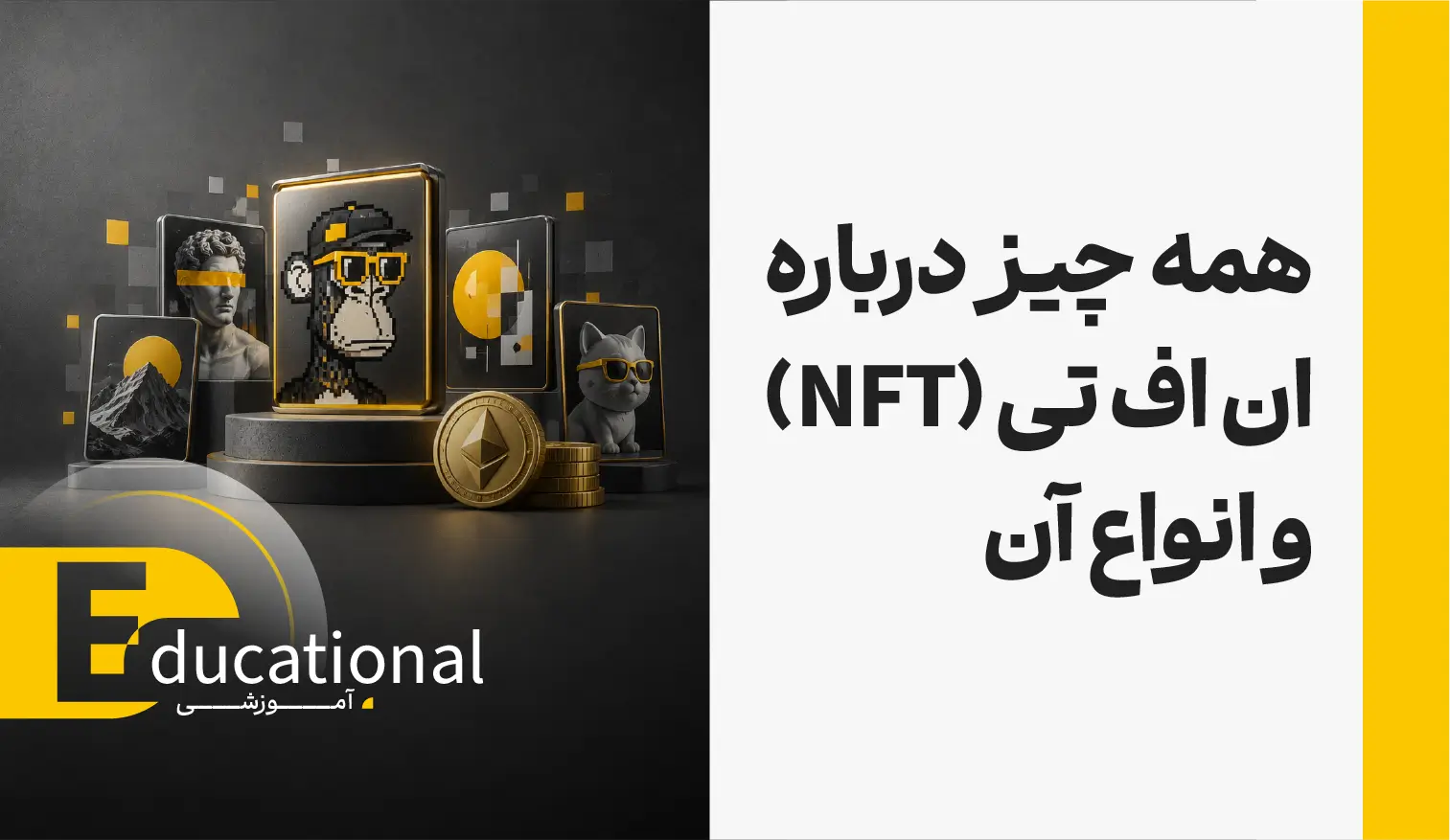
Everything About NFTs and Their Types
Author
Marzieh Mazaheri
Published
 2026/10/04
Updated
2026/10/25
Reading time
5 دقیقه


When you can save an image in a few seconds, what does buying it as an NFT actually mean? Much of the confusion about NFTs starts with this very question. A buyer usually doesn't pay to stop others from seeing or copying the image; they receive a token whose ownership is recorded on a blockchain network. What that ownership is worth and what rights come with it depends on the work, the creator and the project's terms.
To understand what an NFT is, we need to distinguish between three things: the token itself, the file or asset linked to it, and the rights the buyer gets. This distinction helps us better understand how NFTs are used in art, gaming and the metaverse, and also keeps us from accepting any claim about «digital ownership» without checking it.
What Is an NFT, in Simple Terms
NFT stands for Non-Fungible Token. Non-fungible means each token has a distinct identity and no other unit can be swapped in for it exactly; just as two photos by the same photographer, even if they look alike, are not one and the same work.
To make this clearer, imagine a photographer who wants to create an NFT for one of their photos. They prepare the photo along with information such as the title and description, and using a smart contract, create the corresponding token on the blockchain . This process is called minting (Mint) . After minting, the token has a specific ID, and anyone can see which address holds it and when it was transferred.
The photo itself may still be published on the photographer's website, where others can view or save it. That's why we need to distinguish between these three things:
- Token: an asset recorded on the blockchain with a specific ID and owner.
- The file and information about the work: the photo, title and description linked to the token. The file itself is not necessarily stored on the blockchain.
- Buyer's rights: what the token holder is allowed to do with the work, such as displaying it or using it commercially. These rights should be set out in the terms under which the work is released.
So when someone buys an NFT, they get a token linked to a work or an access right. This purchase doesn't necessarily allow them to reproduce the photo or use it commercially; those rights may still belong to the photographer.
Before buying, it should be clear what you're getting besides the token. If the rights and features that come with it aren't clear, judging its real value becomes difficult too.
Fungible vs. Non-Fungible Tokens
With fungible assets, units of the same type are usually interchangeable. For example, when you receive one unit of a fungible token, what generally matters is its amount and type, not who held that particular unit before.
With non-fungible tokens, the identity of each asset matters. Two NFTs from the same collection may have different traits, histories or uses and trade at different prices. Of course, being non-fungible doesn't mean being unsellable; these tokens can be traded, but you can't assume they're all worth the same.
On the Ethereum network, standards define the technical rules for creating and transferring tokens. ERC-20 is known as the standard for fungible tokens and ERC-721 for non-fungible tokens. Under ERC-721, a single contract can manage many NFTs, each with its own ID; a separate contract isn't needed for each token.
The ERC-1155 standard is more flexible and can hold several types of tokens in one contract. For example, a game can use it to manage a large number of identical items alongside some unique assets. Batch transfers are also a feature of this standard and, under the right conditions, can cut costs compared with several separate transfers.
|
Feature |
Fungible tokens |
Non-fungible tokens |
Semi-fungible tokens |
|
Interchangeability of units |
Units of the same type are usually interchangeable |
Each token has its own identity |
Depends on the design and state of the asset |
|
What to check |
Token amount and type |
Each token's ID, traits and rights |
Amount, category and specific traits |
|
Example use |
Payment token or stablecoin |
Artwork or unique item |
Some tickets and hybrid assets |
|
Technical structure |
e.g. ERC-20 |
e.g. ERC-721 |
Depends on the standard and contract design, e.g. ERC-3525 |
The term «semi-fungible» isn't a fixed model for every project either. For example, tickets can be designed to work the same way before an event and then turn into distinct collectibles afterwards; but such a change has to be built into the project's mechanism and doesn't happen on its own.
What Are the Types of NFTs?
NFTs are mostly known for collectible images, but their use isn't limited to pictures. Wherever identifying a specific asset, tracking its transfers or defining access matters, this technology becomes a possible option.
That said, different uses shouldn't be judged by the same yardstick. The value of an artwork may depend on the artist's reputation, while the value of a game item is tied to how it's used in the game. Looking at the types of NFTs is only useful when these differences are taken into account.
Digital Art and Collectibles (CryptoPunks and Bored Apes)
Part of the NFT market is dedicated to digital artworks, from illustration and photography to animation and generative art. The term NFT Art refers to this area: works whose release and the ownership of their linked tokens are handled through the blockchain.
So if you're asking what a photo NFT is, it usually means a token linked to a photo. This link doesn't make the file uncopyable, nor does it necessarily mean the photo itself is stored on the blockchain.
Collections such as CryptoPunks (CryptoPunks) and Bored Ape (Bored Ape) are well-known examples of digital collections. In collections like these, the combination of visual traits, supply and buyer attention can all play a part in valuation. Some projects also offer perks such as membership or access to events; perks that should be checked separately in that collection's terms.
One point that often gets overlooked when buying, and that I recommend paying more attention to, is where the file is stored. An NFT's image and data may sit on a server or on a system such as IPFS. That said, using IPFS on its own doesn't guarantee the file will stay available forever.
The next important point is that when evaluating a work, it's better not to mistake scarcity for demand. An image may have only one token and still find no buyer. Knowing the creator, the buyer's rights and how the file is stored gives you a clearer picture of the purchase than relying on a limited number of tokens.
Blockchain Game Items (GameFi)
In some blockchain games, assets such as characters, equipment or land are issued as NFTs. The term NFT Games is usually used for games that use these tokens in part of their structure. GameFi, meanwhile, refers to combining games with financial mechanisms, so the two terms don't mean exactly the same thing.
In such games, a player may be able to hold an item in their own wallet or transfer it through compatible marketplaces. This increases their control over the token, but the item's usefulness can still depend on the software and the developer's support.
The potential advantages of this structure are:
- the ability to transfer or sell some assets outside the game's internal environment;
- viewing token balances and transfer history on the network;
- defining rewards and economic mechanisms based on digital assets;
- shared use of some items, if different games actually support them. Of course, having a common standard isn't enough to use a sword or character in two games, because each game has to accept that item's appearance, abilities and usage rules.
On the other hand, if a game shuts down, the token may stay in the wallet but lose its use and demand. When assessing these projects, the quality of the game and the reason users stick around matter a lot; an economy that depends only on new buyers coming in doesn't provide solid backing for the value of the items.
Virtual Land and Real Estate in the Metaverse
In some virtual environments, land or specific spaces are offered as NFTs. The token holder may be able to build content within the designated area, host exhibitions or make their space available to others. The platform determines the limits of these permissions.
The link between NFTs and the metaverse lies in this very recording and transfer of distinct assets. That said, not every metaverse environment necessarily uses a blockchain, and not every NFT is related to the metaverse.
Owning virtual land is also fundamentally different from owning physical land. Using this asset depends on the environment continuing to operate, its technical capabilities and its rules. Even if the token remains, a decline in users can affect the economic value of the space associated with it.
When examining such assets, the practical question is: who uses this space, and for what purpose? The limited number of land parcels alone does not show that there is demand for renting, advertising or commercial activity on them.
Music, video and other assets
A piece of music, a short video, an event ticket or the right to access exclusive content can also be linked to an NFT. For example, an artist may issue a token that lets its holder receive a special edition of an album or attend a specific event.
In this model, the financial relationship between creator and audience can become more direct, but intermediaries do not always disappear. Marketplaces, file storage infrastructure and service providers may still play a role in offering and using the work.
The buyer's rights must also be clear. Buying a token linked to a piece of music does not necessarily grant permission to republish it, use it in advertising or receive a share of its revenue. These depend on the license and agreement that come with the work.
Uses and benefits of NFTs in the crypto world
The main use of NFTs in crypto is to create a way to identify and transfer distinct assets. A smart contract sets the rules of this process, and the network keeps track of the token's status. This structure can make it easier to check records and to interact across compatible applications.
Its most important capabilities can be explained in a few points:
- Tracking token ownership: The ability to check the holder's address and transfer history, depending on the structure of the network and the contract.
- Transfer between compatible tools: The ability to hold or move the token in wallets and applications that support it.
- Defining access: Using the token for membership, receiving a service or entering a specific space.
- Setting terms of use: Defining certain rules through a smart contract, if the relevant feature has been implemented.
Specialized marketplaces are usually used to buy and sell these assets. NFT Marketplace It is an environment for displaying collections, placing offers and trading. Keep in mind that a work being listed on such a marketplace does not by itself confirm that the publisher owns the rights to it or that its price has been set reasonably.
One feature we hear a lot about with NFTs is the creator's share of later sales of the work, known as a «royalty». Using the ERC-2981 standard, the creator can specify who receives this share and how much. But recording this information does not guarantee payment; the marketplace or trading method must also support it. So it cannot be said that the creator will definitely earn income every time the work is resold.
My advice to you as an Iranian user is to check the terms of an NFT marketplace carefully before using it. You may be able to hold the token in your wallet or transfer it on the network, but due to platform restrictions you may not have access to all of the site's features. So before connecting your wallet or paying any fee, make sure you know what services that marketplace offers you.
In the end, an NFT is useful when it makes recording ownership or transferring an asset easier for the user. The mere fact that a product has an NFT does not mean it has become more useful or more valuable.
Challenges, risks and the future of NFT technology
A possible drop in price is not the only risk of NFTs. You may own a token that no buyer can be found for, whose associated file is unavailable, or whose promised project benefits are no longer provided. To evaluate this market, you need to consider the token's value, storage security and its dependence on external services together.
The most important points to keep in mind are:
- Liquidity: The price listed by the seller does not mean a trade will take place at that price. The asking price differs from the amount you can actually receive.
- Wash trading: Buying and selling between related accounts can create a misleading picture of demand or trading volume.
- Unauthorized publishing: Someone may link a work that does not belong to them to an NFT. Registering a token does not count as permission to publish the work.
- Wallet security: Signing a malicious request or granting an inappropriate approval can expose your assets to theft, even if your recovery phrase has not been revealed.
- Dependence on the project: Rule changes, discontinued services or lost files may limit the use of the token.
Some traders buy NFTs to sell them at a higher price within a short time; this is called NFT Flipping . Profiting from this method is not as simple as it seems. You may not find a buyer for the token, or buyers' offers, after trading fees are deducted, may even be lower than what you paid.
Before buying, check these points:
- Was the token issued by the collection's official contract?
- What rights or features do you get by buying it?
- Where are the image, video or data associated with the token stored?
Look carefully at the sales history as well. The fact that an NFT once sold at a high price does not mean you can sell it at the same price. The number of buyers and current offers give a better picture of its market.
As I mentioned, NFTs can be used for more than buying and selling collectibles; for example, in event tickets, memberships, game items and digital certificates. A token can even be linked to a real-world asset, but ownership and rights to that asset must also be clearly defined and enforceable in the real world.
To assess a project, ask yourself: If the price of this NFT does not go up, is owning it still useful to me? The answer to this question helps you separate the project's real utility from the hope of selling it to the next buyer.
Frequently asked questions
What does NFT stand for and what is it used for?
NFT stands for Non-Fungible Token , meaning «non-fungible token». This token has a distinct identity and can be used to record and transfer assets such as artworks, game items or access rights.
What is the main difference between the ERC-721 and ERC-1155 standards?
ERC-721 is used to manage non-fungible tokens with independent IDs, and a single contract can hold many tokens. ERC-1155 allows several types of tokens, including fungible and non-fungible assets, to be managed in one contract and supports batch transfers.
Is it possible to copy an NFT's image?
Yes; if the image is accessible, it can usually be saved or copied. This does not transfer ownership of the original token. Someone else may also link the same image to a different token; that is why checking the issuer and the contract address matters.
What does minting an NFT mean?
Minting is the process of creating a token on the blockchain. When creating an NFT, the token ID and its associated data are defined according to the contract's rules. The file itself may be stored off-chain; so minting does not necessarily mean uploading the image to the blockchain.
To create one, you usually need to choose a network and a publishing tool, prepare the file and details of the work, and complete the issuance process. The cost and details depend on the method you choose. Successfully creating a token does not by itself mean it will become valuable or sell.
Contents of this article


Related articles
User reviews

Newest
 Upload image