Ways to Identify and Prevent Crypto Fraud or Scams

Author
Arezoo Ghoochani

Expert review
Mohammadreza Minaei
Published
 2026/09/14
Updated
2026/11/02
Reading time
15 دقیقه


Crypto scams in 2026 usually do not start with a direct hack of the blockchain . Scammers mostly rely on social engineering, impersonation, phishing, fake investment platforms, malicious wallet requests and fraudulent payment instructions to convince users to take an action themselves that ultimately leads to the loss of their assets or access credentials. The scale of this threat is significant. According to data Coin Bureau cited in the original article, up to $17 billion may have been stolen through crypto scams and fraud in 2025. The FBI also reported that reported losses from crypto investment fraud exceeded $7.2 billion that same year, an increase of about 24 percent compared to 2024. AI has also made impersonation more convincing, and according to Chainalysis data, AI-powered scams were about 4.5 times more profitable than traditional scams in 2025 data.
This guide helps you recognize the signs of a crypto scam, better understand its common types, independently verify the credibility of a platform or person, understand what different wallet requests mean, and know what steps to take if you have already clicked a link, entered information, signed something or sent crypto.
What Is a Crypto Scam?
A crypto scam is a type of fraud in which the victim is tricked into doing something that gives the criminal access to their money, account or digital assets. Contrary to popular belief, the attacker does not necessarily need to hack the blockchain itself. They may convince the victim to send crypto, hand over login details or a private key, approve a malicious smart contract, install malware or invest in a fake platform.
Confirmed blockchain transactions are usually irreversible, and in non-custodial wallets the authority to sign transactions lies directly with the wallet owner. So a wrong approval or permission can put assets at risk without the blockchain network itself being hacked.
In general, explaining what a crypto scam is is simple. In short, most scams in the crypto market try to convince you to send crypto, share your access credentials with others or approve a dangerous wallet request. The best defense is to ignore them entirely, calmly verify the person or platform through an independent source and know exactly what you are sending, signing or approving.
What Is the Difference Between a Scam, a Hack and an Exploit in the Crypto Market?
Let's quickly go over these differences in the table below:
|
Term |
Meaning |
|
Scam |
The victim is deceived into taking an action such as sending crypto or signing a malicious request. |
|
Hack |
The attacker gains unauthorized access to an account, device, wallet or system. |
|
Exploit |
The attacker takes advantage of a weakness in software or in the logic of a smart contract. |
These categories can overlap. For example, a phishing attack may steal login details, and the attacker may later use the same details to take over an exchange account.
How Are Crypto Scams Usually Carried Out?
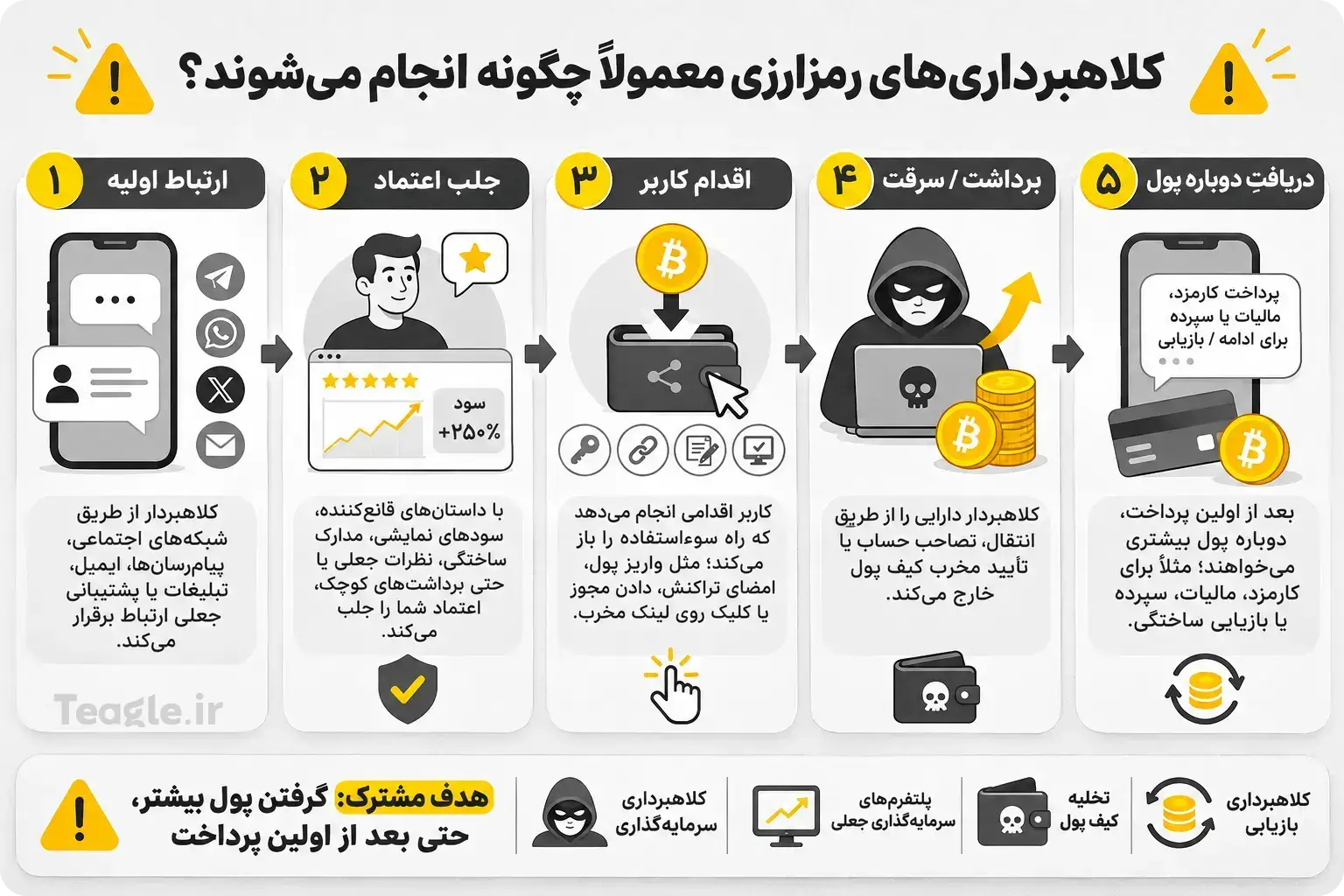
Many scams follow a similar cycle, even if their story and method differ:
Initial contact → Building trust → Action → Asset extraction → Attempt at further extraction
1. Contact
A scammer may reach the victim through social media, dating apps, Telegram, WhatsApp, phishing emails, search ads, fake customer support or recruitment messages. The first contact can seem completely harmless, such as an investment offer, a job opportunity, an account alert, a romantic conversation or a support request.
2. Building Trust
Next, the scammer tries to build credibility and may pose as a romantic partner, celebrity, executive, investment expert, recruiter or support agent. Fake reviews, trading dashboards, apparent profits and even a small successful withdrawal can be used to build trust.
3. Getting the Victim to Act
Once trust is established, the victim is pushed to do something that puts them at risk, such as depositing crypto, providing account details, connecting a wallet, signing a token approval, installing malware or remote access software, or scanning a QR code.
4. Extraction and Further Extraction
The initial loss may come from a direct transfer, an account takeover or a malicious wallet approval. But the scammer often does not stop there and may later ask for a withdrawal fee, taxes, an account unlocking fee or another deposit. Someone else may even approach the victim as a «crypto recovery service» and promise to return the stolen assets in exchange for an upfront payment.
How Can You Tell You Are Dealing With a Crypto Scammer?
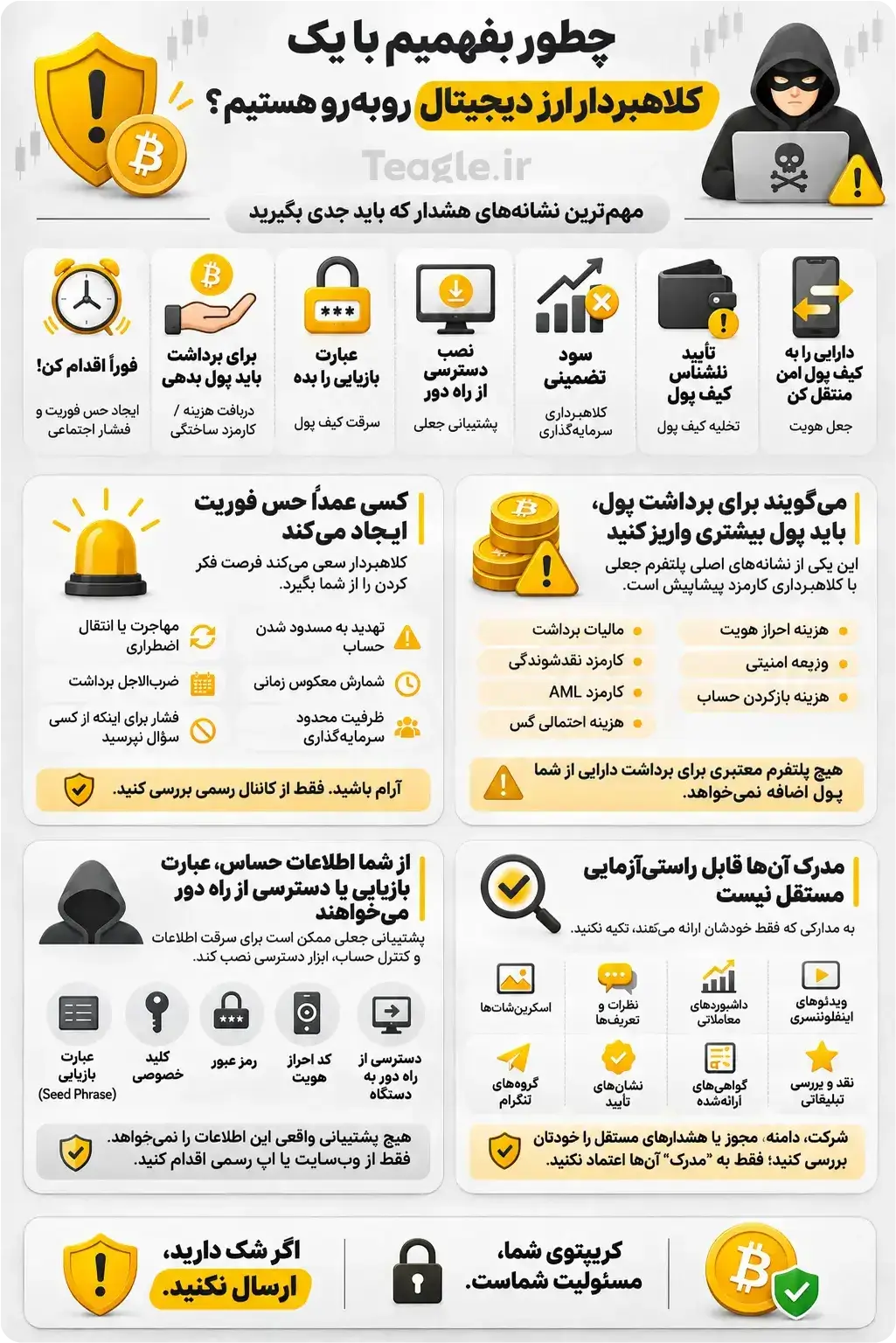
Scams look different, but the warning signs repeat in many of them: creating urgency, asking for more payments, requesting sensitive information and offering evidence that cannot be independently verified. Signs that can help you spot crypto market scams faster include the following:
- Someone is trying to rush you
Scammers take away your chance to verify by creating urgency. Threats of account suspension, countdowns, limited investment capacity, emergency wallet migrations, sudden withdrawal deadlines and even requests not to discuss the matter with anyone else are examples of this tactic. The rule is simple: the more pressure there is to act immediately, the less time you have for independent verification. Slow down and check the information through an official channel you found yourself.
- They ask you for more money in order to withdraw
If you are asked to pay an additional amount to withdraw your assets, you are facing one of the most important signs of a fake trading platform or an advance-fee scam.
- Withdrawal tax
- Verification fee
- Liquidity fee
- Security deposit
- Anti-money laundering (AML) fee
- Account unlocking fee
- Supposed gas payment
A scammer may first show fake profits in your account or allow a small withdrawal, and then demand USDT, another stablecoin or a new deposit to release your main balance.
- Requests for your recovery phrase, private key or remote access
Genuine wallet or exchange support should never need your recovery phrase, private key, password, authentication code or remote control of your device. Fake support may ask you to install tools such as AnyDesk or TeamViewer and then use that access to steal information or take control of your account. If someone claiming to be support asks for such information or access, cut off contact and reach out to support yourself through the company's official website or app.
- Evidence that cannot be independently verified
Screenshots, customer testimonials, trading dashboards, influencer videos, Telegram groups, verification badges, certificates and reviews provided by a project's own promoters are not strong evidence, because they can be fabricated or manipulated. A very professional website can also be fake, a large social media following can be bought and a certificate can be forged. Verification should be done through a source that the person asking for money has no control over.
The Most Common Types of Crypto Scams in 2026
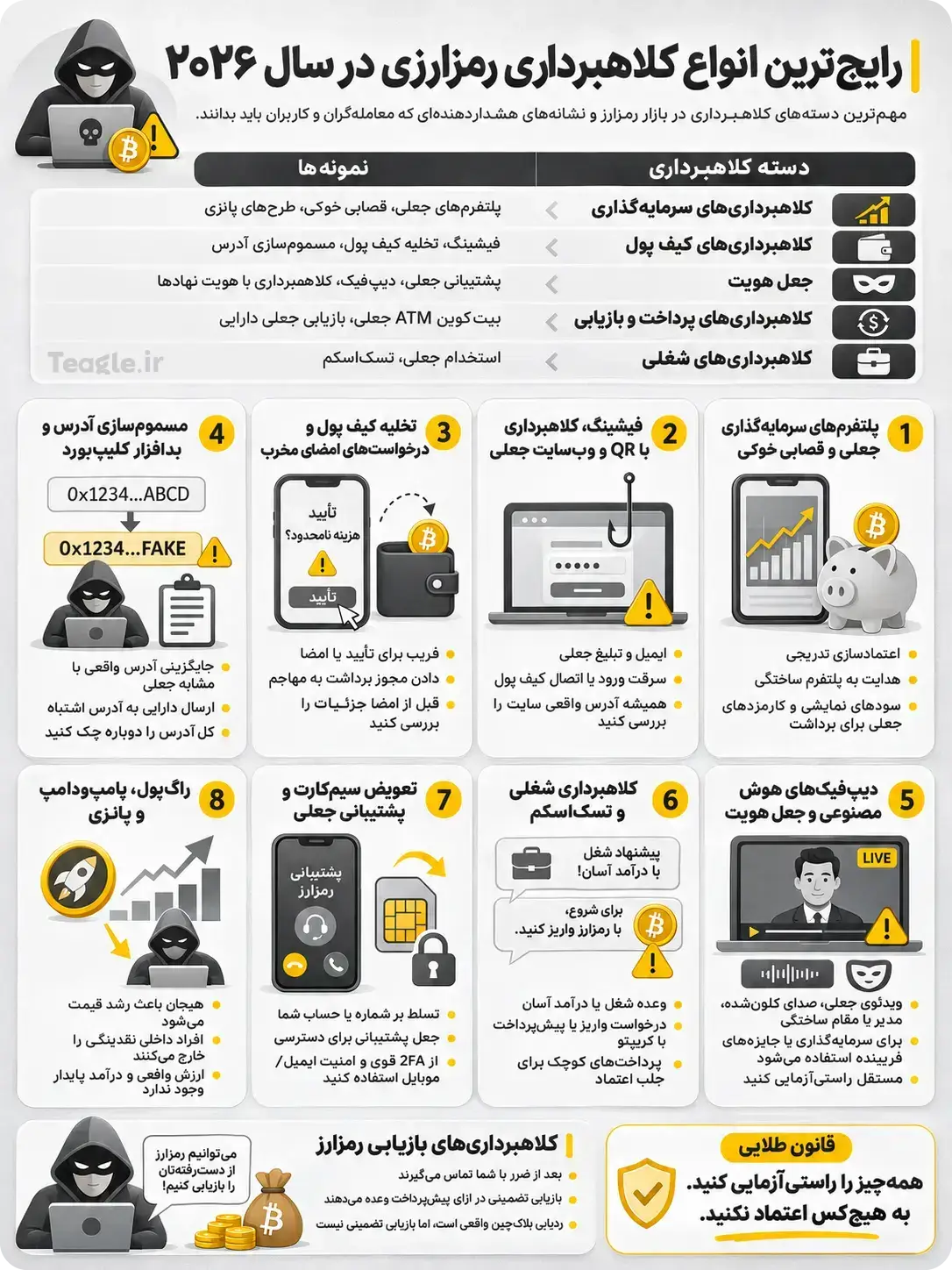
|
Category |
Examples |
|
Investment scams |
Fake platforms, Pig Butchering and Ponzi schemes |
|
Wallet scams |
Phishing, wallet drainers and address poisoning |
|
Impersonation |
Fake support, deepfakes and impersonation of officials |
|
Payment and recovery |
Payment scams and fake recovery services |
|
Job scams |
Fake recruiters and task-based scams |
Fake investment platforms and Pig Butchering scams
Pig Butchering scams and other trust-based scams often start on social media, dating apps, Telegram or WhatsApp. The scammer first builds a relationship and trust, then brings up a crypto investment opportunity and steers the victim to a fake trading platform that shows fabricated profits. As deposits grow, withdrawals may be blocked and the victim may be asked to pay taxes, verification fees or a security payment. Even a small initial withdrawal does not prove the platform is legitimate, because the scammer may deliberately allow a small withdrawal to build more trust.
Phishing, QR scams and fake crypto websites
Phishing can come through a fake exchange email, a cloned wallet website, malicious ads, fake login pages, browser extensions, QR codes and even physical mail. For example, a fake page may ask you to connect your wallet or enter your exchange login details.
- Bookmark trusted websites.
- Check the full domain name carefully.
- Do not click on unsolicited links or QR codes.
- Check account alerts through the official app or website.
Wallet drainers and malicious signature requests
A Wallet Drainer tricks the user into giving a smart contract or attacker a permission that allows assets to be transferred.
|
Action |
What usually happens? |
|
Connect |
A DApp can interact with the wallet's public address. |
|
Sign |
A message or action is cryptographically approved. |
|
Approve |
A smart contract can receive permission to spend tokens. |
|
Send |
A transaction is executed on the blockchain. |
Dangerous requests can include ERC-20 approvals, unlimited Allowances, Permit signatures and SetApprovalForAll permissions.
Address poisoning and clipboard malware
In Address Poisoning, the scammer plants an address similar to a real one in your transaction history so that later, when copying an address, you mistakenly pick the fake one. In Clipboard Malware, when you copy a wallet address, the malware replaces it with the attacker's address before it is pasted. Do not rely only on the first and last few characters or on transaction history to verify the recipient address. Where possible, use a trusted address book or an independent source you have already verified.
AI deepfakes and impersonation scams
AI has made impersonation harder to detect. Scammers can produce deepfake livestreams, cloned voices, fake executives, government officials, fictitious investment advisers and promotional videos for fake trading platforms. Even hacked social media and YouTube accounts can be used to promote fake giveaways or AI trading bots. So the appearance of a video, a voice or a verified account alone is not enough to prove legitimacy.
Crypto job and task-based scams
In this method, depositing crypto is presented as part of an online or remote job. You may be offered work such as optimization, product rating or simple online tasks, and then be asked to deposit USDT or another cryptocurrency to continue working or to unlock your earnings. A legitimate employer should not ask you to deposit crypto to start work, complete tasks or receive earnings.
SIM swapping and fake crypto support
In a SIM Swap attack, the attacker tries to move the victim's phone number to another SIM card. As a result, text messages, recovery codes and login processes may end up in the attacker's hands. Fake exchange support can also lead to account takeover through the same route or by requesting remote access. Make protecting your email account a priority, use stronger authentication methods such as a Passkey or a security key where possible, and never install remote-control software just because someone claiming to be support asked you to.
Rug Pulls, pump and dumps and Ponzi schemes
A Rug Pull means insiders withdraw the liquidity or otherwise drain the project's value. Pump and Dump means coordinated promotion pushes a token's price up and insiders sell their holdings before the price crashes. Ponzi or HYIP means new deposits are used to pay apparent returns to earlier investors, not to fund a sustainable economic activity.
Guaranteed returns, unrealistic APY, an unclear source of income, tokenomics dependent on insiders, aggressive rewards for recruiting new people, low liquidity and a team that cannot be independently verified are all warning signs.
Crypto recovery scams
This type of scam targets victims who have already lost money. Someone presenting themselves as a hacker, blockchain investigator, recovery service or law firm may promise to return stolen crypto in exchange for an upfront payment. Tracing blockchain transactions is a real activity carried out by exchanges and law enforcement, but a «guaranteed recovery» is a different matter. Seeing stolen assets on the blockchain does not mean a private company can return them to you.
How to avoid getting hit by crypto scammers?
-
Watch out for a sense of urgency: threats of account suspension, countdowns, emergency wallet transfers and pressure to act immediately are common tactics in these scams. Also…
-
Do not pay more money to withdraw money; a request for taxes, verification fees, a security deposit or extra crypto before a withdrawal is a serious warning sign!
-
Protect your wallet and account: do not give your recovery phrase, private key, password, authentication code or remote access to anyone claiming to be support.
-
Verify independently: check the domain, company, regulator, app publisher, smart contract and support channel through sources not controlled by the person promoting it.
-
Know what your wallet is approving: connecting a wallet, signing a message, approving a token permission and sending a transaction are not the same.
-
Match your response to the type of exposure: secure your compromised accounts, revoke suspicious permissions, switch wallets if your recovery phrase was exposed, and stop any further payments immediately.
How to check whether a crypto platform is legitimate?
Do not judge a platform just by its professional look. Before depositing crypto, check its domain, legal entity, regulatory status if any, official app publisher, track record and withdrawal behavior through independent sources.
- Check the exact domain name.
- Find the company or legal entity operating the platform.
- Where applicable, check regulator records or company registration.
- Check the official app publisher on the App Store or Google Play.
- Check how long the platform has been operating.
- Search for regulatory warnings, legal actions and independent scam reports.
A genuine company registration can be part of the verification process, but on its own it does not prove that the platform is trustworthy.
Table of signs that do not prove a crypto platform is legitimate
|
Sign |
Does it prove legitimacy on its own? |
|
Professional website |
No |
|
Listing on the App Store |
No |
|
One successful small withdrawal |
No |
|
Positive reviews |
No |
|
Verified social media account |
No |
|
Endorsement by an influencer or celebrity |
No |
|
Regulatory license |
Stronger evidence, but still not an absolute guarantee |
Check the platform's legitimacy through a source it does not control
Independent verification means checking the platform's claims without using the links, phone numbers or documents provided by the person promoting it.
- Type the official website address yourself or use a trusted bookmark.
- Open the official app directly instead of going through a link in a message.
- Look up the relevant regulator's records yourself.
- Find the support contact through the company's official domain.
- Check the smart contract address on the project's official website or official documentation.
If the only proof you have that a platform, company or contract is legitimate comes from the person asking you for money, you haven't done any independent verification yet.
Can a wallet be emptied just by connecting it?
Connecting a wallet on its own usually doesn't let a DApp transfer assets. The main risk depends on what you sign, approve or authorize after connecting.
|
Action |
Typical use |
Risk level |
|
Connecting a wallet |
Sharing the public address and enabling interaction |
Usually low on its own |
|
Signing a message |
Proving control or authorizing an action |
Depends on the signature type |
|
Token Approval |
Granting a token spending approval |
Medium to high |
|
Unlimited Approval |
Granting broad token spending authority |
High |
|
SetApprovalForAll |
Granting NFT authority to an operator |
High |
|
Sending a transaction |
Executing an action on the blockchain |
Depends on the action |
|
Sharing the Seed Phrase |
Granting full control of the wallet |
Critical |
Why can token approvals be dangerous?
A token approval lets a smart contract spend specific assets from your wallet within the limits of the approval. An ERC-20 approval may have a set cap, but an unlimited approval creates much broader authority until you revoke it.
Approvals such as SetApprovalForAll can create significant authority over NFTs, and Permit signatures can, in some cases, allow tokens to be spent without a separate approval transaction. Newer mechanisms such as EIP-7702 have also introduced new ways to delegate authority to smart contract code, so unfamiliar or unusual requests should be reviewed carefully before signing. The key point is that a Wallet Drainer doesn't necessarily need your Seed Phrase; a malicious approval or a dangerous wallet signature may be enough to make moving your assets possible.
Transaction simulation is useful, but not an absolute guarantee
Transaction Simulation can show a preview of the expected outcome of a blockchain transaction before you approve it, for example a token transfer or a change in approvals. It's a useful layer of defense, but it shouldn't be treated as a guarantee of security.
The best approach is layered: use transaction simulation, read wallet prompts carefully, check the DApp and smart contract independently, and don't sign requests you don't fully understand.
What should you do if you think you've been scammed?
The right response depends on what has been exposed. Clicking a phishing link, entering login details, signing a token approval, revealing a recovery phrase and sending crypto each have different consequences. The checklist covers points to consider if your account may have been compromised by fraud:
- Simply clicking a phishing link doesn't necessarily mean your crypto is lost. Close the page, check that nothing was downloaded or installed, and don't approve any follow-up requests. If you entered a password or login details, change them immediately from a trusted device. Secure the linked email account too, because access to your email can be used to reset passwords for exchanges and other accounts.
- Connecting a wallet on its own is usually not permission to transfer assets. Disconnect the DApp and review recent activity and wallet approvals. If you approved a Token Approval, Permit, SetApprovalForAll or any other suspicious signature, review the granted approval and revoke it if possible. You can use the relevant blockchain explorer or reputable approval management tools.
- If someone else has gained access to your recovery phrase or private key, consider the wallet fully compromised. Create a new wallet on a trusted device and move your remaining assets to the new addresses. Even if nothing has been stolen yet, don't reuse the exposed recovery phrase. Revoking Token Approvals isn't enough in this case, because the recovery phrase or private key gives the attacker direct control of the wallet.
- If you sent crypto Stop sending money immediately, even if the scammer claims another payment will unlock a withdrawal or reverse an earlier transfer. Record details including the transaction hash, the recipient wallet address, the blockchain network, the amount and time of the transfer, screenshots and messages, and the website domain and social media accounts. Notify any exchange or crypto service involved as quickly as possible and report the matter to the relevant authorities. A confirmed transaction may not be reversible, but reporting quickly can help if the assets reach a service that is able to freeze them. Don't pay anything to anyone who contacts you unsolicited promising «guaranteed recovery».
- If your exchange account or phone number has fallen into someone else's hands: if an account takeover or SIM Swap is possible, first secure the accounts that can be used to reset other accounts. Change your email password and revoke unrecognized sessions. Report any unauthorized SIM transfer immediately. Replace compromised SMS or 2FA methods used to authenticate your account. On your exchange account, revoke active sessions, review withdrawals and contact support through the official channel.
Where to report crypto fraud?
First, notify the exchange or wallet provider involved. Depending on where you live and the type of fraud, you can report it to the police or cybercrime authorities, the national fraud reporting service and, where relevant, the financial regulator. Also report the scammer's account on the social network, messaging app or platform they used.
The original Coin Bureau article points American readers to channels such as FBI IC3, FTC ReportFraud, the SEC and the CFTC. These routes are specific to the US reporting system; users in Iran or other countries should use the official authorities of their own country.
Gather evidence before reporting
- Transaction hashes
- Wallet addresses
- Blockchain network
- Amount sent
- Time and date of transactions
- Screenshots
- Website domains
- Usernames
- Phone numbers
- Email addresses
- Chat or payment records
Transaction hashes and wallet addresses are especially important, because they give exchanges, blockchain investigators and legal authorities specific, traceable on-chain information.
FAQs about crypto scams
What are the most common crypto scams in 2026?
Common ones include fake investment platforms, Pig Butchering, phishing, Wallet Drainers, address poisoning, AI impersonation, fake support, task-based scams and fake recovery services.
How can you tell if a crypto offer is a scam?
Watch for pressure to act fast, guaranteed returns, requests for more payments, requests for your Seed Phrase or sensitive information, and claims that can't be verified from an independent source.
How do you check whether a crypto platform is legitimate?
Check for yourself the exact domain, the legal entity, regulatory records if any, the official app publisher, the operating history and independent warnings.
Can a fake platform allow withdrawals at first?
Yes. Some fake platforms deliberately allow a small withdrawal to build trust and then push the user to deposit larger amounts.
Can you lose assets just by connecting your wallet to a website?
Connecting on its own usually doesn't mean permission to transfer assets. The risk mostly comes from a malicious signature, approval or transaction after connecting.
Can signing a message give access to your crypto?
Depending on the signature type, it may approve a specific permission or action. So before signing, you should know exactly what the wallet is asking you for.
What is a Wallet Drainer?
It's a type of malicious software or mechanism that tricks users into approving asset transfers or granting permission to spend their assets.
What is Address Poisoning?
It's a method in which a similar-looking fake address is planted in your transaction history so that later, when copying an address, you mistakenly send assets to the attacker.
Are crypto jobs that require a deposit scams?
In many cases, this is a serious warning sign. A legitimate employer should not ask you to deposit crypto to access tasks, earnings or commissions.
Can an exchange return crypto sent to a scammer?
Sometimes it can, but there is no guarantee. If the assets reach a service that is able to freeze them and the report is made quickly, the chances of help are higher.
What should I do if I have shared my Seed Phrase?
Assume the wallet is compromised, create a new wallet and move the remaining assets to the new addresses as soon as possible.
Are crypto recovery services legitimate?
Some blockchain tracing services are real, but promises of guaranteed recovery and requests for upfront payment are very serious warning signs.
Article source:
Coin Bureau, Crypto Scams to Avoid in 2026: How to Spot, Verify and Stop Them
Contents of this article


Related articles
User reviews

Newest
 Upload image