
A Comprehensive Guide to Trading Gold on Crypto Exchanges

Author
Marzieh Mazaheri

Expert review
Mohammadreza Minaei
Published
 2026/10/24
Updated
2026/11/03
Reading time
8 دقیقه


Gold has always been one of the safest investment havens for preserving the value of assets against inflation and economic crises. However, traditional ways of buying and holding gold come with challenges such as the risk of theft, possible insurance and storage costs, the buy-sell price gap and, in the case of jewelry, manufacturing fees. In recent years, linking blockchain technology with real-world assets (RWA) has offered a new take on this equation. Investors can now, with a few clicks on crypto exchanges , connect to the global gold market. But this method differs in some ways from the common picture people have of buying gold, which I will explain further below.
Can you buy and sell gold on a crypto exchange?
If you mean buying coins, bars or gold jewelry and receiving them physically, the mere presence of a gold symbol on a crypto exchange does not mean that the exchange sells such products. What is traded on these platforms is a gold-backed digital token, not a piece of gold that is shipped to you after purchase.
These tokens are a way to invest in gold without holding it directly. For example, each unit of PAXG or XAUT represents one troy ounce of pure gold held by a custodian. You can buy a fraction of a token, subject to the exchange's minimum order, and later sell it on the same market. Its price also depends on the value of the backing gold, although it may differ from the spot price per ounce. This method suits someone who wants to invest in gold without being personally responsible for storing it.
What does trading gold on a crypto exchange mean?
Trading gold on a crypto exchange usually refers to buying and selling gold-backed tokens. The gold symbol on a crypto exchange also refers to crypto assets such as PAX Gold (PAX Gold — PAXG) and Tether Gold (Tether Gold — XAUT). When you buy these tokens, it is not a physical asset but a digital balance that is added to your account, representing a specific amount of gold held by a custodian. You can buy a fraction of a token, subject to the exchange's minimum order, and sell it later. Its price depends on the value of the backing gold, but market supply and demand can cause it to deviate from the global gold price.
On some exchanges, gold-related derivative contracts are also traded. In these trades, you take a position on price changes and do not necessarily become the owner of the token or the backing gold. So before buying, it should be clear whether the symbol you choose is a gold token on the spot market or a contract that only tracks gold price fluctuations.
What is tokenized gold?
Tokenized gold is a digital asset created on blockchain networks, such as Ethereum, whose value is tied to physical gold. In this model, a custodian company or entity holds standard gold bars in secure vaults and issues or mints tokens in proportion to the amount of gold stored and the unit defined for the product.
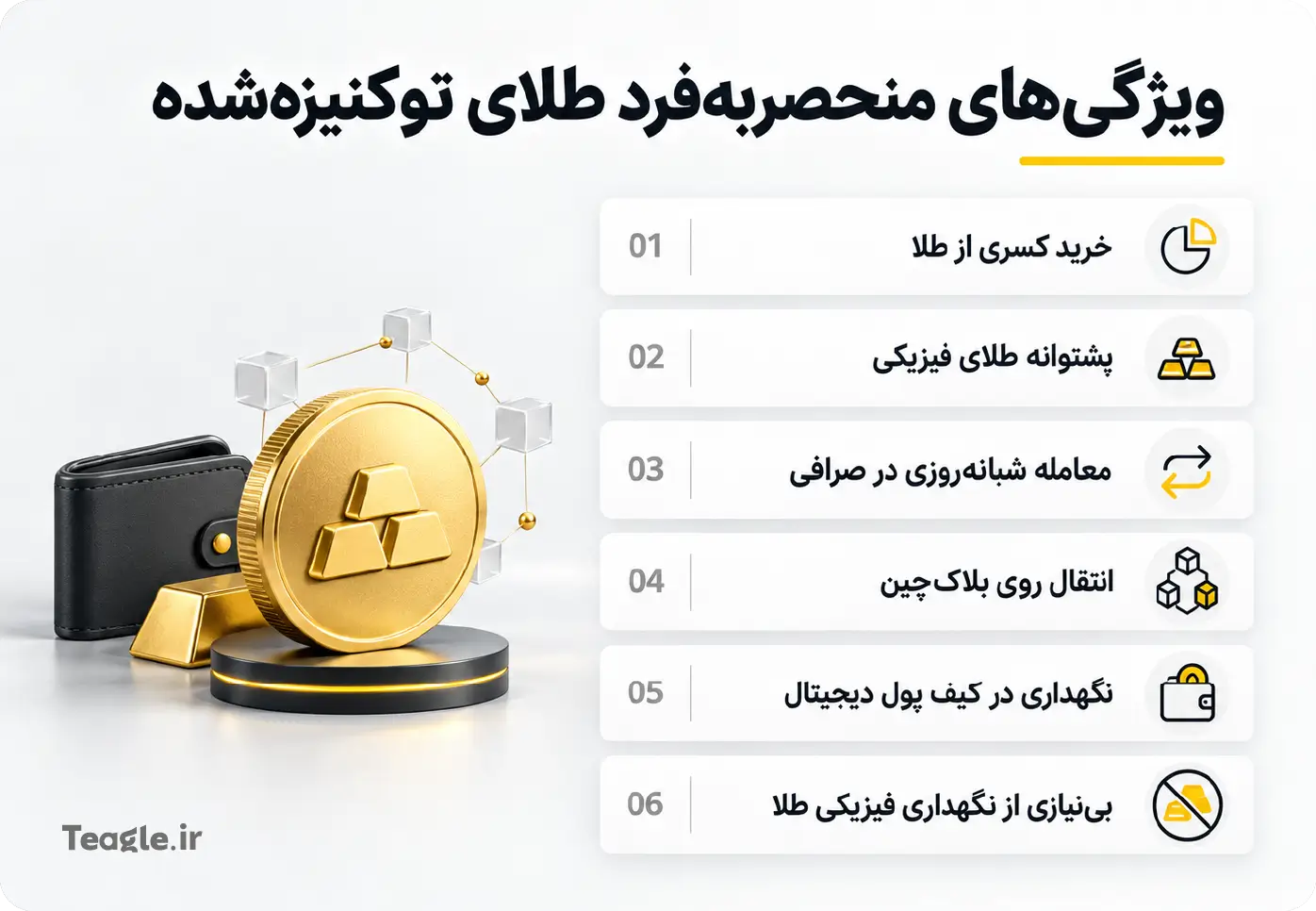 In the redemption process, tokens are removed from circulation or burned according to the issuer's mechanism, and an eligible holder can receive, depending on the product, gold or the proceeds from its conversion. Physical delivery is subject to the issuer's minimum amounts, identity verification, fees and restrictions.
Below we introduce two well-known projects in this field:
What is PAX Gold?
The PAX Gold token, ticker PAXG, is managed by the American company Paxos Trust Company, N.A and issued on the Ethereum and Solana networks. Its key features are:
- Gold backing: Each unit of PAX Gold represents one troy ounce of pure gold, equal to about 31.1 grams. The backing gold is held in London in the form of standard bars approved by the London Bullion Market Association (LBMA). These bars are usually called «400-ounce» bars, but their pure gold content can range from 350 to 430 troy ounces.
- Regulatory oversight: Paxos now operates under the supervision of the US Office of the Comptroller of the Currency (OCC). Oversight by the New York State Department of Financial Services (NYDFS) relates to the company's previous regulatory structure.
- Ability to check bar information: If you hold the tokens in a personal wallet on supported networks, you can enter your wallet address in Paxos's official tool to see the serial number, weight and vault information of the backing gold. This tool is not designed to independently view each user's balance in centralized exchange accounts.
- Ability to receive physical gold: To request delivery of a full bar, you must have a verified Paxos account, submit at least 430 PAXG tokens and pay the related fees. Once the actual weight of the bar is determined, the excess tokens, minus applicable fees, are returned to your account.
What is Tether Gold?
Tether Gold (XAUT) is issued by TG Commodities, S.A. de C.V. This company has taken over responsibility for issuing and redeeming the tokens from TG Commodities Limited. This digital asset is issued on the Ethereum and Tron networks and has also expanded to BNB Smart Chain. Its multichain version, called XAUT0, makes it possible to use this asset on other networks such as TON and Polygon.
The main features of Tether Gold are:
- Gold backing: each unit of Tether Gold represents one troy ounce of pure gold, equal to about 31.1 grams, from standard bars approved by the London Bullion Market Association (LBMA).
- Storage location: The gold backing the tokens is held in a vault in Switzerland.
- Ability to buy small amounts: Tether Gold is divisible to six decimal places, so you do not need to buy a whole token to invest. The minimum order amount is set by the exchange.
- Ability to receive physical gold: Gold delivery is only made in the form of full bars and for verified customers. You usually need to submit at least 430 tokens; tokens in excess of the bar's weight are returned. Delivery takes place in Switzerland, and the redemption fee and shipping costs are borne by the customer.
- Minimum purchase from the issuer: Buying directly from Tether Gold requires at least 50 tokens. This condition applies to the issuer's services; on exchanges you can buy smaller amounts according to that platform's minimum order.
What is the difference between tokenized gold and physical gold?
Comparing tokenized gold with traditional gold, including bars, coins or jewelry, clarifies the advantages and nature of both assets:
|
Comparison factor |
Physical gold (coins, bars or jewelry) |
Tokenized gold (PAXG or XAUT) |
|
Ownership and delivery |
Held directly by the investor or deposited with a custodian |
Rights to the backing gold under the issuer's terms; tokens held on-chain or in an exchange account |
|
Storage risk |
Theft, loss, purity fraud and, if a custodian is used, the risk of holding with a third party |
Private key, smart contract, exchange and issuer risk, and the possibility of freezing |
|
Divisibility |
Depends on the weight and type of physical product |
Fractions of a token can be bought; minimum purchase subject to exchange rules |
|
Trading hours |
Usually limited to market and seller business hours |
Usually 24 hours on active markets; direct issuer services subject to separate terms |
|
Fees and costs |
Buy-sell price gap, possible storage costs, coin premium and manufacturing fees for jewelry |
Trading fee, spread, withdrawal or network fee and, if used, redemption fee |
|
International transfer |
Subject to shipping and customs rules and related restrictions |
Transfer on a supported network, subject to issuer and platform restrictions |
How to trade gold on a crypto exchange?
Trading gold on a crypto exchange is very similar to buying other cryptocurrencies, and the steps are generally as follows:
1. Choosing an exchange and a gold-related asset
First, you need to choose a reputable exchange that offers gold-related pairs such as PAXG/USDT or XAUT/USDT. To choose the best exchange for trading gold, in addition to fees, market depth, token withdrawal options and access conditions, check the list of active markets, identity verification requirements and geographic restrictions.
After choosing an exchange, you need to decide which token fits your strategy. To make this choice, compare the backing, the issuer's regulatory structure, redemption terms and the liquidity of that trading pair.
For Iranian users, checking the issuer's terms is also essential. Tether Gold has placed Iran on its list of prohibited jurisdictions, and Paxos also makes providing services and accepting accounts subject to sanctions regulations. Buying tokens on the secondary market does not guarantee access to the issuer's direct services, physical redemption or protection from freezing. For this reason, we recommend trading on a reputable domestic crypto exchange.
2. Depositing funds and buying gold tokens
- Funding your account: First, fund your account with a rial deposit on domestic exchanges or by depositing supported stablecoins such as USDT and USDC.
- Placing an order: Go to the Spot market and choose your order type:
- Limit Order: You set a specific buy price; execution depends on the price reaching the set level and on a matching order being available.
- Market Order: You buy at the prices available in the order book; in a thin market, the order may be filled across several price levels.
Once the order is filled, your tokenized gold balance appears in your exchange account.
3. Selling and withdrawing the asset
After buying a gold token, you can sell it on the exchange or move it to a personal wallet for safekeeping. The steps for each are as follows:
- Selling the token: Go to the relevant trading market and place your sell order. Once the order is filled, the proceeds are added to your rial or stablecoin balance, depending on which market you sold the token in.
- Withdrawing to a personal wallet: First, make sure the destination wallet supports the token and the chosen network. Then, in the exchange's withdrawal section, enter the destination address, network and amount, and review the details and fee before confirming.
- Holding after the transfer: Once you move the token, protecting the private key and recovery phrase is your responsibility. This reduces your reliance on the exchange, but it does not remove the issuer's ability to impose restrictions; for example, under the PAXG terms, Paxos can also freeze tokens held in personal wallets.
Is the price of digital gold the same as the global gold price?
The price of gold-backed tokens such as PAX Gold and Tether Gold is tied to the global gold price, but it is not necessarily equal to it at every moment. As I mentioned earlier, each unit of these tokens represents one troy ounce of pure gold, but their trading price on an exchange is set by the orders of buyers and sellers. That is why being backed by one ounce of gold does not mean always trading at the exact price of one ounce.
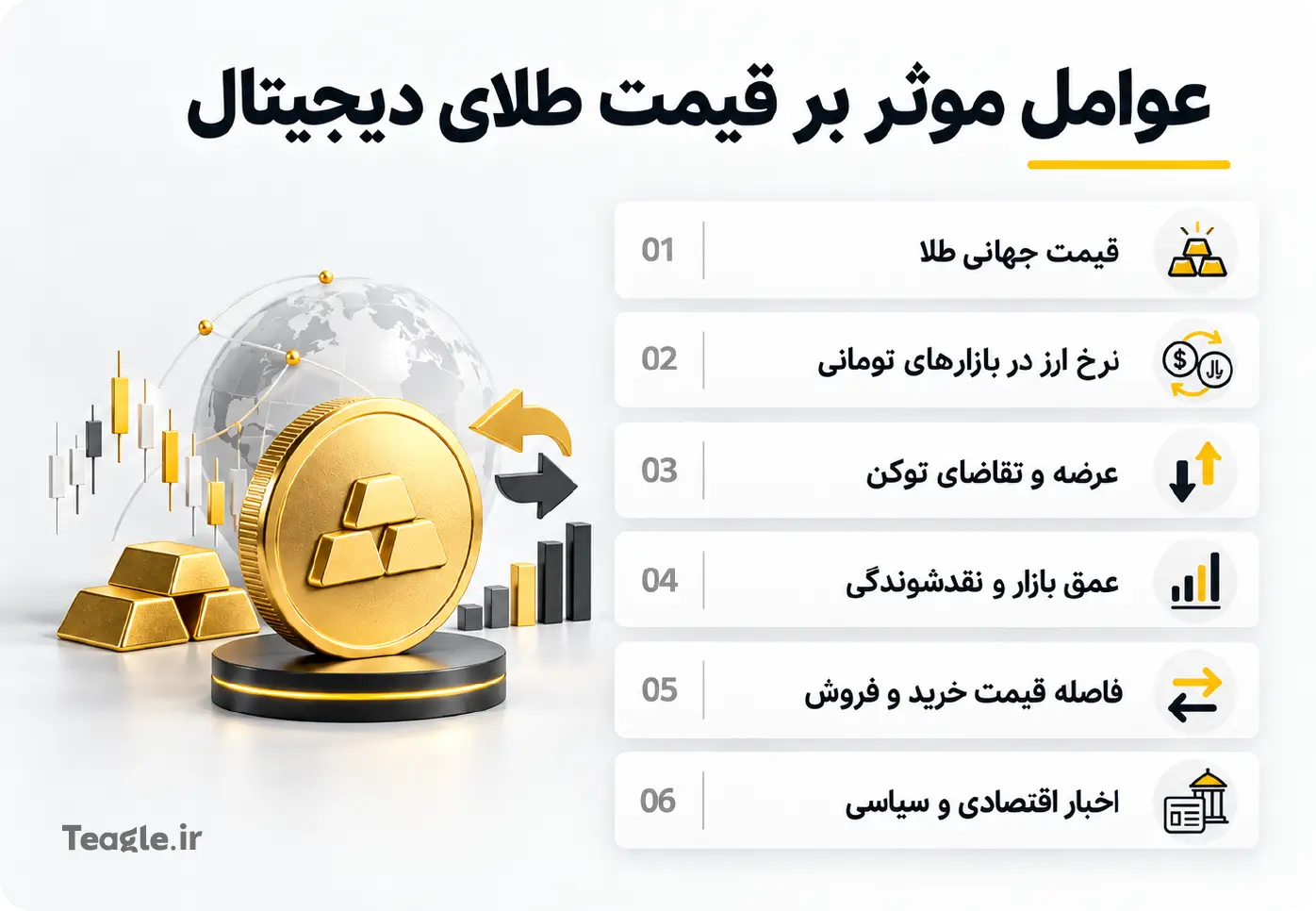
To compare, you also need to look at prices in the same currency. If you buy the token in a Toman market, its price is affected not only by the global ounce price but also by the dollar or Tether to Toman exchange rate. So the global gold price may stay flat while the token's Toman price rises as the exchange rate goes up.
A gold token's price may be higher or lower than the value of the gold backing it; this gap is called a «premium» and a «discount», respectively. In Iran's domestic gold market, the terms «positive bubble» and «negative bubble» are also commonly used for a positive or negative gap between the market price and the underlying value. This price gap can be related to several factors:
- Supply, demand and market depth: In a market with fewer orders, a large buy or sell can move the price more.
- The gap between buy and sell prices: The price you pay to buy differs from the price you can sell at in the same moment. This gap is called the spread.
- Transfer and redemption costs: Fees and the conditions for converting the token into gold or cash affect whether a price gap can be exploited.
- Global gold market closures: The token may keep trading over the weekend. During that time, fresh news can push its price away from gold's last recorded price.
Arbitrage, meaning exploiting price differences between markets, can help bring prices closer together; but costs and redemption limits prevent this gap from always disappearing instantly. Paxos also treats the PAXG trading price in the order book as separate from the direct buy and sell price based on the London gold market. So when buying, check not only the displayed global ounce price but also the executable price of your order and the final cost of the trade.
What are the costs and risks of trading digital gold?
Investing in digital gold is not without challenges, and three main components need to be reviewed:
Fees and spread
- Exchange fee: This is the charge for executing a trade. Its rate depends on the exchange, the trading pair, the order type, the user tier and trading volume, so a single fixed range cannot be applied to all platforms.
- On-chain fee: Transferring the token on the blockchain requires paying that network's fee. For example, transferring the ERC-20 version on Ethereum incurs a gas fee. The exchange's withdrawal fee may also differ from the actual network fee.
- Direct creation and redemption fees: This cost is different from the exchange's transfer or trading fee. Paxos publishes a separate fee schedule for direct creation and redemption of PAXG, which may change. Tether Gold also charges a 0.25% fee for direct purchase or redemption under its published terms, and physical delivery involves a separate cost.
- Price spread: This is the gap between the highest bid and the lowest ask in the order book, and it matters more in thin markets or for large orders.
Liquidity risk
The liquidity of PAXG and XAUT depends on the exchange, the trading pair and market conditions. A token's market cap alone does not show the price at which your large order will be filled.
In addition, when placing a sell order, you may face price slippage . Placing orders in a deeper market and using limit orders can help control this risk, but high liquidity does not guarantee slippage-free execution either.
Issuer and gold-backing risk
Unlike Bitcoin, tokenized gold relies on the issuer and custodian to hold the backing and provide redemption services. This reliance creates counterparty risk.
What should you check before buying digital gold?
To enter this market with a clear view, it is essential to review these three factors:
1. Backing and how the gold is stored
Check whether the product is backed by allocated gold or unallocated gold.
Allocated gold refers to specific bars identifiable by serial number, weight and purity. With PAXG, a holder of less than a full bar can own a proportional share of that bar, and allocation across bars can also change under the issuer's mechanism.
By contrast, unallocated gold usually represents a claim to a certain amount of gold from an institution, without any specific bar being assigned to the holder. The legal consequences of insolvency must be assessed based on the contract, the custody structure and the applicable laws; the use of the label «allocated» alone is not enough to draw a firm conclusion.
2. Issuer credibility and transparency
Review the independent attestation reports on reserves. These reports should not necessarily be considered equivalent to a full audit of all of the company's activities and risks.
Paxos publishes PAXG reserve attestation reports monthly. Reports published from 28 February 2025 onward were issued by KPMG LLP, and earlier reports were by WithumSmith+Brown, PC.
Transparency in disclosing vault holdings and the issuer's regulatory framework are tools for evaluating the product; but having reserve reports or legal oversight does not eliminate all investment risks.
3. Trading volume and liquidity
Before trading on an exchange, analyze the daily trading volume of the pair you want, the gap between buy and sell prices, and the order book depth.
A more liquid market can let orders be filled with a smaller price gap and less slippage; but for large orders, checking the volume available across several price levels matters more than just looking at daily trading volume.
Who is trading gold on a crypto exchange suitable for?
Trading digital gold is most useful for people who want to invest in gold but do not need to receive coins or bars. That is because what is traded as gold on a crypto exchange is usually a gold-backed token, not a physical item you take delivery of after buying. Small investors can gradually build their holdings by buying fractions of a token, and crypto traders can allocate part of their capital to gold on the same trading platform.
This approach reduces the hassle of storing physical gold, but in return, the choice of exchange, the issuer's credibility and wallet security become more important. Before buying, make sure the platform's services are available to you and that the fees suit the size of your investment; especially for Iranian users, being able to buy the token does not by itself guarantee access to the issuer's services or protection from being frozen.
Contents of this article


Related articles



User reviews

Newest
 Upload image