Trading Sessions in the Forex and Crypto Markets

Author
Admin
Published
 2026/03/10
Updated
2026/10/25
Reading time
5 دقیقه


Forex and crypto, as major global financial markets with very high liquidity, are not based and centralized in a single location, unlike traditional stock exchanges. Each of these markets plays its part, to varying degrees, across different time zones, and market activity in each geographic region varies according to the working hours of institutions and traders in that region. Each of these geographic activity windows is called a «trading session». The importance of these sessions becomes clearer once a trader understands that trading volume, volatility and price behavior in each session follow the rules and psychology specific to that geographic region. In addition, the impact of each session in proportion to its importance, and the overlap of sessions with one another, doubles the significance of this topic for the market.
While the forex market follows a 5 -day cycle with set hours, the cryptocurrency market, through exchanges, is active 24 hours a day, 7 days a week. Even so, crypto market volatility is also strongly influenced by the working hours of the world's major financial centers and by the sessions. In this article, we aim to gain a full understanding of the concept of the trading session (Trading Session) in the forex and crypto markets.

What does a trading session (Trading Session) mean and why does it matter?
Put simply, the term trading session (Trading Session) refers to a specific time window during the 24-hour day in which major financial centers, banks and large investment institutions in a particular geographic region are active, or, in common terms, «open». Obviously, business activity follows sunrise and sunset and the start of the working day under each country's official regulations.
The vast expanse of the Earth means that a market like forex is always active in at least one geographic region. In other words, when the sun rises in the east, the markets of Oceania and Asia begin trading, and as the sun moves west, it becomes the turn of the European and then North American markets. So it can be said that although the forex market is active at set hours, during the 5 days of its trading week it is active almost around the clock. This sequence keeps the forex market continuously open, because at least one financial center in the world is always operating.
Trading sessions matter to us because market liquidity (the ease of buying and selling an asset) changes throughout the day as each session, and with it its traders, becomes active. Liquidity in each of these sessions (London, New York, Tokyo and Sydney) and the behavior of traders in them differ from one another. For example, during London session hours liquidity is high, while at the end of the New York session and the start of the Sydney session liquidity is low, which directly affects price volatility and trader behavior. In other words, each session has a personality or archetype; for example, the Asian session is usually known for calm, ranging moves, while the London and New York sessions are when strong trends and large price swings occur.
Trading sessions in the crypto market
We should not assume that because trading in the cryptocurrency market runs around the clock without closing, the time of trading does not matter. The reality is that a large share of the cryptocurrency market's liquidity is provided by large financial institutions that operate during the official office hours of their geographic region. Data shows that Bitcoin's biggest moves happen during New York and London session activity. In fact, the cryptocurrency market follows the global liquidity cycle, and trading during the hours when global forex markets are active increases the chances of success for trend-based strategies.
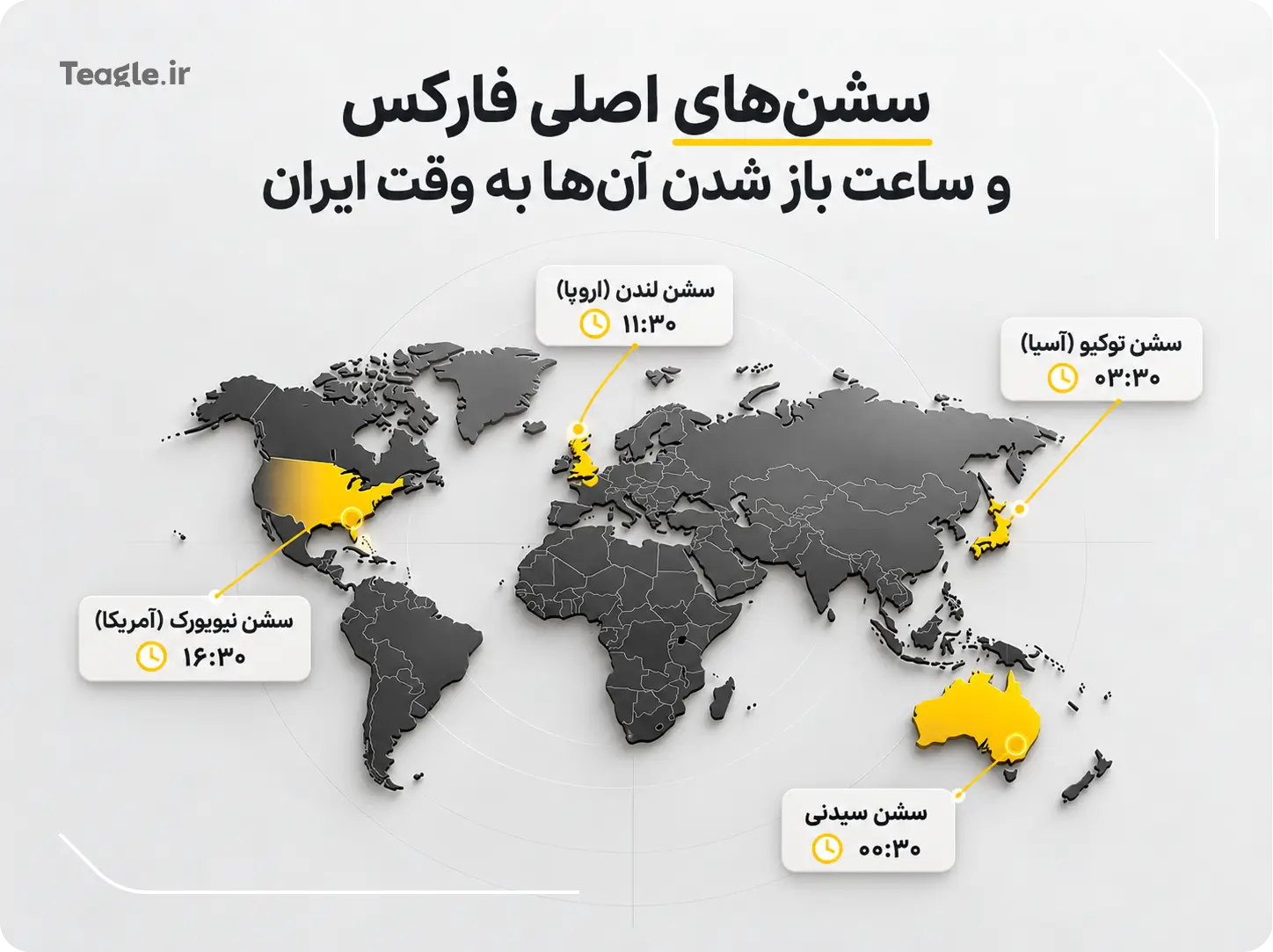
The main forex sessions and their opening times in Iran time
The forex market is divided into 4 main trading sessions, a division based on the operating hours of the world's major financial centers. The main forex sessions are:
- Sydney session
- Tokyo session (Asia)
- London session (Europe)
- New York session (America)
Of course, there are other sessions such as New Zealand, Frankfurt, Riyadh, Dubai, etc., but they are not as important as the main sessions. Knowing the exact times of the 4 sessions mentioned in Iran time is crucial for Iranian traders, because Iran is positioned in a time zone where some of the main sessions and their overlaps coincide with daytime and evening hours in Iran. Below, we review the four trading sessions in order.
Sydney session – the start of the global trading cycle
Since the sun rises in the east, the Sydney session is the first trading session in the forex and crypto markets, reopening the forex market on Monday after the Saturday and Sunday break. This session starts at around 12 a.m. Iran time (20:30 at GMT) and stays active until 8:30 a.m. Iran time. The Sydney session is known as the calmest forex session, and its trading volume is lower than that of the other sessions.
Naturally, in the Sydney session, currency pairs with the Australian dollar (AUD) or New Zealand dollar (NZD) on one side are traded more. For most traders, this session alone is not suitable for trading because of its low liquidity and low volatility compared with other sessions. But this very calm provides a good time to review previous trends and trades and to set up new trades.
Tokyo session – the hub of Asian activity
The Tokyo session becomes active roughly halfway through the Sydney session. Tokyo accounts for the largest volume of trades in Asia, which is why it is also called the Asian session. This session starts at around 03:30 a.m. Iran time ( 00:00 a.m. GMT) and continues until around 12:30 noon Iran time.
In this session, currency pairs involving the Japanese yen (JPY) see significant volatility due to high trading volume. Economic news releases from Japan, China and Australia (because of the Sydney–Tokyo overlap) during this session are price drivers.
London session – the heart of global liquidity
London is known as the world's largest financial network and the most important forex trading center in the world, so it is natural that serious activity in currency pair trading begins with the start of this session. The London session starts at around 11:30 a.m. Iran time (08:00 in the time zone of GMT) and continues until 20:30 Iran time. This session coincides with the opening of European markets, and huge liquidity is injected into the market by major banks in the UK and the European Union.
In this session, volatility rises sharply, and major forex currency pairs such as EUR/USD, GBP/USD and USD/CHF see significant moves. Many traders believe the market's real daily trend usually forms during the London session.
New York session – the high-volatility, high-volume session
Alongside the London session, the New York session is a major hub of financial institutions and trading markets. This session starts at around 16:30 p.m. Iran time ( 13:00 in the time zone of GMT) and stays active until 01:30 a.m. Iran time. The US dollar, as a key global currency present in many forex trades, sees price reactions after the New York session opens.
In this session we see the opening of major US stock markets, the release of important fundamental economic news (such as the employment report and Federal Reserve decisions), along with trading in the world's leading stock indices such as the Dow Jones, Nasdaq and S&P 500 . In general, the New York session is very exciting and attractive for active, swing-seeking traders.
Complete table of forex session times in Iran time and GMT
For precise trade planning, the table below shows the standard operating hours of the main markets. Note that Iran's official time is 3hours and 30 minutes ahead of Greenwich (GMT). It should be noted that due to daylight saving time changes in Europe and the US, these hours may shift one hour back or forward for half of the year.
|
Session |
Opening time (Iran) |
Closing time (Iran) |
Opening time (GMT) |
Closing time (GMT) |
|
Sydney |
00:00 |
08:30 |
20:30 |
05:00 |
|
Tokyo (Tokyo) |
03:30 |
12:30 |
00:00 |
09:00 |
|
London (London) |
11:30 |
20:30 |
08:00 |
17:00 |
|
New York (New York) |
16:30 |
01:30 |
13:00 |
22:00 |
Session overlap (Overlap); the best time to trade
A session overlap occurs when 2 major trading sessions are active at the same time. Among session overlaps, the London–New York overlap (as the world's two most important sessions) is the most important and influential. Below, we look at the session overlaps.
1. London and New York overlap
From 16:30 to 20:30 Iran time, the financial centers of both Europe and the US are active. This is the best time for traders looking for high liquidity, low spreads and strong directional moves. Most important economic news is released at the start of this overlap.
2. Tokyo and London overlap
From 11:30 to 12:30 Iran time, the Asian market is closing and the European market is opening. This overlap is not as important as the London and New York overlap, and it is generally said that the market's early trends start in this session.
3. Sydney and Tokyo overlap
From 03:30 to 09:30 Iran time, the Sydney and Tokyo sessions overlap, and this session is commonly called the «Asian session». As mentioned, volatility in this period is lower than in the 2 London and New York sessions, but there is enough liquidity for trading currency pairs related to Asian currencies.
Session-based trading strategies
Some traders adjust their strategies based on sessions. However, it should be noted that thousands of variables and strategies affect a trader's trades, and one should not rely solely on session-based trading strategies. Below we mention some of these strategies. In fact, time is as important as price in technical analysis .
1. London session breakout strategy (London Breakout)
The logic of this strategy is based on the low volatility of the Asian session, where price moves within a fairly defined range, and when the London session begins, the inflow of liquidity causes a breakout (Breakout) of this range. In this strategy, traders mark the high and low of the Asian session and, when the London session opens, enter a trade in the direction of the asset's price breakout.
2. Kill zones strategy (Kill Zones)
Kill zones are roughly 2 to 3 hour time windows in which large financial institutions execute their orders. Two kill zones, in the London session (around 11:30 to 14:30 Iran time) and the New York session (around 16:30 to 19:30 Iran time), are respectively the times when the liquidity hunt strategy is executed against the low and high of the Asian session followed by a move in the day's main direction, and when the US market sets its direction and usually completes or reverses the London session's moves.
Tools and indicators for displaying trading sessions
Naturally, in the age of technology, there is no need to manually calculate session times and match them with the broker's clock, because session indicators are designed to automatically display these time zones on the chart. Below we mention some of them.
Forex session indicator for MetaTrader 4 and 5 (MT4 / MT5)
MetaTrader platforms do not display sessions by default, but there are many free indicators for this.
- Market_Sessions (for MT5): This simple indicator, released in 2019 , shows sessions with colored boxes on the chart.
- Session Daylight Gradient (for MT5): By providing a background Gradient it shows trading sessions on a daily basis.
- Pro Sessions (for MT4): An indicator that, in MetaTrader 4 shows the high and low levels 4 of the main sessions.
Session indicator in TradingView (TradingView)
TradingView has very modern, user-friendly indicators developed by its user community; below we mention 2 of them.
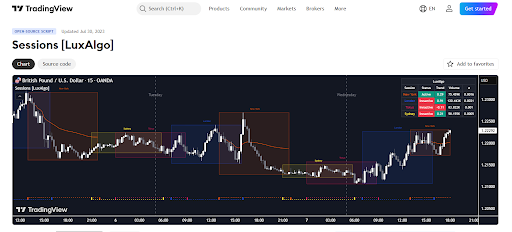
- Sessions by LuxAlgo: One of the best indicators, showing session zones and overlaps with high clarity.
- Session Highs and Lows Indicator: This indicator automatically displays the kill zones and ranges of each session.
Professional traders' tips and advice for choosing the right session
Success in trading depends not only on technical knowledge but also on smart time management.
1. Matching the symbol to the session: If you trade pound-related (GBP) or euro (EUR) currency pairs, be sure to be active in the London session. If your focus is on stock indices such as the Dow Jones (US30) or gold (XAU/USD), the New York session and the overlap period offer the best opportunities.
2. Time psychology: Many traders, due to «fear of missing out» (FOMO), try to trade in every session. This leads to mental fatigue and wrong decisions. The best strategy is to pick one or two sessions (for example, London and the start of New York) and focus fully on that time window.
3. Caution during news: The New York session can be very dangerous due to the release of high-impact economic news. If you are a beginner, it is recommended that you stay out of the market for at least 15 to 30 minutes before and after major news (such as interest rates or NFP) to stay safe from erratic volatility and false spreads.
4. Using confluence (Confluence): When a support or resistance level in technical analysis coincides with the opening of an important session (such as London), that level's validity becomes much higher.
|
Trading symbol |
Best session to trade |
Reason |
|
Gold (XAU/USD) |
London and New York overlap |
Very high liquidity and reaction to dollar news |
|
Dow Jones (US30) |
New York session (early hours) |
Wall Street opening and sharp index volatility |
|
EUR/USD |
London session and overlap |
Trillions of dollars moving between Europe and the US |
|
Bitcoin (BTC) |
New York session |
Entry of institutional investors and funds ETF |
|
GBP/JPY |
Tokyo–London overlap |
Sharp volatility due to interest rate differentials and trading volume |
FAQs about trading sessions
Does the crypto market have closures or specific sessions?
No, the crypto market is open 24 hours a day and 7 days a week. However, its main trading volume and big swings line up with the forex sessions (especially London and New York). On weekends (Saturday and Sunday), liquidity drops and the likelihood of deceptive moves in crypto increases.
How does the structure of crypto sessions differ from forex?
In forex, sessions have precise time boundaries and the market is fully closed on weekends. In crypto, sessions are liquidity-based; that is, the market is open, but the price's «momentum» is stronger during the business hours of major financial centers. Crypto volatility within a single session can also be far more extreme than in forex (sometimes up to 20 percent movement in a single day).
What role do sessions play in determining market volatility?
Sessions are the driving engine of volatility. Volatility is the result of large orders entering the market. Sessions with larger financial centers (London and New York) generate more volatility. Session overlaps, where orders from two geographic regions converge, mark the peak of volatility and liquidity across the 24-hour day.
Contents of this article


Related articles

User reviews

Newest
 Upload image