
The Best Time to Trade Cryptocurrency

Author
Arezoo Ghoochani

Expert review
Mohammadreza Minaei
Published
 2026/09/13
Updated
2026/10/25
Reading time
12 دقیقه


If you're looking for a magic hour to trade crypto, there isn't one. The crypto spot market is normally active 24 hours a day, 7 days a week, but trading conditions are not the same throughout the day.
The best time to trade crypto depends on what you want from a trade: more liquidity, a lower spread , higher volatility, more momentum or less slippage. So instead of treating the time of day as an entry signal, it's better to see it as a filter for finding suitable trade execution conditions. For many major Bitcoin and Ethereum pairs, the overlap between European and US activity—roughly 13:00 to 16:00 UTC—is worth looking at; but this window is not definitive trading advice and should be tested for your own asset, pair and exchange.
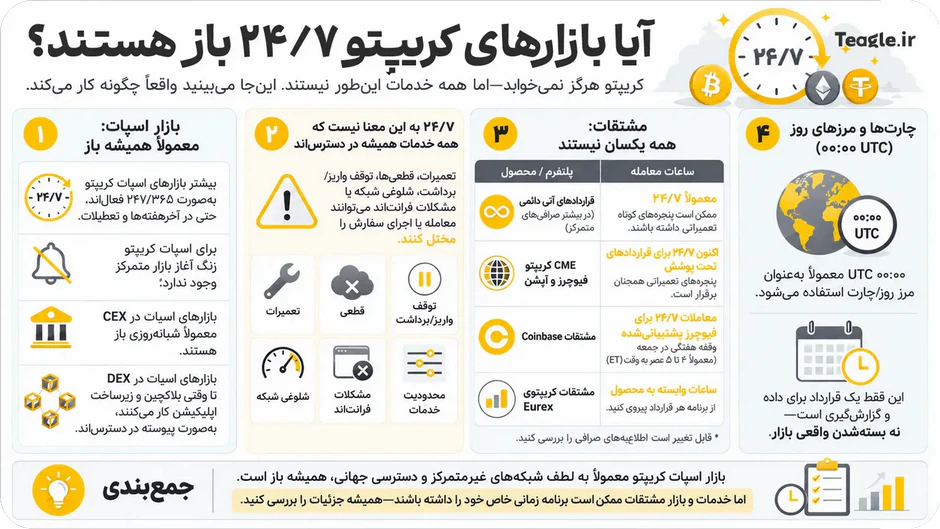
Crypto trading hours: 24 hours a day, 7 days a week!
Most crypto spot markets are available 24/7/365, meaning Bitcoin, Ethereum and many other cryptocurrencies can be traded at night, on weekends and on public holidays. Unlike traditional markets, the crypto spot market has no single, centralized global opening and closing time.
Of course, being 24/7 doesn't mean there are never any disruptions. Centralized exchanges may go offline for maintenance, and decentralized exchanges also depend on the state of the blockchain, smart contracts, liquidity pools and front-end infrastructure. Also, 00:00 UTC is commonly used to mark the daily candle boundary, but trading does not stop at that time.
How do crypto spot, futures and options trading hours differ?
The spot market is usually active continuously, but the derivatives market doesn't necessarily follow the same schedule. Perpetual Futures trade almost continuously on many crypto exchanges and have no traditional expiry date.
By contrast, futures and options on regulated platforms may have set trading hours and maintenance windows. So you shouldn't assume that all of a cryptocurrency's derivatives follow exactly the same schedule just because the coin itself trades 24/7. For each contract, it's best to check the product specifications and the exchange's trading schedule, especially if trade timing matters a lot to you.
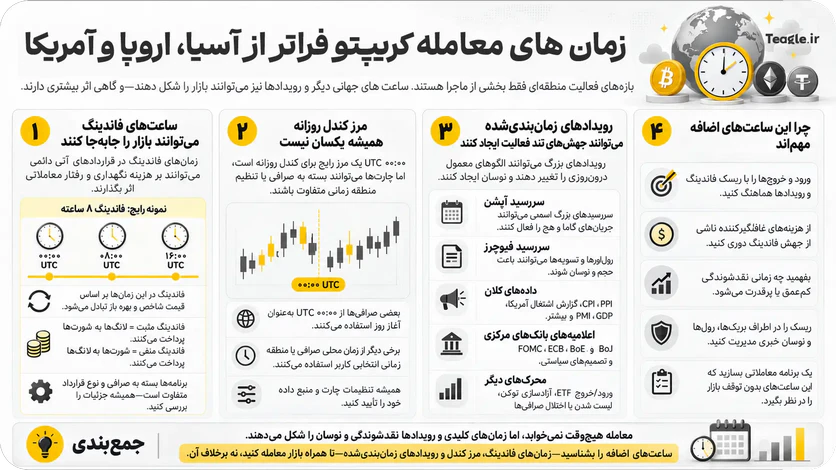
When are the Asian, European and US trading sessions in the crypto market?
Unlike forex, the crypto market has no official Asian, European and US sessions. These terms are only used to describe the periods when traders and financial institutions in a region are usually more active. So you shouldn't assume the crypto market officially opens when London business hours start or closes when New York activity ends.
Asian, European and US market activity windows in UTC
Asia: around 00:00 to 08:00 UTC
Europe: around 07:00 to 16:00 UTC
US: around 13:00 to 22:00 UTC
Europe–US overlap: around 13:00 to 16:00 UTC
The Europe–US overlap is worth looking at because London and New York traders can be active at the same time, and for part of this window US economic data and US financial market activity may also be in play. Even so, this window is only a starting point for testing, not a guarantee of higher volume or profitability.
How does daylight saving time affect crypto session timing?
UTC does not observe daylight saving time, but financial centers like London and New York change their local time during the year. As a result, their active hours shift relative to UTC for parts of the year. The crypto market itself doesn't close or open because of daylight saving time; what changes is how each region's active hours line up with UTC.
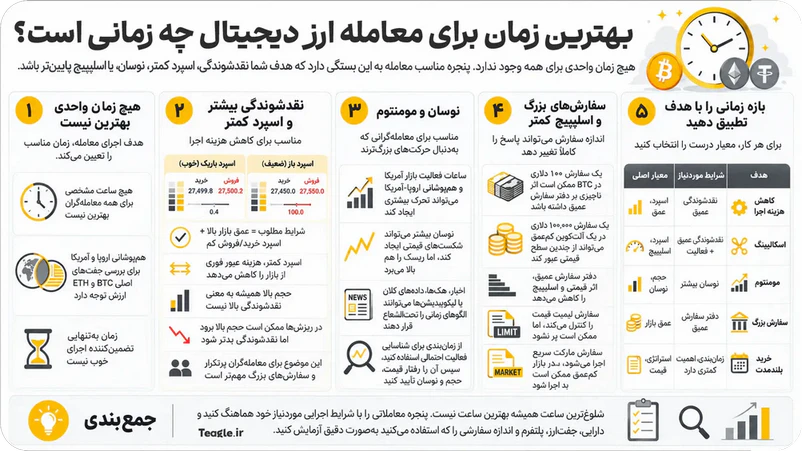
What is the best time of day to trade crypto?
There is no universal best time to trade crypto. The right time to trade depends on your asset, pair, exchange, order size and trading style. For a scalper, spread and slippage may be the most important criteria, while a momentum trader pays more attention to volume and volatility.
Best time to trade for higher liquidity and lower spreads
Liquidity shows how much the price changes when you buy or sell an asset. A market with good liquidity usually has more depth, a narrower bid-ask spread and enough participation to absorb new orders. The spread is the gap between the best bid and the best ask price. A lower spread means you pay less in execution costs to enter and exit a trade. However, high trading volume doesn't necessarily mean high liquidity; during a sharp sell-off volume may be high while market depth shrinks and order execution gets worse.
Best time to trade for higher volatility and momentum
If your strategy relies on momentum and fast price moves, high-volatility periods may be more attractive to you. US market activity and the Europe–US overlap may be worth looking at here, since they can coincide with institutional activity and major economic data releases. But higher volatility doesn't mean a sure opportunity. The same move that can create a breakout may reverse very quickly. Sudden news, security incidents, regulatory news or cascading liquidations can also completely change the usual pattern of market hours.
Best time for large orders and reducing slippage
For large orders, order book depth becomes especially important. A small Bitcoin order in a deep market may have little effect on the price, but the same amount of capital in a low-volume altcoin can eat through several price levels and worsen the average execution price.
Slippage is the difference between the expected price and the actual execution price of an order. Limit orders can set a maximum or minimum acceptable price, but they're not guaranteed to be filled. A Market order prioritizes speed of execution and, in a thin order book, may be filled at less favorable prices.
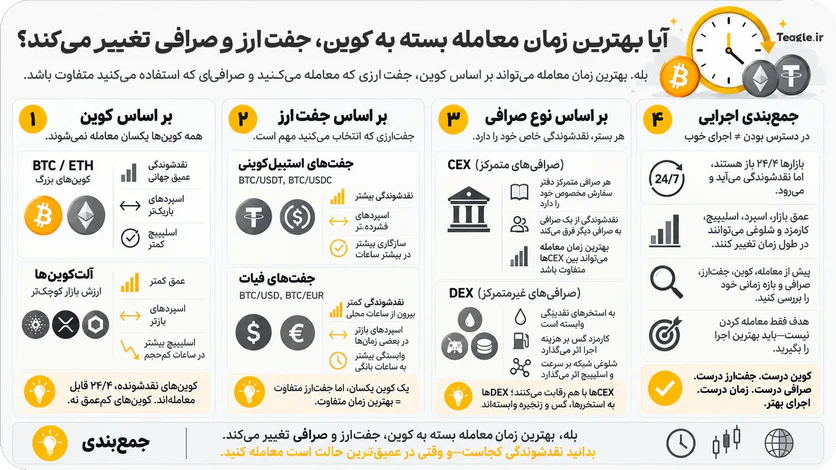
Does the best time to trade change by cryptocurrency, pair and exchange?
Yes. A pattern you see for Bitcoin won't necessarily repeat for Ethereum, a small altcoin, another pair or even the same pair on another exchange. Liquidity is spread across exchanges, fiat pairs, stablecoins and on-chain pools.
How the right time to trade Bitcoin and Ethereum differs from altcoins
Bitcoin and Ethereum usually trade on more markets with greater depth, so their liquidity is usually more resilient to shifts in regional activity. Small altcoins, on the other hand, may face thin order books and more slippage during quiet hours.
How stablecoin and fiat pairs differ in trading time
Pairs like BTC/USDT, BTC/USDC, BTC/USD and BTC/EUR are not the same market. Their traders and liquidity sources differ. Stablecoin pairs usually have more constant participation from crypto-native traders, while fiat pairs can show more regional activity.
How trading conditions differ on centralized and decentralized exchanges
Two centralized exchanges can have different spreads and depth for the same coin at the same moment. On DEXs, besides pool liquidity, network fees, blockchain congestion and the trade execution structure also matter. So a DEX being available 24/7 doesn't mean conditions are right for executing a large order.
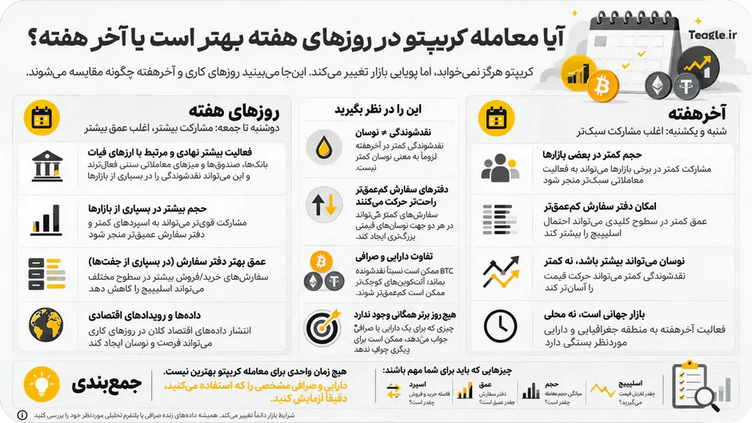
Is crypto trading better on weekdays or weekends?
Crypto is active on Saturday and Sunday too, but weekend market conditions can differ from weekdays. Reduced banking activity and some institutional activity may lead to lower volume or order book depth in some markets.
How do crypto market liquidity and volatility differ on weekends?
Lower volume doesn't necessarily mean lower volatility. When the order book is thin, there are fewer orders to absorb buying and selling pressure, and even a relatively large order can move the price more. This effect is usually more noticeable in low-volume altcoins.
Is there a particular day of the week that is best for trading crypto?
It cannot be reliably said that Tuesday, Friday or Sunday is always the best day to trade crypto. Weekly patterns change with the market cycle, asset type, exchange and the period studied. Historical data can be a hypothesis to test, but it does not guarantee future performance.
What other timing factors affect crypto trading?
Regional trading hours are not the only important timing factor. In crypto trading, funding payment times, the daily candle boundary, contract expiries and economic data releases can also affect market activity or trading costs.
Funding payment times in perpetual futures
In perpetual futures contracts, the funding rate helps keep the contract price aligned with the spot market. Depending on the funding rate, a trader holding an open position at the funding evaluation time may pay or receive an amount. Funding timing depends on the exchange and the contract; for example, OKX uses eight-hour intervals for many contracts, but not all contracts necessarily follow the same schedule.
What time does the daily crypto candle close?
The crypto market does not actually close each day; charts divide continuous trading into time intervals. On many charts, 00:00 UTC is the boundary between two daily candles, but exchange or chart settings can differ. When comparing daily indicators, check the chart's time zone.
Options expiries and major economic data releases
Futures and options expiries can change market activity as positions are closed, hedged or rolled over. Releases such as US CPI, the jobs report or central bank decisions can also cause rapid moves in Bitcoin and other risk assets.
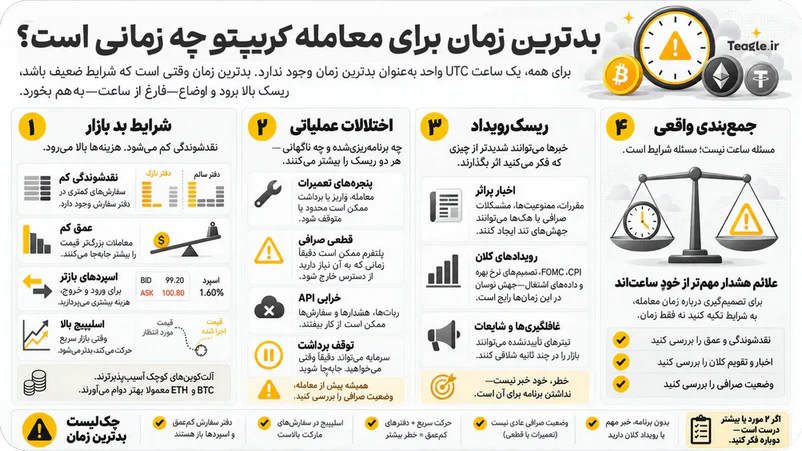
When is the worst time to trade crypto?
Just as there is no single universal best hour to trade, no specific hour can always be considered the worst time. The more important warning signs are low liquidity, wide spreads, high slippage and exchange disruptions.
- Low liquidity and wide spreads
When the order book is thin, even a medium-sized order can sweep through several price levels and cause significant slippage. A wide spread also raises the cost of entering a trade. A combination of low volume, thin depth, wide spreads and rapid price changes is usually a more important warning than the hour itself.
- Exchange maintenance and disruptions
A 24/7 market can also face outages. Maintenance, matching engine failures, API downtime or blockchain network disruptions can interfere with trade execution or asset transfers. Before a time-sensitive trade, check the exchange's current status and maintenance schedule.
- Trading during major events without a trading plan
Volatility becomes more dangerous when a trader enters the market without an execution plan and risk management . Unconfirmed news, economic data, cascading liquidations or exchange disruptions can cause rapid moves and poor order execution.
How to find the best crypto trading hours for your strategy
The best approach is to test suitable hours for the specific asset, pair and exchange you actually trade on, rather than relying on a general rule.
Checking liquidity, spread, trading volume and volatility
- Choose the exact asset and trading pair.
- Check the same exchange or DEX you use to execute orders.
- Compare hourly trading volume over a meaningful period.
- Record and compare spread and order book depth during those same hours.
- Record the expected price and the actual execution price to check slippage.
- Compare weekday performance with Saturday and Sunday.
- See whether the pattern holds across different market conditions or only applied to a specific period.
- The main criterion should match your trading style: scalpers focus more on spread and slippage, momentum traders on volume and volatility, and traders with large orders on market depth.
Converting UTC to local time
UTC is a good reference for comparing crypto trading hours because it does not shift with daylight saving time. Once you find a suitable window in UTC, convert it to your local time and recheck it when the financial regions you follow change their clocks for daylight saving.
Choosing trading hours that suit your trading style
Scalpers are more sensitive to execution quality, because spread and slippage repeat across a large number of trades. Day traders usually want a mix of liquidity and volatility. Swing traders are less sensitive to the exact entry time, since they hold positions for several days. Long-term investors are also usually not sensitive to minor differences in trading time, although large orders still depend on market depth.
Conclusion: there is no universal best hour to trade crypto!
The crypto spot market is usually active continuously, but execution conditions change throughout the day. Liquidity, volume, volatility, market depth, regional activity and major events can make trading conditions better or worse. The Europe–US overlap can be an interesting window for examining the major BTC and ETH pairs, but it cannot be considered the best trading time for every trader. Your asset, trading pair, exchange, order size and strategy determine which conditions suit you best.
The best approach is to view the hour as an execution filter, not a buy or sell signal. The hour tells you when you can trade; but liquidity, spread, market depth, slippage and volatility determine how well that trade can be executed.
Article source: Coin Bureau — Crypto Trading Hours: What Is the Best Time to Trade Crypto?
Contents of this article


Related articles


User reviews

Newest
 Upload image