
A Guide to Risk Management in Trading: 6 Ways to Control Losses and Protect Your Capital

Author
Arezoo Ghoochani
Published
 2026/09/05
Updated
2026/10/25
Reading time
9 دقیقه


In everyday life we are always dealing with risk, from crossing the street to buying insurance! In the financial markets, risk management is also vital to a large extent; it refers to a structured set of actions for identifying, assessing and managing potential losses. For traders and investors in the crypto market, risk management means controlling their exposure to financial risks before losses occur, rather than only thinking about solutions after taking a loss. In this guide, we first look at the risk management process, then cover the main types of risk in the crypto market and common methods for controlling losses.
The Risk Management Process: From Identifying Risk to Ongoing Control
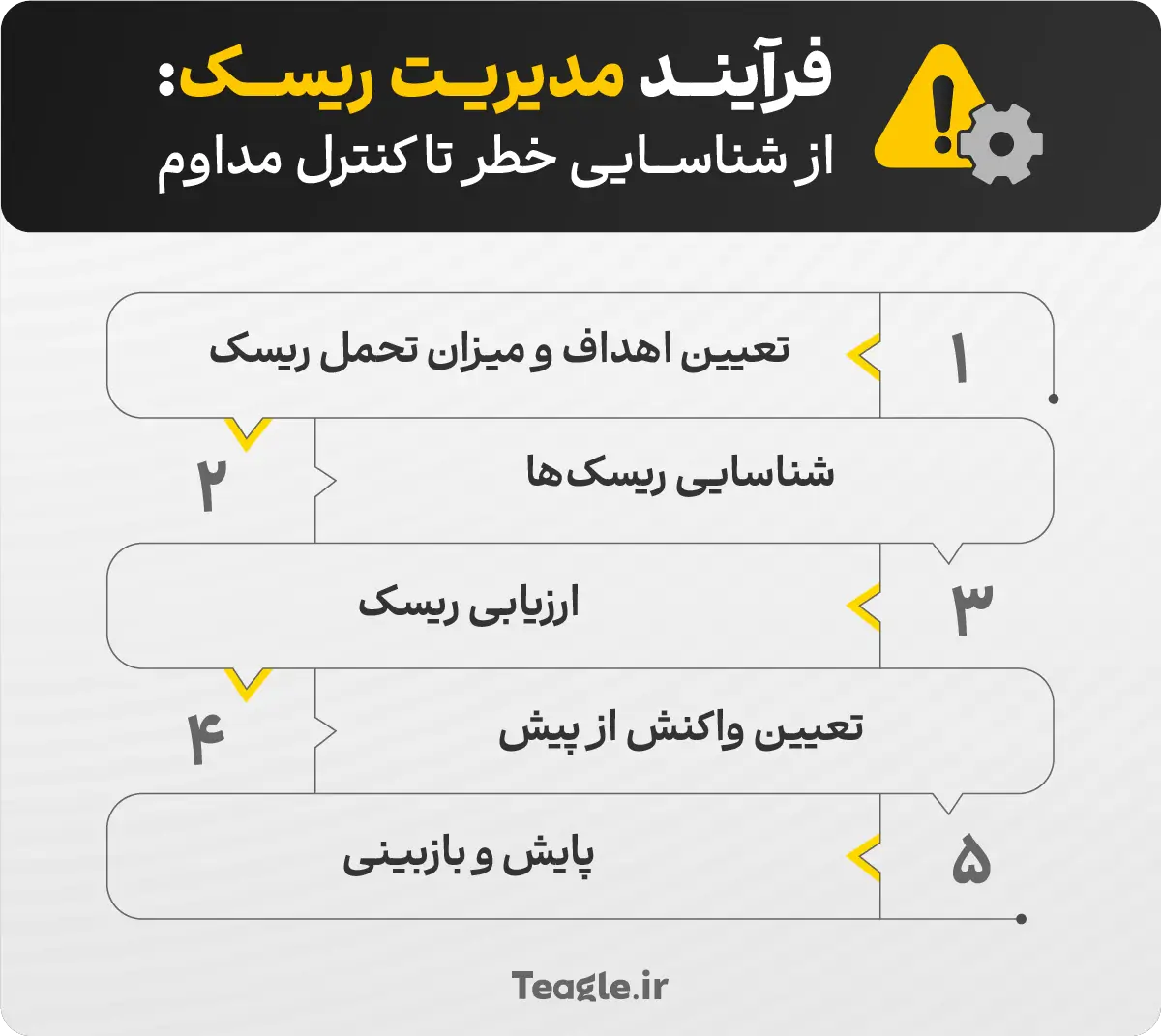
Risk management in trading is not a one-time decision; it is an ongoing process that can be followed in five main stages.
- Setting Goals and Risk Tolerance
First, you need to define what you want from your activity in the market. Is your goal long-term investment and gradual wealth growth, or are you looking to profit from short-term trades? A conservative investor usually prefers lower volatility at the cost of accepting potentially lower returns, while an aggressive trader may accept a larger drawdown to achieve higher returns. Knowing the right approach for your circumstances and personality affects many of your later decisions.
- Identifying Risks
Next, you need to identify the risks your strategy faces. These risks are not limited to price volatility and can include an exchange's financial problems, smart contract vulnerabilities, regulatory changes and simple user errors, such as sending assets to the wrong address.
- Assessing Risk
For each risk, examine two things: the likelihood of it happening and the severity of its consequences. Market price corrections may be relatively common and vary in severity; by contrast, a wallet hack may happen less often, but if it does, it can cause a very heavy loss. This assessment helps you focus your resources and time on the more important risks first.
- Deciding Your Response in Advance
For each risk, it is best to decide how you will respond before it happens. Setting a stop loss before entering a trade, keeping long-term assets in a hardware wallet and choosing DeFi protocols that have independent security audits are examples of this approach. Planning ahead means you make fewer emotional decisions in the middle of a crisis or sharp volatility.
- Monitoring and Review
Finally, you should regularly check whether your risk management framework is still effective. The crypto market is active around the clock and conditions can change quickly. A strategy that performs well in a bull market may need adjusting during a prolonged downtrend. Regular review lets you adapt to new conditions without making hasty changes.
The Concept of Financial Risk and Types of Risk in Financial Markets
Market risk refers to the possibility of an asset losing value as a result of overall market conditions and price fluctuations. One common tool for controlling this risk is the stop loss; an order that can automatically close a position when the price reaches a specified level. A trailing stop can also preserve part of the profit made during uptrends while protecting the position against a sudden price reversal.
What Is Liquidity Risk?
Liquidity risk arises when you cannot buy or sell an asset quickly enough without significantly affecting its price. This problem is more common with low market cap tokens or meme coins that have shallow order books. Trading in markets with high volume and a narrower gap between bid and ask prices can reduce this risk. Checking an asset's 24-hour trading volume before entering a trade is also a useful habit.
Credit and Counterparty Risk: From Exchanges to Lending Platforms
Counterparty risk used to relate mostly to the possibility of borrowers defaulting, but in the crypto market it can also include platform risk; that is, the possibility of an exchange or lending platform going bankrupt or being unable to meet its obligations. The collapse of FTX and Celsius in 2022 showed how quickly this type of risk can turn into a real loss. Checking a platform's transparency and proof-of-reserves reports can help assess this risk. For long-term holding, a hardware wallet also reduces dependence on a third party.
Operational and Technical Risk
This category includes human errors and technical problems. Blockchain transactions are usually irreversible, so entering the wrong address can lead to the permanent loss of assets. Double-checking the address before confirming a transaction, enabling two-factor authentication (2FA) on exchange accounts and keeping software and firmware up to date are simple steps to reduce this risk.
Smart Contract Risk in DeFi
In DeFi, smart contract risk refers to the possibility of a bug or vulnerability in a protocol's code; a problem that, if exploited by attackers, can lead to loss of funds. To reduce this risk, it is better to use protocols that have undergone thorough security audits by independent firms and whose audit reports are publicly available. A project's audit history can usually be checked in its documentation or repository.
Systematic Risk: When the Whole Market Falls Together
Systematic risk occurs when a large part of the market falls at the same time. Since many crypto assets are highly correlated with Bitcoin during extreme market periods, buying a large number of altcoins does not necessarily mean real diversification. To reduce this type of risk, you can allocate part of your portfolio to assets that behave differently, such as certain stablecoins, tokenized gold or fiat currencies. Of course, stablecoins are not risk-free either, and events such as losing their peg to the underlying asset (Depeg) can cause losses.
6 Practical Methods for Managing Risk in Trading and Investing
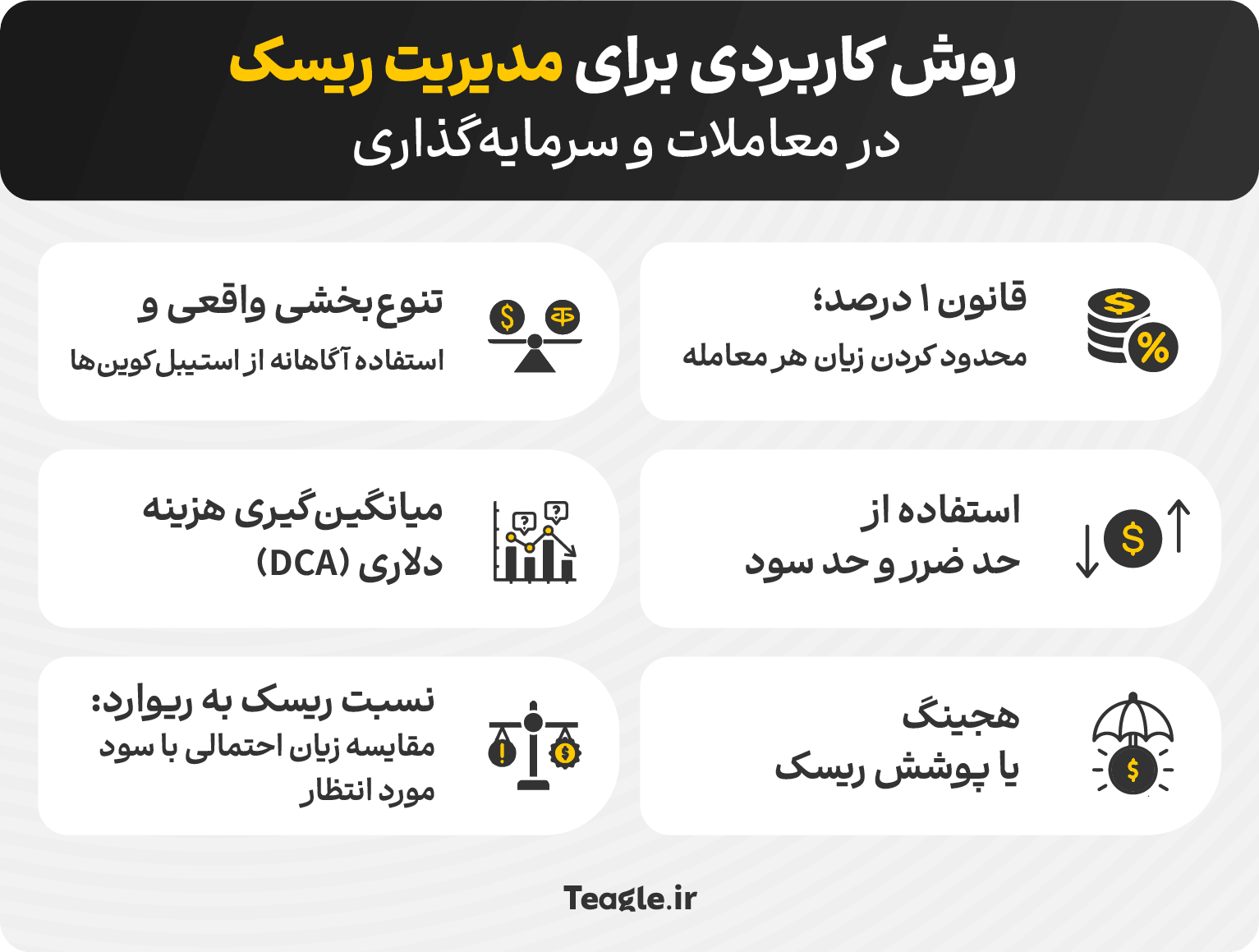
1. The 1% Rule: Limiting the Loss on Each Trade
The 1% rule says you should set up each trade so that if your stop loss is triggered, your loss does not exceed 1% of your total account value. The key point is that «position size» is not the same as «risk amount». Position size is the total capital you put into a trade, while the risk amount is the loss you take if your stop loss is triggered. For example, if your account balance is $10,000, under this rule the trade should be structured so that its maximum potential loss is $100. This approach helps ensure that a few consecutive losing trades do not wipe out a large part of your capital.
2. Using Stop Loss and Take Profit
A stop loss (Stop-Loss) closes a trade when the price moves against your expectation and reaches a specified level. A take profit (Take-Profit) is triggered when the price reaches your profit target. Setting these levels before entering a trade means that during sharp market volatility, your decisions are less influenced by fear, greed or hope of a price recovery.
3. Hedging
Hedging means opening offsetting positions to reduce your net market exposure. For example, someone might hold a long-term Bitcoin position in a cold wallet and, alongside it, open a smaller short position in the futures market to offset part of the impact of a possible short-term price drop. The goal of hedging is not necessarily to profit from both positions; rather, it is to reduce the impact of adverse market moves on the main asset.
4. Real Diversification and Informed Use of Stablecoins
Holding several altcoins does not necessarily create real diversification. If most of the assets in your portfolio fall at the same time when Bitcoin drops, having many assets does not necessarily reduce risk in a meaningful way. More genuine diversification happens when part of your capital is placed in less correlated assets, such as certain stablecoins, tokenized gold or fiat currencies. Of course, each of these assets has its own specific risks and should be assessed separately.
5. Dollar-Cost Averaging (DCA)
Dollar-cost averaging suits investors who prefer to invest a fixed amount at regular intervals instead of trying to identify the best entry point. For example, buying a set amount of Bitcoin every week averages out the purchase price over time and reduces the investor's reliance on accurately predicting the market bottom. That said, DCA does not eliminate market risk or guarantee profit either.
6. Risk-to-Reward Ratio: Comparing Potential Loss with Expected Profit
The risk-to-reward ratio compares a trade's potential loss with its potential profit. A 1:2 ratio means the trader targets two units of profit for every unit of risk taken. Many traders use ratios of at least 1:2 or 1:3 as one of their entry filters; that is, if a trade setup does not offer enough profit potential relative to its potential loss, they skip it. However, the risk-to-reward ratio alone does not guarantee profitability and should be considered alongside win rate, strategy quality and market conditions.
Frequently Asked Questions About Risk Management in Financial Markets
What is risk management in the crypto market?
Risk management in the crypto market is the process of identifying and preparing for potential losses before they happen. It involves setting goals, using tools such as stop losses and position sizing, protecting assets against technical and platform risks, and continuously reviewing your trading approach.
What is the 1% rule in trading?
This rule states that each trade should be structured so that no more than 1% of total trading capital is lost if the stop loss is triggered. So the 1% rule does not necessarily mean limiting position size; rather, it is about calculating position size in proportion to the stop-loss distance.
What are the most important risk management principles for beginner traders?
For new traders, the most important steps are setting stop losses on trades, not committing more capital than they can afford to lose, storing long-term assets securely, and learning risk management principles before increasing their capital.
How does diversification reduce crypto market risk?
Diversification can reduce the impact of one asset's poor performance on the overall portfolio. However, in the crypto market, simply holding a large number of altcoins does not count as full diversification, because many of them move in the same direction during broad market downturns.
How can smart contract risk be reduced?
One of the most important steps is using protocols that have been audited by independent, reputable security firms and whose audit reports are publicly available for review. Limiting the amount you hold or deposit in any single protocol can also reduce your exposure to any one risk.
Original source: Binance Academy — A Beginner’s Guide to Risk Management
Contents of this article


Related articles



User reviews

Newest
 Upload image