
What Is Hedging and Who Is It Suitable For?

Author
Admin
Published
 2026/03/10
Updated
2026/10/25
Reading time
5 دقیقه


Risk has always come with either profit or loss. In the forex world, one of the best methods we can recommend to you traders for controlling risk is risk hedging, or hedging. Hedging is a trading strategy that allows traders to partly reduce the impact of sudden market swings and have better control over the risk of their trades. Teagle intends to examine hedging in forex and how to use it in precise detail for you, so stay with our team until the end of this article.
What Is Hedging in Forex?
A forex hedge, or hedging in forex, is a strategy aimed at reducing or managing risk in currency trading. Hedging is an approach used by investors, businesses and traders, from beginners to professionals.
Long-term traders use hedging to partly control the impact of sharp market swings. Investors who make short-term trades can also manage the risk of their trades by hedging. Key points about risk hedging include the following:
1) Having a proper understanding of market conditions and how volatility affects trades
2) The timing of the hedge is very important, because any delay changes the profit or loss.
3) Keep in mind that hedging does not eliminate market and trading risk; it only reduces it.
Types of Hedging Strategies (Hedging) in Forex
In forex, there are various hedging strategies, and the choice depends entirely on the trader's goals, the type of asset and the risk management approach. Below, we review the types of hedging strategies (Hedging) in forex.
Direct Hedging
This is the most common and simplest type of hedging. In this method, you take an opposite position on exactly the same currency pair on which you have an open trade. For example, if you have a 1-lot buy on EUR/USD, you also open a 1-lot sell. In this case, the impact of price movement in the market is reduced, and the profit and loss of the two positions largely offset each other. However, keep in mind that costs such as spread, commission or swap can affect the final result of the trade.
Currency and Currency Pair Hedging
In this method, the trader uses hedging with a related currency. For example, if a trader has a buy on the currency pair EUR/USD but is worried about the US dollar strengthening, they can open a sell position on a currency pair such as GBP/USD in which the dollar is involved. If the dollar strengthens, the price drop in the second pair can offset part of the loss on the first trade. In this case, the trader uses the correlation between currencies to protect earlier trades. This type of hedging is also called cross hedging .
Hedging with Derivatives
Risk hedging in financial markets can also be done with derivatives. Instruments such as options(Options), futures contracts (Futures) and swap contracts (Swaps) are among the instruments used for risk management.
Professional traders, financial institutions and international companies usually use these instruments to reduce risks such as exchange rate fluctuations, interest rate changes or commodity price changes. With these instruments, the impact of sharp market swings on capital or business costs can be partly prevented.
What Is the Difference Between a Hedging Account (Hedging) and Netting?
Trading platforms such as MetaTrader have two types of trading systems: the hedging account and the netting account. Hedging and netting accounts are two different methods of managing and recording trades.
In a hedging account, the trader can hold several buy and sell positions on one asset at the same time; that is, if they open a buy position on, for example, the currency pair EUR/USD , they can also take a separate sell position, and both trades are recorded and managed independently. This feature is very useful for risk hedging strategies, since the trader can reduce volatility risk with an opposite position. In contrast, in a netting account all positions on one asset are aggregated and netted; that is, if the trader opens a buy position and then a sell, the system automatically offsets them against each other and keeps only the net result (Net position). In other words, a hedging account suits flexibility and precise risk control, while a netting account is used for simplicity and faster calculation of the overall trading position.
What Are Risk Hedging Instruments?
In the volatile world of financial markets, risk management plays a vital role. Risk hedging instruments are solutions that investors and traders use to protect their portfolios against unwanted price swings, which we will cover below.
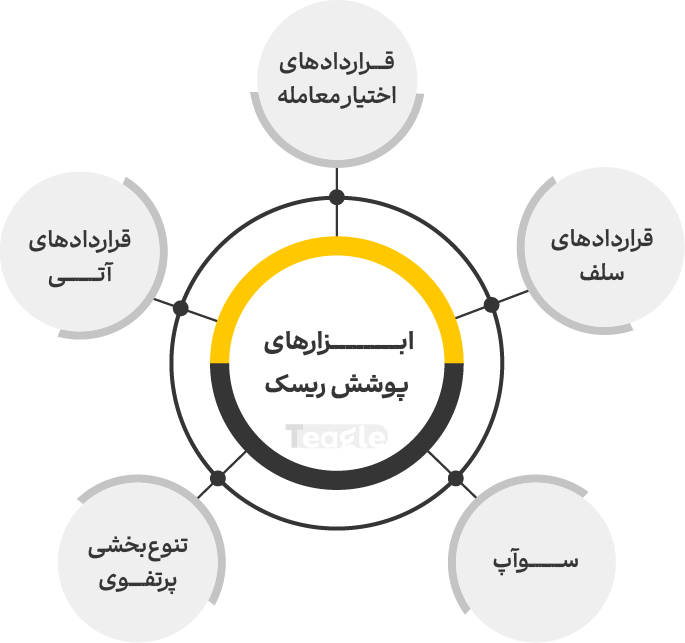
1. Futures Contracts
These contracts are agreements to buy or sell an asset in the future at a set price.
Feature: Standardized and tradable on futures exchanges.
Use in hedging: If a company expects a commodity's price to rise, it can enter into a futures buy contract to lock in the price.
Example: A wheat producer enters into a futures contract to sell wheat in order to sell its crop in the future and protect against a possible price drop.
2. Options Contracts
They give the holder the option to buy or sell an asset in the future at a set price, without the obligation to trade.
Feature: Flexible, limited risk (only the option premium).
Use in hedging: Companies use call or put options to protect themselves from adverse changes in exchange rates or commodity prices.
Example: An importer can hold a call option on the dollar so that if the exchange rate rises, its import loss is offset.
3. Forward Contracts
Private contracts between two parties to buy or sell an asset in the future at an agreed price.
Feature: Non-standardized and usually concluded between companies and banks.
Use in hedging: For hedging exchange rate or commodity price risk.
Example: An Iranian company that must pay in euros in three months enters into a contract with a bank to buy euros at a set rate to protect against a price increase.
4. Swaps
A contract to exchange cash flows or rates between two parties for a set period.
Types: Interest rate swap, currency swap, commodity swap.
Use in hedging: Companies use swaps to exchange interest rates or the currency of payment with a counterparty and keep their costs stable.
Example: A company with dollar debt can do a currency swap with another company to convert the payment into rials and reduce dollar volatility risk.
5. Portfolio Diversification
Although diversification is not considered a contractual instrument, it is one of the oldest risk management methods. In this method, the investor spreads their capital across several different asset baskets to control the overall risk of the portfolio .
Feature: Reducing risk by spreading capital across several different assets with low correlation.
Example: An investor holds part of their capital in gold, part in stocks and part in currency so that a loss in one is offset by growth in another.
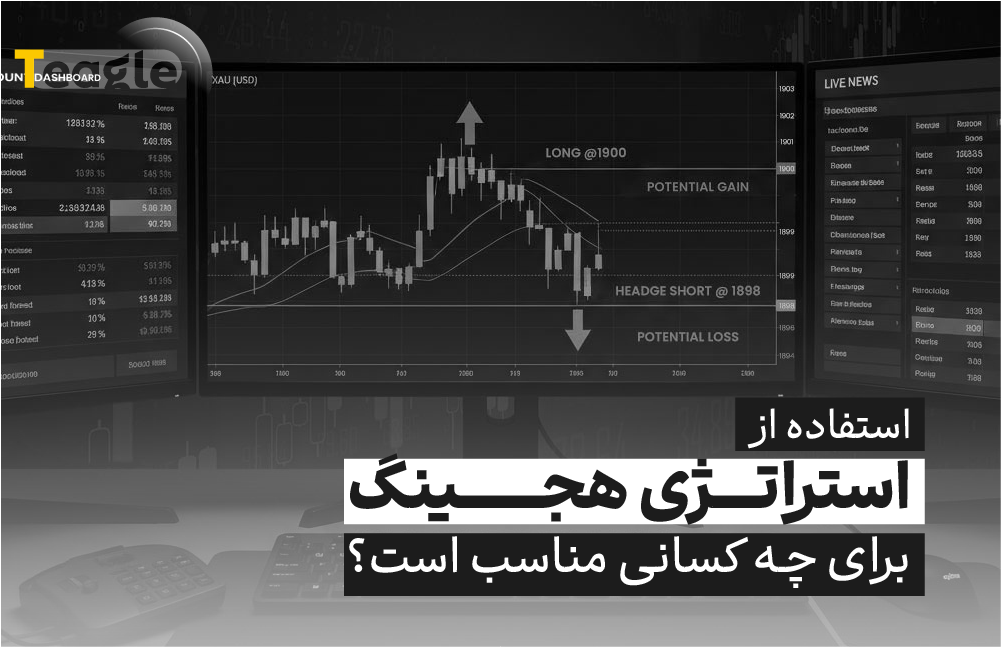
Who Is the Hedging Strategy Suitable For?
Hedging in trading is not an absolute rule and is not recommended for everyone; it is useful when a trader or an organization wants to guard against large price swings.
1. International companies: to lock in exchange rates in foreign transactions
2. Professional forex traders: to protect profits during short-term volatility
3. Long-term investors: to reduce the impact of financial crises
4. Hedge fund managers: to improve the return-to-risk ratio
Keep in mind that hedging done wrong can reduce profitability and even lock up your capital, so before taking any action, make sure you have a precise and thorough understanding of the market and risk management.
Tips for Success with a Hedging Strategy
If you want to succeed with a forex hedging strategy, prioritize a few key points:
1. Know your assets and their correlations well: Positive or negative correlation between currency pairs can determine how effective a hedge is in a trade.
2. Set a clear goal for the hedge: Is the goal to protect current profits or to prevent further losses?
3. Get the timing right: Entering a hedge at the wrong time sharply reduces returns.
4. Use technical and fundamental tools: Keep this in mind, because they are very effective in identifying the right time to hedge in trading.
5. Monitor positions continuously: As you know, market conditions are constantly changing, so hedges must always be reviewed.
Frequently Asked Questions About Risk Hedging
What are the benefits of hedging in trading?
- Reduced swings in profit and loss
- Capital protection during unstable market periods
- Greater confidence in financial decisions
- Helps with planning and improving investment
- Protecting principal against sudden market crashes
- Lower chance of a margin call
- Buying time to correct a trading mistake
How is risk managed in hedging strategies?
Risk management means exercising control to reduce the impact of potential losses in trading. In hedging strategies, this is usually done by combining trading positions and setting an appropriate size for each position.
In other words, by opening positions that partially offset each other, the trader tries to reduce the impact of sharp market swings on their capital. Choosing the right trade size and continuously reviewing market conditions also play an important role in the success of this approach.
What Is Delta Hedging?
Delta hedging is an advanced risk hedging method used mostly in options trading. In this method, the sensitivity of the option price to changes in the price of the underlying asset (delta) is calculated, and based on that, trading positions are adjusted so that the risk from price swings in the underlying asset is largely reduced.
Put more simply, delta hedging makes a trading portfolio more resilient to small price moves, so that a rise or fall in the price of the underlying asset is offset by other positions. However, this strategy requires constant rebalancing and does not fully eliminate all market risks.
Contents of this article


Related articles

User reviews

Newest
 Upload image