
Managing Trading Portfolios and Investment Baskets in Financial Markets

Author
Admin
Published
 2026/06/01
Updated
2026/10/25
Reading time
5 دقیقه


An introduction to trading portfolios and portfolio management in financial markets
Success in financial markets comes from careful planning, proper risk management and a full understanding of the field's basic concepts. One of the key concepts in financial markets is the portfolio, or investment basket, and portfolio management. In this article, we try to take a close look at what a trading portfolio is, and also get to know its types and how to use portfolio management strategies in various markets such as the stock market and crypto.
What does portfolio mean? (Definition, pronunciation and concept in simple terms)
Put simply, the word portfolio (Portfolio), whose Persian equivalents are «asset basket» or «stock basket», essentially refers to a collection of financial assets that a trader has put together with the goal of making a profit. Continuing with the meaning and pronunciation of portfolio, we should note that the word's roots go back to French (Portefeuille), and in financial markets it is pronounced «portfoy» in Persian. It is worth mentioning that the words «portfolio» and «portfoy» have the same meaning.
To better understand what a portfolio is, in simple terms: when we invest all our capital in just one stock or one particular asset, we drastically increase our risk of loss and our exposure, because if the price of that stock or asset falls or crashes, our entire capital is at risk. But in a trading portfolio, we hold a mix of different assets in our basket, including shares of several companies, gold, cryptocurrencies, currency pairs and even cash. This way, if some of our assets drop in price, another part of the assets in the portfolio that has turned a profit can offset the resulting loss and keep the overall return at an acceptable level.
Types of investment portfolios
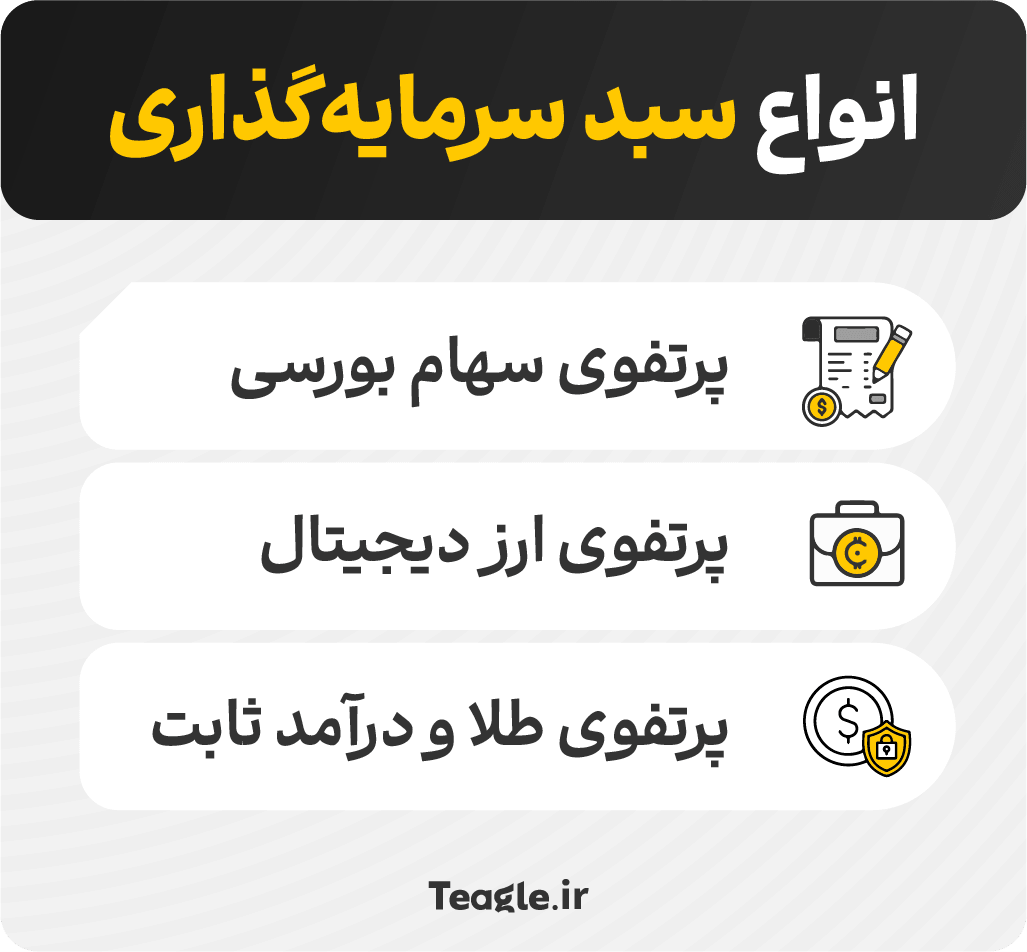
Depending on our financial goals and the risk management we have in mind, we can build different types of investment portfolios. These portfolios can be categorized by the type of assets they hold or by their strategy, which we cover below:
Stock market portfolio
This type of portfolio consists of a collection of shares of public companies listed on the Iranian stock exchange. The main goal of building a stock portfolio is to pick stocks from different industries such as petrochemicals and oil, banking, automotive, etc., so that a stock market portfolio reduces the risks caused by fluctuations in any single industry and, overall, turns a profit. For example, we put the banking stock «Vbmellat» alongside the automotive stock «Khodro» and the petrochemical and oil stock «Shbandar» in our stock portfolio.
Crypto portfolio
If we are looking for a crypto portfolio (cryptocurrency basket) or a dollar-based portfolio, this section is especially important. Because of extreme volatility, high liquidity and the dependence of some coins on news, we need a comprehensive crypto investment portfolio in the cryptocurrency market. In general, the best crypto investment portfolio usually includes a mix of the following:
- Leading coins to keep the portfolio stable (such as Bitcoin and Ethereum)
- Stablecoins to preserve the dollar value of capital (such as Tether and USD Coin)
- Altcoins for greater growth potential (such as Ripple and Cardano)
Gold and fixed-income portfolio
A gold portfolio can be a combination for reducing risk and preserving the value of our assets. Having gold in the portfolio helps us protect part of our capital against inflationary swings. On the other hand, a gold fund portfolio is also a good choice for those who want to profit from gold market movements without buying physical gold. In addition, combining gold with fixed-income assets creates an excellent balance between return and safety. For example, including fixed-income funds alongside gold can form the safe, risk-free, profit-generating part of our basket, creating a steady cash flow for the portfolio during market downturns.
How do we build an investment portfolio?
Building a suitable investment portfolio is one of the most important steps we take for asset risk management and for achieving good, sustainable returns. By choosing the right assets and managing the portfolio, we can invest properly and protect our trading portfolio from market volatility. Below are the steps for optimizing an investment portfolio:
Setting financial goals and risk tolerance
Before doing anything, you should determine what our goal for investing is. Are we after long-term capital growth, or is our goal a steady monthly income? On the other hand, our risk tolerance depends on factors such as age, financial obligations, personality type, amount of capital, etc. These variables determine the type of investment portfolio (aggressive, defensive, etc.). For example, an 18-year-old who is about to enter the world of financial markets and earning an income usually has a higher risk tolerance than someone close to retirement and can hold an aggressive portfolio.
Selecting and combining assets
After setting the strategy, it is time to choose suitable assets for the portfolio. We should choose assets that are inversely correlated with each other. In other words, when one asset drops in price or value, the other stays flat or grows. For example, an investment portfolio that combines stocks and gold is considered a good asset mix.
Diversifying the investment portfolio
Portfolio diversification (Diversification) is one of the key topics in portfolio management. We should not focus on just one asset, one specific financial area or one particular industry. Spreading capital across different asset classes (stocks, crypto, gold, etc.) as well as across different industries on the Tehran Stock Exchange reduces portfolio risk to an acceptable level, although other factors also affect profitability.
How to manage a trading portfolio
Managing a trading portfolio plays an important role in controlling risk and optimizing returns. Portfolio management is not a one-off action but an ongoing process, also known as portfolio management or asset management. By reviewing market conditions, managing trading positions, diversifying assets and making sound decisions, we can improve our investment performance. Below we look at portfolio management and how it is done:
Setting take profit and stop loss
Discipline is the first step in managing a trading portfolio. Setting take profit and stop loss levels is a trading essential. These tools help us stay away from emotional decisions and execute our trading positions based on analysis and logic.
Calculating portfolio risk and return
Calculating portfolio risk and return is one of the main foundations of our capital management, because it shows us how vulnerable an investment portfolio can be to market swings and, on the other hand, how much profit it can bring us.
To calculate portfolio return, we multiply each asset's return by its weight in the portfolio and add them up. For example, if 60% of the portfolio is in an asset with a 10% return and 40% in another asset with a 5% return, the average portfolio return is about 8%. For risk, the volatility of returns is generally measured; for example, if an asset's price keeps swinging between 900 and 1200 Toman over time, its risk is higher than an asset that only moves between 980 and 1020 Toman. That is why, when building a portfolio, both return and volatility should always be considered together.
Optimizing and continuously reviewing the portfolio
Market conditions have never stayed the same over time. Assets that led the market last year may have stagnated this year. For this reason, we need to review our investment portfolio at different intervals, for example once every 6 months or once a year, and if necessary, rebalance (Rebalance) it according to our intended strategy; that is, review the proportions between assets to maintain balance. This process can be done by selling some assets and buying other valuable assets.
What is portfolio risk and how can it be reduced?
Portfolio risk refers to the likelihood of a portfolio losing value due to factors such as market volatility and the poor, sometimes unexpected, performance of assets. As we mentioned earlier, the more capital is concentrated in a limited number of assets, the higher the portfolio risk usually is. That is why we should try to manage and control our portfolio's risk using various methods. In this section, we will cover the concept of portfolio risk and the most important ways to reduce it, including diversification and asset allocation management.
Types of Risk in an Investment Portfolio
In portfolio management, understanding the types of risk matters a lot. Each risk can affect our portfolio's performance in a different way. In general, investment risks fall into 2 main categories, systematic risks and unsystematic risks, and knowing them helps us make better decisions for managing the portfolio and reducing potential losses.
1. Unsystematic risk: A type of risk in financial markets that stems from the internal operations of a specific company or industry; for example, operational risks such as a fire on the company's production line, business risks such as large-scale layoffs of the company's workforce, or financial risks such as the loss of half of the company's capital.
2. Systematic risk (market risk): This is risk that affects the entire market, not just a single stock or asset, which is why it is generally called market risk. The outbreak of war or a change in interest rates can be among the market's systematic risks.
The Role of Diversification in Reducing Risk
By diversifying assets and spreading capital among them, we can reduce the likelihood of losses. In a diversified portfolio, the poor performance of one asset does not necessarily mean the whole portfolio declines, because other assets may perform better and offset part of the loss.
For example, if we concentrate all our capital in the shares of one company, one cryptocurrency or one currency pair, we may suffer a significant loss when its price drops. But if we divide our capital among stocks, cryptocurrencies, currency pairs, fixed-income funds, gold, etc., the negative impact of one asset's decline on the whole portfolio will be smaller. Although diversification cannot eliminate systematic risk, it can greatly reduce the severity of market shocks and give the investor peace of mind.
What Is a Real-Time Portfolio?
A real-time portfolio is a live, online view of our asset portfolio whose value changes instantly based on the latest live market prices. The difference between a real-time portfolio and a regular portfolio lies in timing and update speed; in a regular portfolio, asset values and our profit and loss are usually calculated at the end of the trading day. A real-time portfolio, however, lets us see our trades, portfolio value and current profit or loss in real time so we can make better trading decisions.
What Is the Best Investment Portfolio?
The answer to this question differs for each person, but some successful models can be suggested:
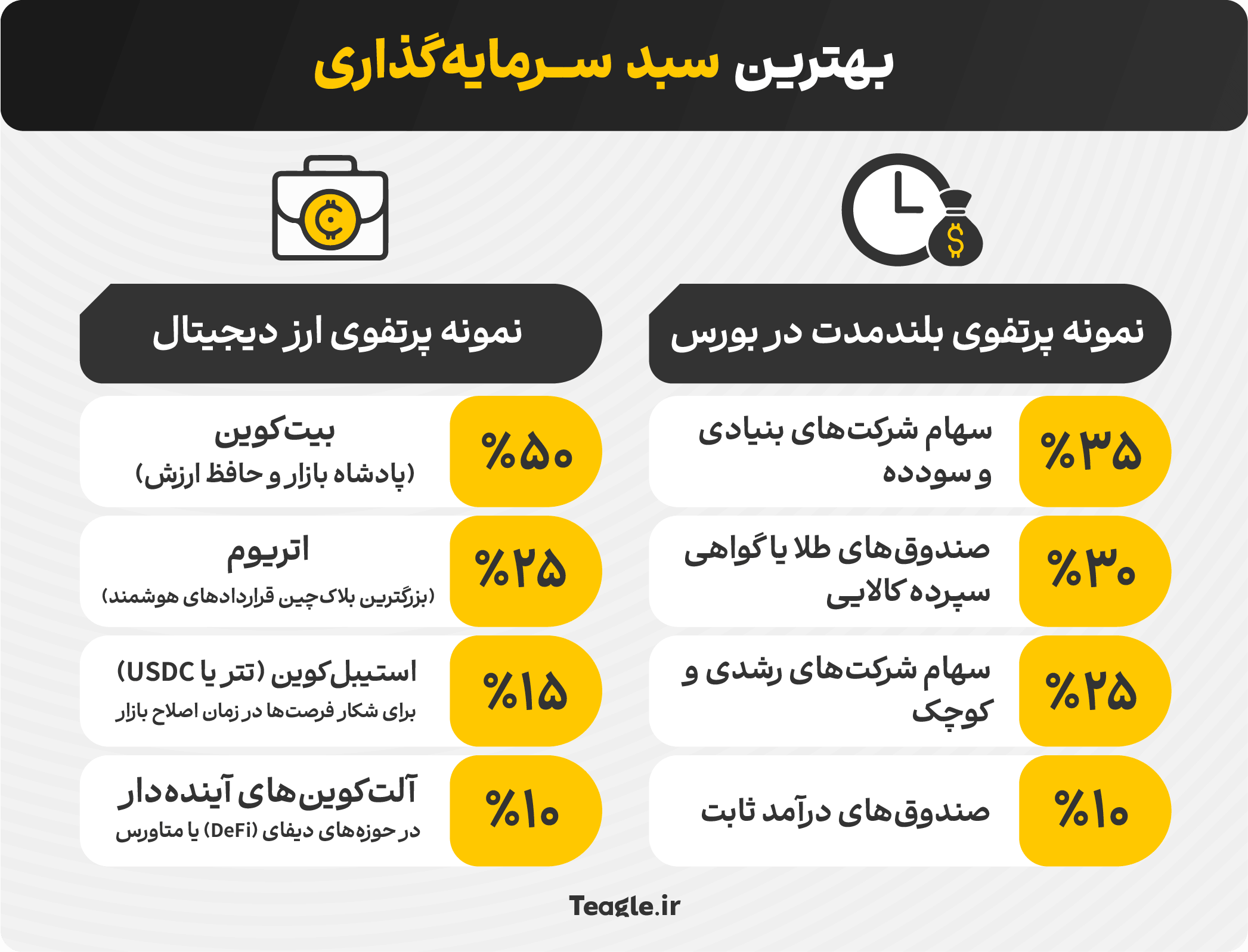
Sample Long-Term Stock Market Portfolio
For a long-term view (more than 3 years), the best stock market investment portfolio includes the following:
- 35% stocks of fundamentally strong and profitable companies: A focus on large, export-oriented, dollar-based companies with high dividend yields (D/P) and solid cash flow to keep the portfolio stable on down days in the market.
- 30% gold funds or commodity deposit certificates: (Increased share as the main defensive weight) In this portfolio, gold acts as a driving engine moving in step with the open-market dollar and the global ounce price, insuring the entire capital against hyperinflation cycles and the devaluation of the national currency.
- 25% growth and small-cap stocks: Smart selection of companies with low market capitalization or major expansion projects that have the potential for price surges distinct from the overall market.
- 10% fixed-income funds: Keeping a small portion of capital as Rial cash in fixed-income funds, solely to park money and have immediate buying power (ready liquidity) to pick up stocks at price bottoms.
Sample Crypto Portfolio
A balanced example of a crypto investment portfolio for a medium-risk investor could look like this:
- 50% Bitcoin (king of the market and store of value)
- 25% Ethereum (the largest smart contract blockchain)
- 15% stablecoins (Tether or USDC) to seize opportunities during market corrections
- 10% promising altcoins in the DeFi (DeFi) or metaverse sectors
Contents of this article


Related articles

User reviews

Newest
 Upload image