
What are centralised and decentralised exchanges and how do they differ?

Author
Admin
Published
 2026/03/10
Updated
2026/10/25
Reading time
5 دقیقه


Blockchain technology took financial transactions into a new phase and challenged the concepts of ownership, exchange and trust. The two categories of centralized and decentralized exchanges are also products of this technology; a centralized crypto exchange follows the traditional structure of financial transactions under the supervision of a specific legal entity, while a decentralized exchange seeks to decentralize away from any specific person or entity and establish individual sovereignty in carrying out trades. That is why understanding the difference between centralized and decentralized exchanges in terms of the structure, security and execution of these two models is essential, both for keeping our assets safe and for understanding trading strategies and the place of each of these exchanges in our trading, and these topics are exactly what we explore in this article.
What is a centralized exchange (CEX)?
A centralized exchange, known in English as a CEX (short for Centralized Exchanges), is a digital platform for exchanging cryptocurrencies and digital assets that is run by a specific private entity or company. The technical structure of a centralized exchange has many similarities with brokers in the stock or forex markets. Just as all our transactions with brokers are recorded and supervised, the same is true in a centralized exchange.
From the explanation above, we can conclude that a centralized exchange, as an intermediary for carrying out exchanges and trades, also holds and manages our assets; exchanges are committed to storing users' assets in software wallets (Hot Wallets) or hardware wallets (Cold Wallets) . Although such a service makes asset management easier for us, keep in mind that risks such as hacking, government and regulatory intervention, poor exchange management or fraud must always be taken into account.
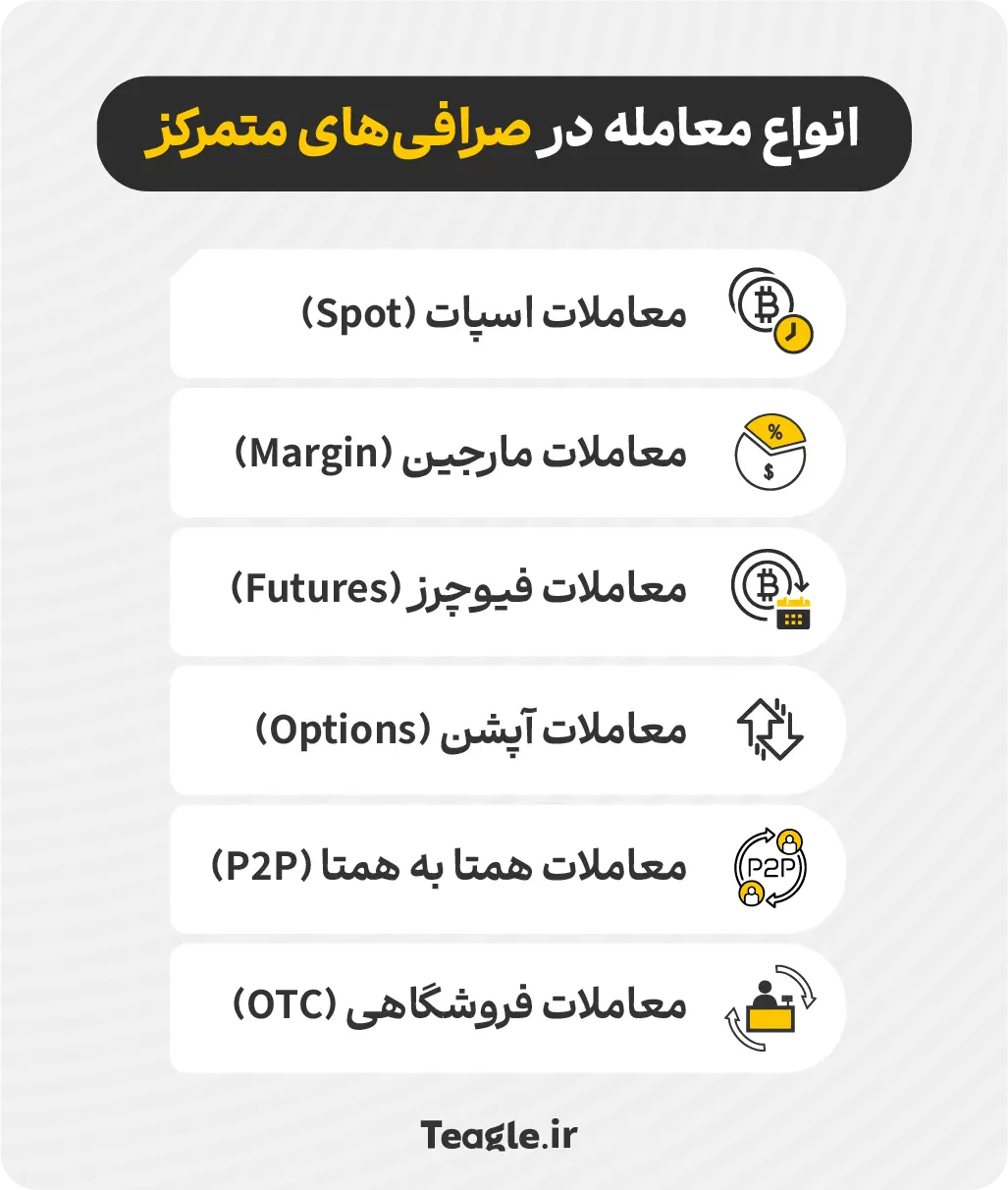
Types of trading on centralized exchanges
Thanks to their powerful, centralized server infrastructure, centralized exchanges can process a wide range of complex trading tools at very high speed. This variety of trading is one of the main reasons for the higher trading volume of centralized exchanges compared to decentralized ones. Note that not all centralized exchanges offer every type of trading listed below, and each exchange's approach is determined by its own rules and the laws of its country:
|
Trade type |
Mechanism and key features |
|
Spot trading (Spot) |
Buying and selling an asset at the market price, with ownership at the moment the trade is executed |
|
Margin trading (Margin) |
Trading with extra credit received from the centralized exchange by providing collateral |
|
Futures trading (Futures) |
Trading an asset at a set price in the future; with an obligation to execute the trade |
|
Options trading (Options) |
Trading the right to buy or sell an asset at a set price in the future; without an obligation to trade that asset |
|
Peer-to-peer trading (P2P) |
Trading assets between two users on the exchange's secure platform |
|
Over-the-counter trading (OTC) |
Trading directly with the exchange |
Pros and cons of centralized exchanges
Evaluating centralized exchanges requires a careful look at the balance between ease of trading and security of trading. Below, we review the pros and cons of centralized exchanges:
|
Pros |
Cons |
|
Liquidity and speed |
Possible security risk and hacking |
|
Ease of use and trading |
No full control over assets |
|
Ability to recover your account if you forget your password, etc. … |
No trading without identity verification |
|
Access to most trade types and advanced tools |
Possible vulnerability to restrictions and sanctions |
What is a decentralized exchange (DEX)?
A decentralized exchange, or DEX, is a type of exchange where trades are handled on-chain (On-chain) through specific automated code called smart contracts (Smart Contracts). In the decentralized model, no central entity or person supervises trades and digital assets are not transferred to the exchange's wallet; instead, they are traded directly from our personal wallet with the counterparty.
Most decentralized exchanges work with a mechanism called an automated market maker (Automated Market Maker - AMM), which makes it possible to trade cryptocurrencies without intermediaries through liquidity pools. A liquidity pool (Liquidity Pool) is a collection of digital assets locked in smart contracts to facilitate trading on decentralized exchanges. In this method, prices are determined by the ratio of assets in the «liquidity pools» (Liquidity Pools) using mathematical formulas.
Pros and cons of decentralized exchanges
Although decentralized exchanges have brought financial independence and privacy, they also face operational and cost challenges that make them unsuitable for some groups of users. In the table below, we list some of the pros and cons of decentralized exchanges:
|
Pros |
Cons |
|
Full control over assets |
Need to pay network fees (Gas fee) |
|
Ability to trade anonymously without identity verification |
Possible security bugs in smart contract code |
|
Global access on the blockchain without government interference |
No centralized, identifiable and responsive support |
|
Very wide variety of tokens in liquidity pools |
Low liquidity for some digital assets |
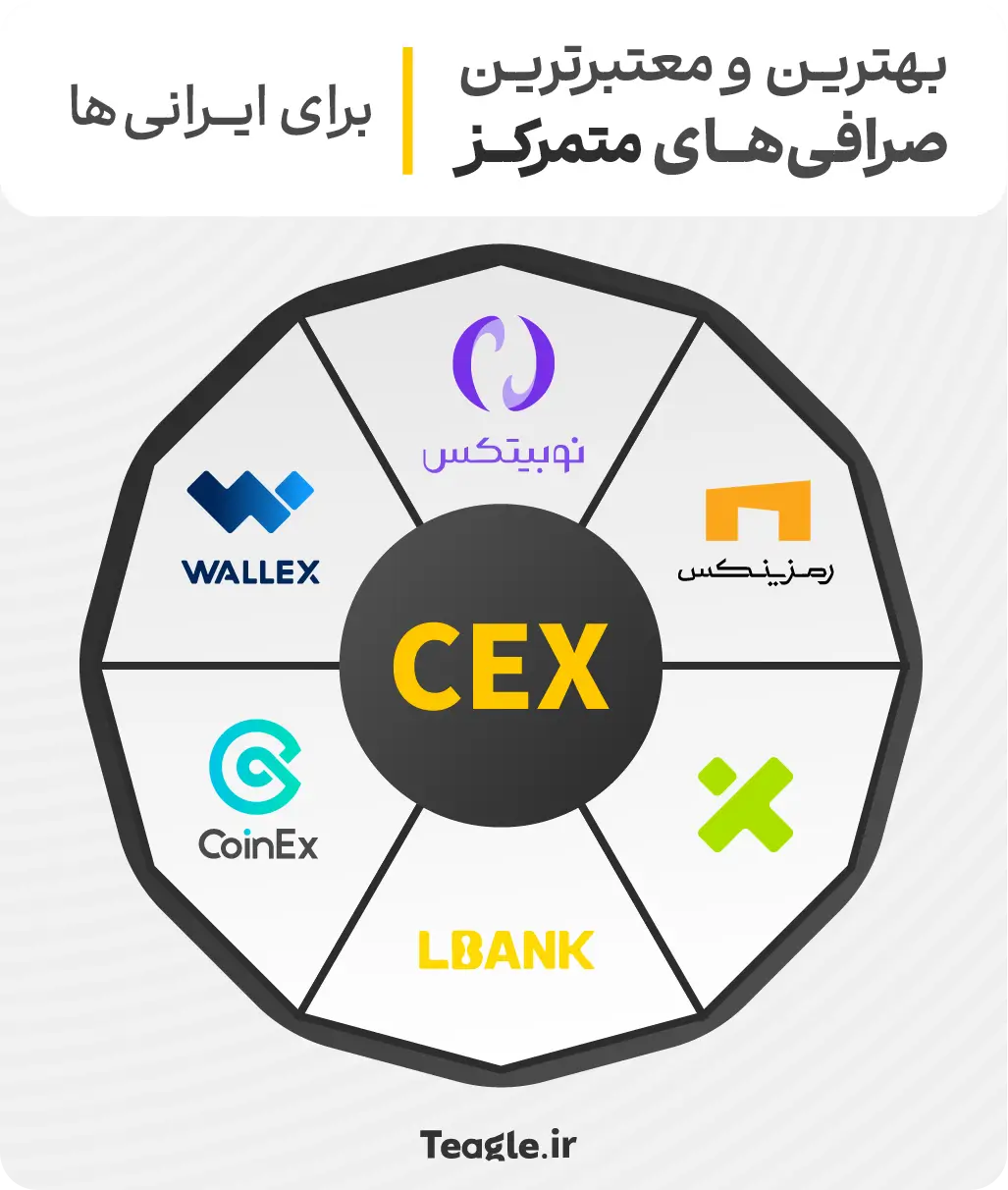
A list of the best and most reputable centralized exchanges for Iranians
For traders living in Iran, choosing a centralized exchange is always overshadowed by international sanctions and banking system restrictions. That is why reputable centralized exchanges started operating inside the country to serve Iranian users, and they have managed to earn a good reputation through the way they operate. Below is a list of the best centralized exchanges for Iranians.
Iranian centralized exchange Nobitex (Nobitex)
Nobitex as the largest and oldest Iranian centralized crypto exchange in Iran, holds a large share of the domestic market, and many Iranian users start out with this exchange. A multi-layer security system, storing user assets in cold wallets and strict identity verification for higher-volume trades are among the features of this exchange. Nobitex was also hacked some time ago, and by returning all of its users' lost assets, it earned a great deal of trust and credibility.
Iranian centralized exchange Wallex (Wallex)
The centralized exchange Wallex, by focusing on smart trading tools and running special advertising campaigns with domestic artists and celebrities, has gained a position and reputation among Iranian traders in recent years. A good, modern user interface and responsive support are among the features of Wallex exchange .
Iranian centralized exchange Ramzinex (Ramzinex)
Ramzinex is known as the Iranian centralized exchange with the widest variety of cryptocurrencies in Iran, giving access to a broad range of cryptocurrencies in Toman. A simple user interface and a variety of trading methods, including leveraged trading, are among the features of this exchange.
Foreign centralized exchange Coinex
Coinex is currently known as one of the most stable foreign centralized exchanges serving Iranians. This exchange has not blocked Iranian IPs and also provides Persian-language support for us Iranians. Also, on Coinex exchange you can verify your identity with Iranian documents.
Foreign centralized exchange LBank (Lbank)
LBank is a foreign centralized exchange that, thanks to its flexible identity verification policies, is a good option for Iranians. On LBank you can trade without identity verification, and it holds an upper-mid position in global rankings.
Foreign centralized exchange XT (XT)
XT is one of the foreign centralized exchanges where you can operate without identity verification, which is why it is also suitable for Iranians and has no ban in this regard. Note that at the time of writing, you can talk to this exchange's support in Persian, but it replies in English via AI.
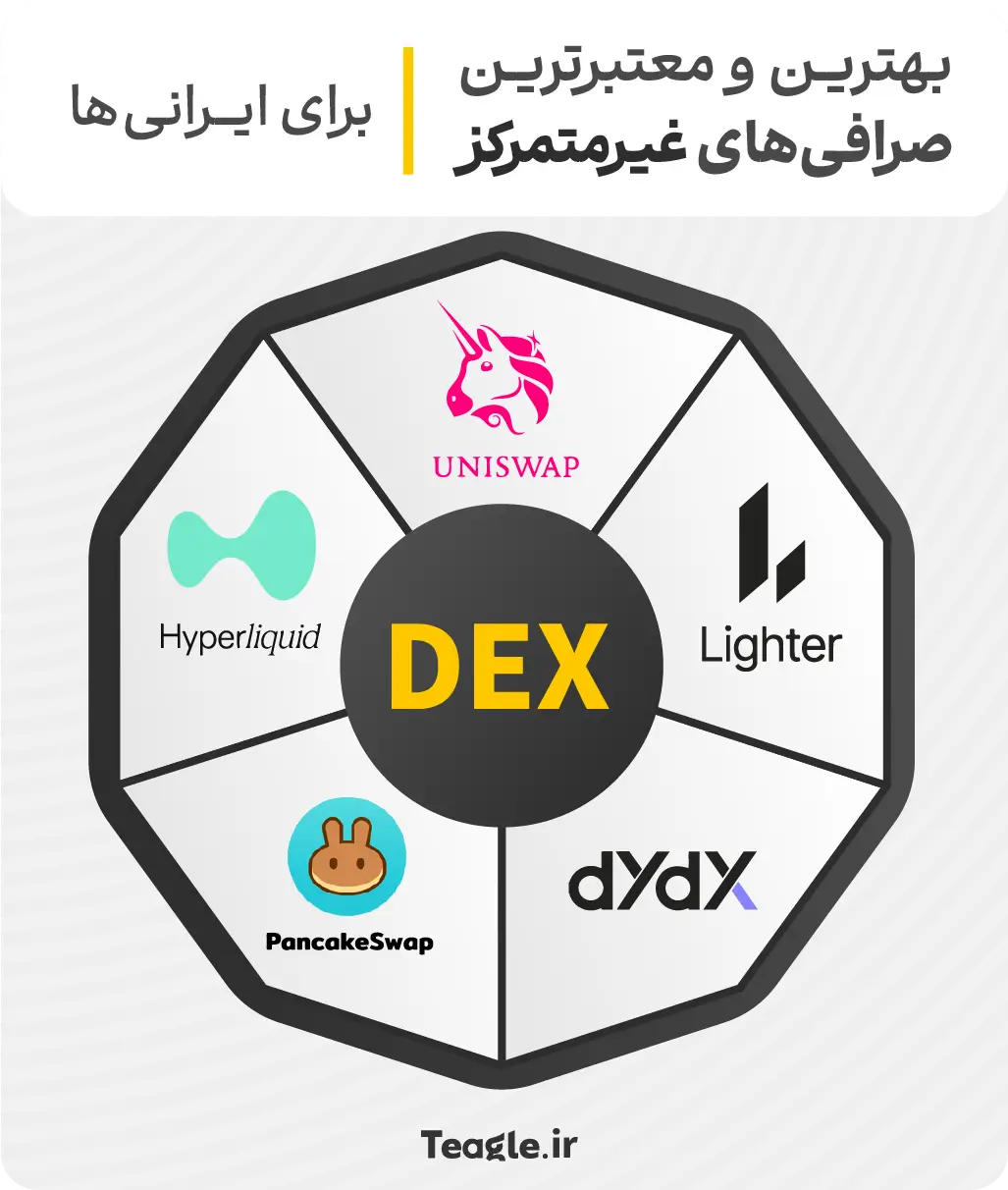
A list of the best and safest decentralized exchanges for Iranians
Because they have no control over assets and require no identity verification, decentralized exchanges are a safe solution for Iranian users seeking maximum security against the risks of foreign and Iranian centralized exchanges or sanctions. Below is a list of the safest decentralized exchanges for Iranians:
Foreign decentralized exchange Uniswap Uniswap
Uniswap is without doubt the king of decentralized exchanges, with one of the highest liquidity and trading volumes in the world, and in addition to the Ethereum network, it is also active on the Polygon and Arbitrum networks.
Foreign decentralized exchange PancakeSwap PancakeSwap
PancakeSwap is one of the most popular decentralized exchanges; it has been accessible to Iranians and has a very good user interface. Although access to this exchange is blocked for Iranian IPs, given the decentralized nature of the exchange, this does not create any problem for trading.
Foreign decentralized exchange dydx
Alongside spot trading, the decentralized exchange dYdX also focuses on futures trading and, like other DEXs, serves users without requiring identity verification. An interesting feature of this exchange is the ability for users to chat online with each other on the exchange's website.
Foreign decentralized exchange Lighter Lighter
The decentralized exchange Lighter is one of the new projects and has recently made its Ethereum Layer 2 mainnet available as well. On this exchange, trades are matched and executed in a fraction of a second.
Hyperliquid crypto exchange HyperLiquid
In 2025, Hyperliquid has become one of the strongest competitors to centralized exchanges. This exchange is built on its own Layer 1 blockchain. This decentralized exchange is compatible with the Ethereum Virtual Machine via (HyperEVM) and enables spot and perpetual orders.
How to use a decentralized exchange
Using decentralized exchanges requires more technical care than centralized platforms, because the slightest mistake in this space is irreversible. To use a decentralized exchange, you first need a wallet; at the start, software wallets such as MetaMask or Trust Wallet are suitable. After installing and setting up the wallet, simply go to the decentralized exchange of your choice, select the currency you want, connect your wallet to the exchange (by copying your wallet address into the exchange), and trade or convert your currency into another currency. Of course, after making the trade on the exchange, you must confirm it in your wallet. With a hardware wallet, this confirmation is done by scanning a QR Code or by other means.
However, you should pay attention to the following points:
- Make sure to use reputable decentralized exchanges.
- Pay attention to the fee of the chosen network (Gas Fee) to avoid losses.
- For foreign decentralized exchanges, we sometimes need to change our IP.
FAQs about centralized and decentralized exchanges
How can we tell whether an exchange is centralized or decentralized?
Centralized exchanges usually let you transfer your assets to the exchange's wallet, and transactions are supervised by a single entity. In contrast, on decentralized exchanges you have full control over your assets and trades are carried out without the need for an intermediary.
What does DEX trading mean?
DEX trading refers to trading on decentralized exchanges (DEX). This type of trading takes place directly between users, without the involvement of central entities.
Can Iranian traders trade on foreign decentralized exchanges?
Yes, decentralized exchanges such as Uniswap and PancakeSwap are easily accessible to Iranians, and they can carry out their trades without identity verification, using digital wallets.
Related articles
Contents of this article


Related articles

User reviews

Newest
 Upload image