
A review of the best forex brokers for trading on a demo account

Author
Marzieh Mazaheri
Published
 2026/10/06
Updated
2026/10/25
Reading time
5 دقیقه


A forex demo account (Forex Demo Account) is an opportunity to practice trading with virtual money, from getting to know the platform and placing orders to testing strategies and risk management. But when choosing a broker, simply offering a demo account is not enough. The account's validity period, the ability to change the virtual balance, the available platforms and the trading conditions all affect the quality and continuity of your practice.
In this article, we compare the demo accounts of several top brokers in terms of features and limitations so you can choose the option that fits your needs. We also explain how to bring your demo practice closer to a real trading plan and why the results of this practice do not guarantee similar performance with real capital.
What Is a Forex Demo Account and Why Is It the Starting Point for Trading?
A demo or practice account lets you trade with virtual money in an environment similar to the real market. You follow prices and charts, place buy and sell orders and see the results of your decisions, without putting your real capital at risk. Profits and losses in this account are also virtual and cannot be withdrawn. A demo account is usually free and provides a good opportunity to learn the platform, work with analysis tools and practice risk management.
Demo accounts are not just for beginners; experienced traders also use them to test strategies and trading robots or to get familiar with a broker's features. However, keep in mind that demo results are not necessarily repeated in a live account, because order execution conditions and the psychological pressure of trading with real money are different.
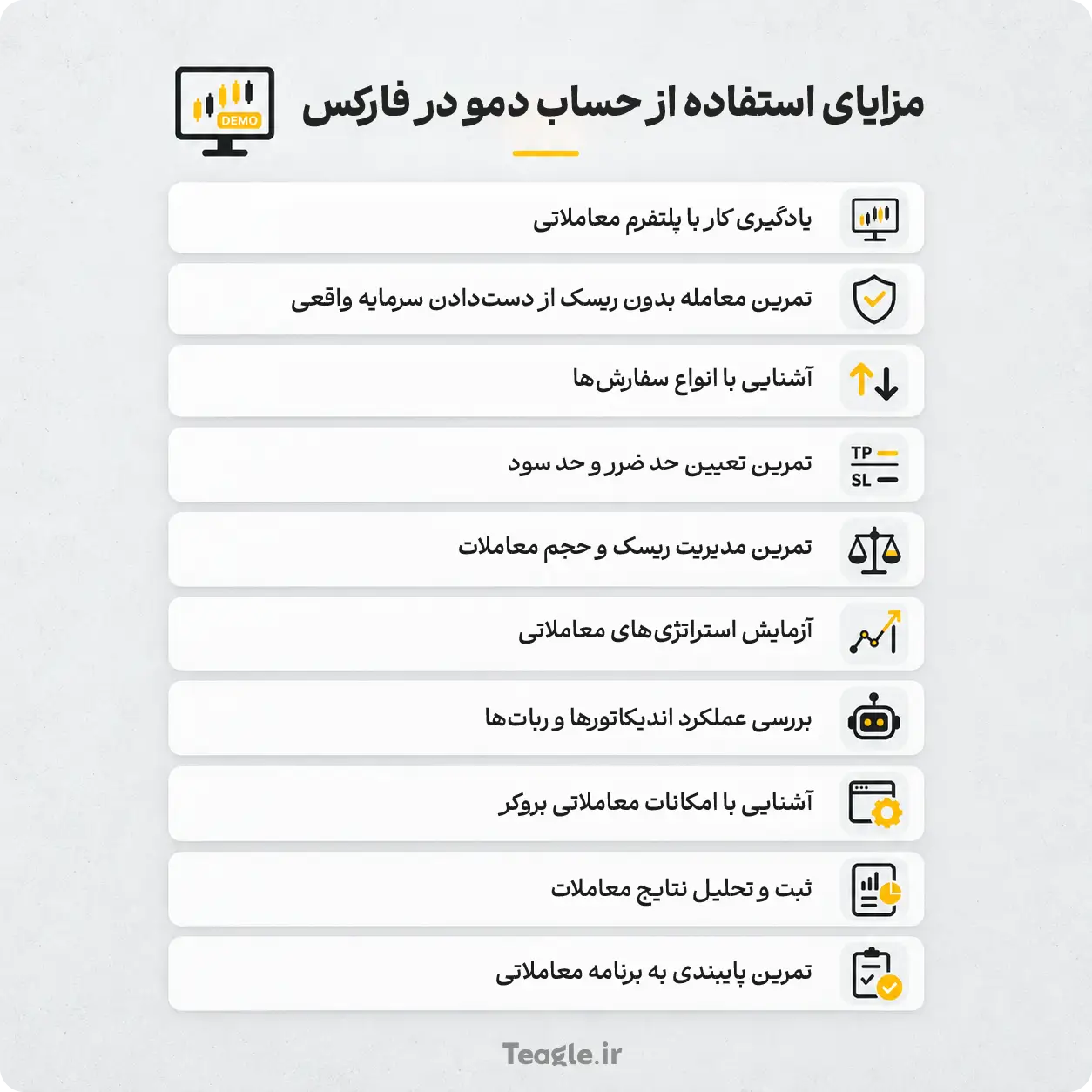
Benefits of using a practice (demo) account in forex
A demo account is a chance to make your early mistakes with virtual money. You can practice placing orders, setting stop loss and take profit, and choosing trade size , and see how each decision affects your account balance. This practice helps you get comfortable with the platform before you start with real capital.
A demo account is also useful for testing trading methods. You can apply your entry and exit rules, use tools such as moving averages and Bollinger Bands, and by recording your results, identify the weaknesses of your method. Experienced traders also use this opportunity to test robots and get to know a broker's features.
Key Differences Between Demo and Live Accounts
The biggest difference between a demo account and a live account lies in the psychological layers and the structure of order execution. In a demo account, because there is no risk of losing real money, the trader does not experience emotions such as fear, greed and stress, and can easily take large positions. By contrast, entering the real market with real capital creates intense psychological pressure that can lead to deviating from the trading plan.
Another difference relates to order execution. In a live account, order processing speed, liquidity and market volatility can cause a trade to be executed at a price different from the requested price; this is called price slippage (Slippage) . Depending on the broker's settings, a demo account may simulate these conditions in a simplified way. For this reason, especially in short-term trading and during news releases, you should not expect demo results to be repeated exactly in a live account.
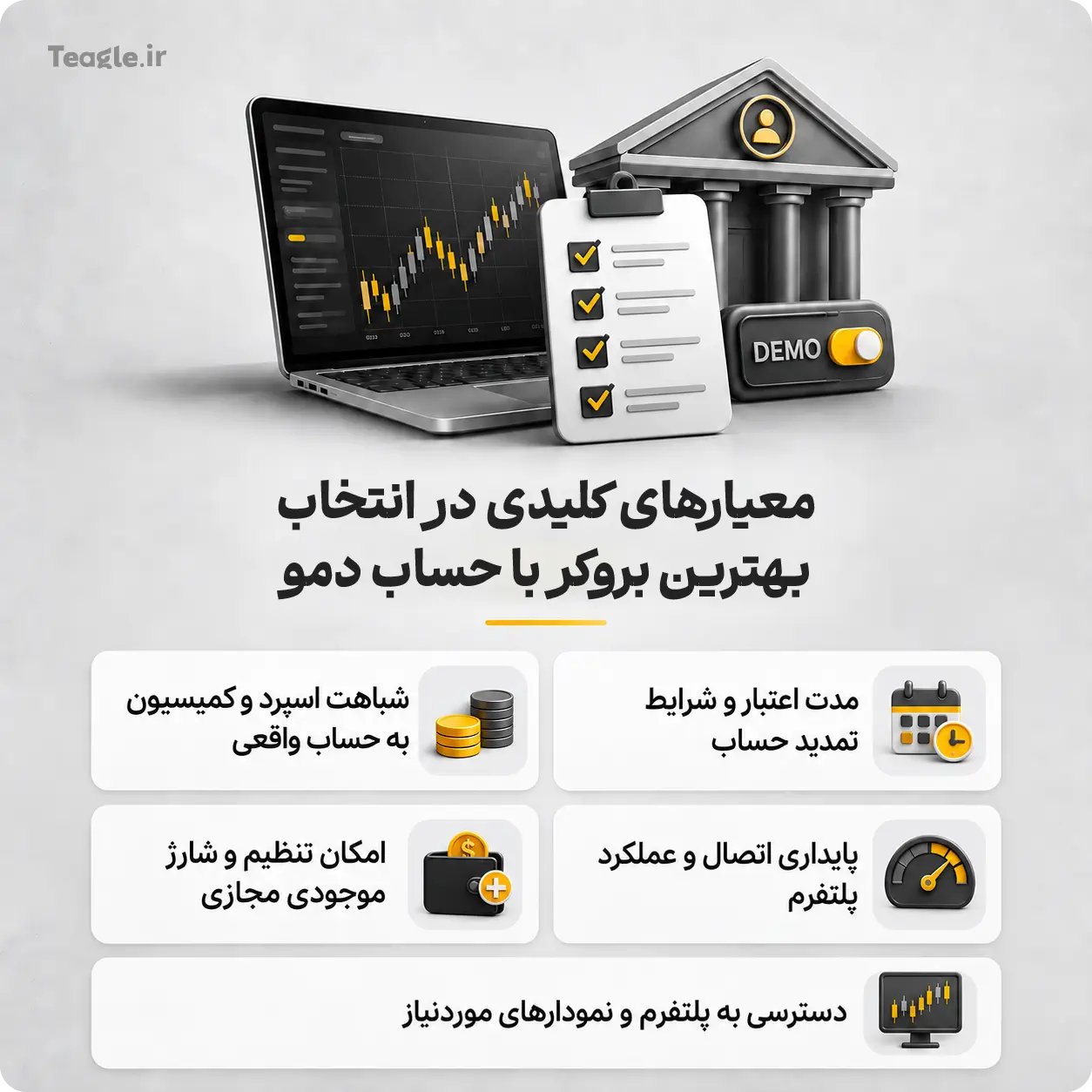
Key criteria for choosing the best broker with a demo account
A demo account is more useful for practice when it fits your trading plan. Trading costs similar to a live account, platform stability, account validity period and the ability to adjust the virtual balance are important selection criteria. For example, if you plan to start with limited capital, it is better to be able to set your demo balance close to that same amount.
The table below shows how each criterion applies to beginner and experienced traders. Note that order execution speed in a demo account does not, on its own, indicate the quality of trade execution in a live account.
|
Evaluation criterion |
Use for beginners |
Use for experienced traders |
|
Spread and commission similar to a live account |
Understanding trading costs and their effect on profit and loss |
Evaluating strategies with trading costs taken into account |
|
Account validity period and renewal terms |
Continuing to learn without interruption and keeping practice records |
Testing strategies over longer periods |
|
Ability to adjust and top up the virtual balance |
Practicing with capital close to the real budget |
Examining money management with different balances |
|
Connection stability and platform performance |
Learning to place and manage orders without frequent disruptions |
Checking the performance of tools and trading robots |
|
Access to the required platform and symbols |
Practicing in the environment they will actually trade in |
Testing the trading method on the intended symbols and platform |
Realistic Simulation of Market Conditions (Spread, Commission and Slippage)
To evaluate a strategy in a demo account, you should also take trading costs into account, including the spread (Spread). The spread, meaning the difference between the buy and sell price, and the commission should ideally match the live account you intend to use. If costs are lower in the demo, a trading method may appear profitable, but in a live account a large part of its profit may be eaten up by costs.
Order execution also matters. Slippage occurs when a trade is executed at a price different from the requested price; not all demo accounts simulate this in the same way. Therefore, especially for scalping and trading during news releases, demo results should be evaluated with the possibility of differences in execution speed and slippage in mind.
Demo Account Validity Period and Balance Top-Up Options
Before choosing a broker, check the demo account's validity period and the conditions for keeping it active. Some accounts expire after a set period, and some are closed if not used. If you have limited time to practice or want to test a strategy over several months, the ability to renew the account and keep your trade history becomes more important.
The ability to increase or reset the virtual balance also makes it easier to keep practicing. With this feature, after your balance drops you can top up the account again or adjust the amount to match your real capital. However, the way to change the balance differs between brokers; it may be done from within the client cabinet, require a request to support, or require opening a new demo account.
Support for Standard Platforms (MetaTrader 4, 5 and cTrader)
The trading platform is the trader's main tool, and the quality of order execution depends on it. Broker support for well-known platforms such as MetaTrader 4 (MetaTrader 4, or MT4), MetaTrader 5 (MT5) and cTrader (cTrader) is considered an undeniable necessity. These platforms provide advanced technical analysis tools and the ability to use automated trading robots.
It is best to open your demo account on the same platform you plan to use in your live account. That said, the broker does not need to offer all three; what matters is that the available platform has the tools and features you need.
In a demo account, you can practice setting up charts, placing orders and managing trades so that when you trade with real money, you are not busy looking for options. If you use a specific indicator or robot, check its compatibility with your chosen platform. Access to the mobile, web or desktop version should also suit the way you trade; the features of these versions are not necessarily the same.
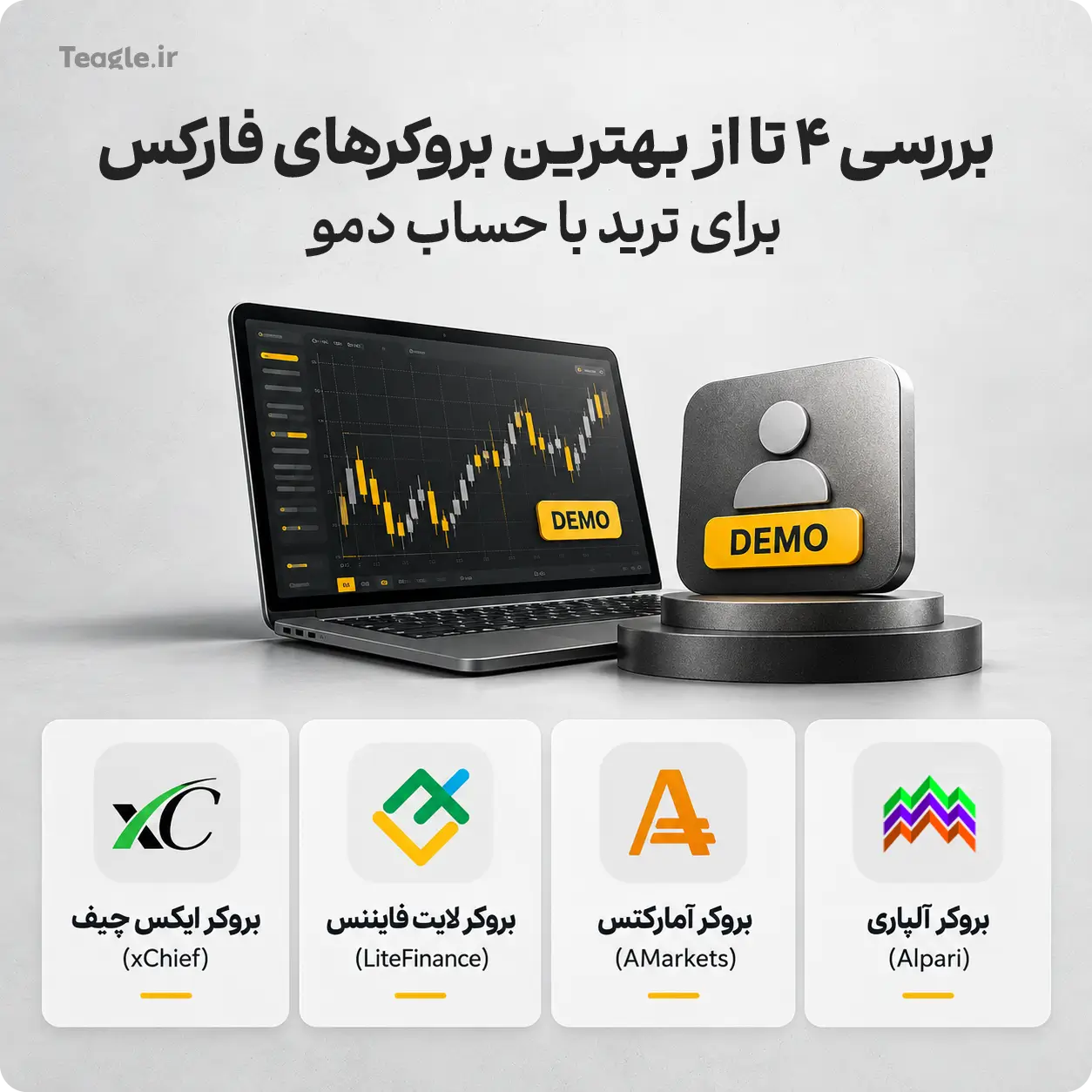
A review of 4 of the best forex brokers for trading with a demo account
Choosing the right broker for practicing on a demo account requires examining the track record and services offered by brokerage firms. Below, we analyze four well-known brokers in the international and regional market that offer good features for practice accounts, so you can choose the option that fits your needs.
Alpari Broker (Alpari)
Alpari broker is one of the longest-established brokers for traders in the region and offers wide access to practice accounts. Alpari is one of the brokers for Iranian users that offers a completely free demo account with no time limit. This feature lets users test their strategies whenever they need to, without the stress of the account expiring.
Support for the popular MetaTrader platforms and a wide range of trading symbols, including major currency pairs, crosses and precious metals, make this broker a suitable option for practice. The demo environment at this broker updates with minimal delay and simulates conditions close to real Standard and ECN (ECN) accounts.
AMarkets Broker
AMarkets is another active broker that provides traders with demo accounts with advanced features. Order execution speed on this broker's demo account is designed so that it shows no noticeable difference from the live environment. Traders can choose any starting balance they like on the demo account to better simulate their real financial situation and test advanced technical analysis tools on the trading platforms.
LiteFinance Broker
LiteFinance focuses on user-friendly platforms and copy trading features and offers highly flexible demo accounts. This broker gives beginners the conditions to learn the basics of market analysis without technical complexity.
Built-in risk management tools and access to daily analysis in the demo environment help traders become familiar with fundamental analysis and economic news in addition to learning the platform. Support for multiple platforms makes it easy to access the demo account from any device.
xChief Broker
xChief is known as a broker with flexible conditions for demo accounts. This broker lets you test different strategies with demo accounts that offer near-real trading conditions. The variety of demo accounts at this broker allows users to choose the account type they want (such as fixed or floating spread accounts) exactly matching their future live account.
The ability to manage virtual credit and reset the account balance without opening a new account keeps practice continuous and uninterrupted. These features have led professional traders to use this broker's services to test their trading robots as well.
A Smart Strategy: How to Practice on a Demo Account as if It Were a Live Account
To make demo practice useful, follow the same rules you plan to follow with real money. Before entering, define the reason for the trade, the order size and the stop loss, and don't take on more risk just because the money is virtual. The goal is to see how your trading method performs and how well you stick to your plan.
After each loss, don't top up the account right away; first look into the cause. If you reset the balance to the starting point after every mistake, you won't properly see the effect of consecutive losses and weaknesses in your money management.
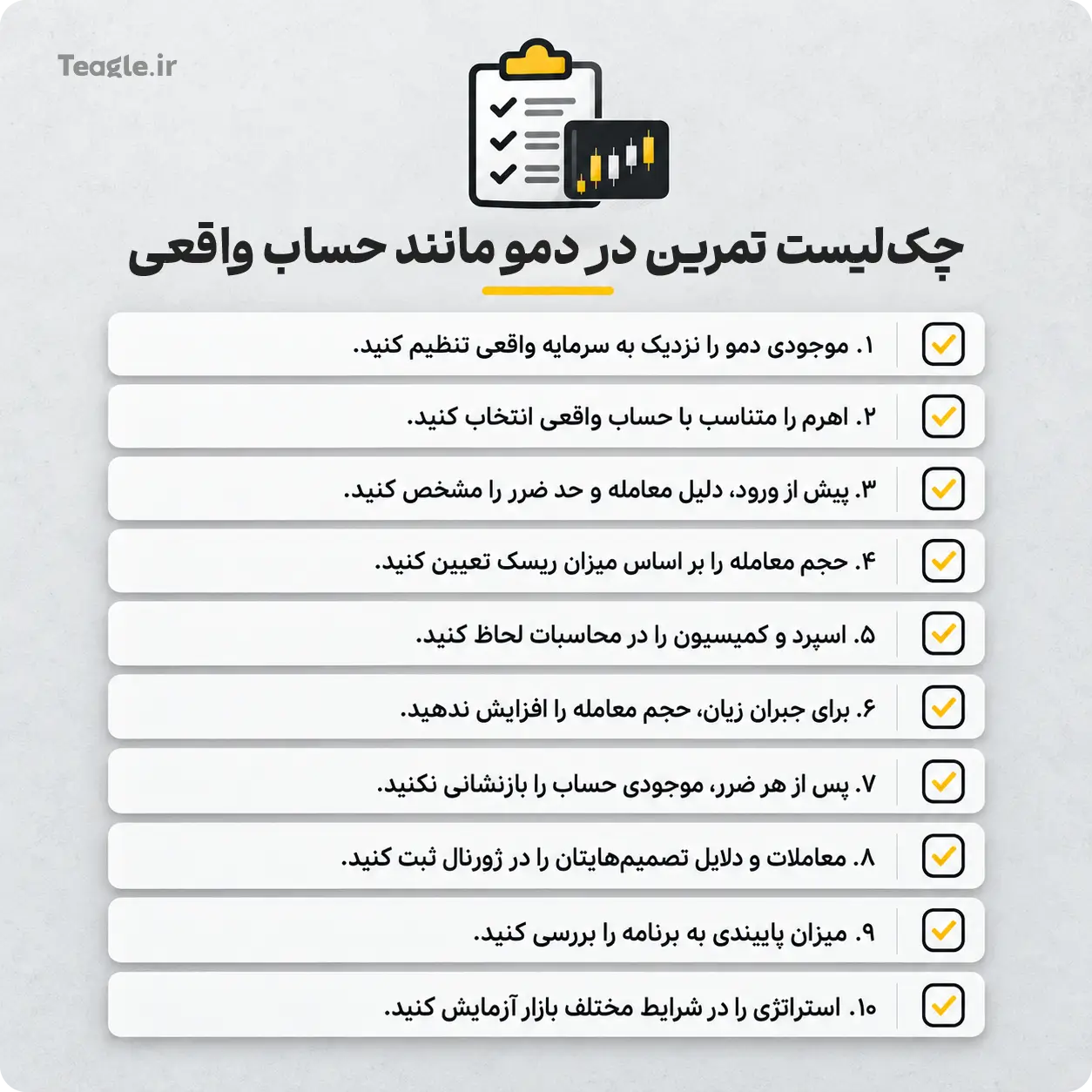
Set the demo balance based on your real capital
If you plan to trade with $1000, practicing on a $100,000 account won't give you a proper picture of your capital constraints. It's better to choose a virtual balance and leverage as close as possible to your live account conditions.
To calculate trade size, first determine the amount you're willing to risk. For example, on a $1000 account, a 1% risk equals $10. Then adjust the size based on the stop-loss distance and the value of each pip or tick so that the estimated loss at the stop loss matches this amount. Also take trading costs and possible slippage into account.
Keep a trading journal and evaluate your strategy
Experience has shown that for the best results, you should record in your journal the symbol, entry and exit times and prices, trade size, stop loss, take profit and the reasons for your decisions. Write down whether you followed your plan or changed the rules mid-trade; this information helps you separate weaknesses in the strategy from mistakes in executing it.
Once you've built up enough trades, review your win rate, average profit and loss, and drawdown. A fixed number such as 50 trades isn't enough on its own for a definitive judgment; what matters is that your method has been tested in different market conditions. A journal provides a more accurate basis for evaluation, but it doesn't guarantee profitability on a live account.
When Should You Move from a Demo Account to a Live Account?
A few profitable trades on demo aren't enough to make the decision. Before moving to a live account, you should have clear rules for entry and exit, choose trade sizes in proportion to your capital and stick to your risk limits even when losing. Your journal records should show that your results came from executing a defined method, not from a few lucky trades.
Two or three months of practice can be a good period for evaluation, but time alone isn't a measure of readiness; the number of trades, market conditions and how well you stick to your plan matter too. If you decide to start live trading, begin with an amount whose loss won't hurt your essential living expenses, and keep risk limited. At this stage, besides your trading results, also examine how you react to real profits and losses.
Related Articles
Contents of this article


Related articles



User reviews

Newest
 Upload image