
Understanding pips and lots (trade size) in forex and how to calculate them

Author
Admin
Published
 2026/06/30
Updated
2026/10/25
Reading time
5 دقیقه


If you ask any experienced trader what the biggest mistake newcomers make in the forex market is, they'll probably answer: «Most people enter a trade before they know exactly what they're putting at risk».
Many traders spend hours searching for the best analysis and entry point, but at the very moment they need to set their position size, they leave everything to feelings, excitement or their account balance. This one small decision can produce tiny profits or heavy losses.
The root of this simple mistake is unfamiliarity with two fundamental forex concepts: the pip and the lot. These two terms are the common language of the market; numbers that determine exactly how much dollar profit or loss each price move creates for you. When we say «50 pips of profit» or «entering with 0.10 lots», we're actually talking about two measures without which no trading strategy makes sense. If you don't want your next trade to turn into an unwanted risk, don't miss the rest of this article.
What Is a Pip in Forex?
Pip is short for «Price Interest Point» and is considered the smallest standard unit of price change in most forex currency pairs. Traders use pips so they don't have to express price changes with long, confusing numbers; a small unit, but important enough to change the fate of a trade.
In most major currency pairs, such as EUR/USD, one pip equals 0.0001 of the price; that is, the fourth digit after the decimal point.
Simply put:
If EURUSD goes from 1.1000 to 1.1001, the price has risen by 1 pip. If 1.1000 goes to 1.1010, the price has risen by 10 pips.
These changes may seem insignificant at first glance, but in practice, depending on the volume you've traded, they can equal a few dollars or even several hundred dollars of profit and loss.
For example, if the EUR/USD price goes from 1.1050 to 1.1065, the market has moved 15 pips. Those same 15 pips can bring about $15 of profit for a trader with a 0.10 lot position and $150 for someone who entered with 1 lot.
Of course, this structure isn't the same for all assets. Some currency pairs such as USD/JPY have only two decimal places, and commodities like gold (XAUUSD) also define the pip differently; a topic we cover in the next section.
The key point, however, is that the number of pips alone doesn't indicate profit or loss. The dollar value of each pip depends on the trade size (lot).
How Much Is Each Pip Worth?
«Pip value» means how many units of currency (for example, dollars) your profit or loss changes by if an asset's price moves by one pip. Contrary to what many novice traders think, pip value isn't a fixed number and depends on factors such as trade size (lot), the trading symbol and the account currency.
If you've looked closely at currency pair prices in MetaTrader or TradingView, you've probably noticed that many brokers display prices with five decimal places. This extra precision may seem confusing at first, but it's actually designed to provide more accurate prices and better order execution.
In this newer structure, the smallest displayed digit is no longer a pip; it's called a pipette.
Put more simply, the pip is the main unit for measuring price change and the pipette is one-tenth of a pip. In other words, 1 pip equals 10 pipettes.
That's why, when viewing a chart, the price may move a few units without having changed by even one full pip. This small difference matters a lot in short-term trading and scalping , because accurate profit and loss calculation depends on these details.
Something many novice traders overlook is that money management calculators, risk calculation indicators and even trading expert advisors all do their calculations in pips, not pipettes.
So when setting your stop loss or take profit, you need to know how precisely your platform displays prices and exactly what each small change means.
How Is a Pip Defined in Gold (XAUUSD) and Other Markets?
The pip plays the same role in all markets: measuring the smallest price changes. But the size of a pip differs depending on the asset type, and this difference is one of the common causes of errors in calculating profit and loss. To keep your calculations accurate and error-free, you need to know how each market defines a «pip»:
Pips in Yen (JPY) Currency Pairs
In currency pairs such as USD/JPY or EUR/JPY, the price is shown with only two decimal places. So each pip equals 0.01 of the price. For example, if USD/JPY goes from 145.20 to 145.35, the price has risen by 15 pips.
Pips in Gold (XAUUSD)
For the XAU/USD symbol, i.e. spot gold, the definition of a pip may differ slightly between brokers, because some brokers display the price with two decimal places and others with three. Still, at most forex brokers used by Iranian traders, each $0.01 change in the gold price is treated as one pipette.
For example, if the gold price goes from 3385.20 to 3386.45, the price has risen by 12.5 pips.
However, when trading gold, knowing the number of pips isn't enough, because pip value also depends on trade size and the contract specifications (Contract Size). That's why two traders can experience completely different profits or losses from the same price move.
Pips in Indices, Oil and Crypto
In these markets, the pip is defined based on the minimum price change (Tick Size). The tick value differs for each symbol and should be checked in the broker's Contract Specification.
What Is a Lot, or Trade Size, in Forex?
If we consider the pip the unit for measuring price movement in the forex market, the lot is the unit for measuring trade size. Simply put, the lot determines how much of an asset you buy or sell, and this in turn determines the profit, loss and risk of each trade.
One of the most common mistakes novice traders make is assuming that trade size depends only on account balance. Yet two traders with the same capital, if they enter the market with different sizes, may get completely different results from the same price move.
To understand this better, suppose two traders open buy trades on EUR/USD and the price rises 20 pips:
The first trader entered with 0.01 lots and the second with 1 lot.
Both trades made exactly 20 pips of profit, but their dollar profit isn't the same, because the trade sizes were different. That's why the concept of the lot in forex is one of the most important concepts to understand well before moving to real trading. In general, the larger the trade size, the higher the value of each pip.
Types of Lots in Forex
So that traders can trade in line with their capital and risk tolerance, brokers offer several types of lots. The only difference between these lots is the contract size, and that difference also changes the value of each pip.
|
Lot type |
Contract size |
Approximate pip value (in USD-quoted pairs) |
Suitable for |
|
Standard Lot |
100,000 units |
About $10 |
Professional traders and large accounts |
|
Mini Lot |
10,000 units |
About $1 |
Semi-professional traders |
|
Micro Lot |
1,000 units |
About $0.10 |
Beginners and small accounts |
|
Nano Lot |
100 units |
About $0.01 |
Practice accounts or certain specific brokers |
It should be noted that the values above are approximate and are only exact when the second currency of the pair is the US dollar. In other currency pairs or assets such as gold, pip value changes according to the exchange rate and contract specifications.
The Relationship Between Pips and Lots: Why Are These Two Concepts Linked?
If we were to give just one simple formula for understanding how these two concepts relate, we could say:
«The pip shows how far the price moves, and the lot determines how many dollars that move is worth to you.»
In other words, a pip has no monetary meaning without a lot, and a lot cannot determine profit or loss without pips. Suppose the price of EUR/USD rises 30 pips after a trade is opened. The result of this move for three different traders would be as follows:
|
Trade size |
Value per pip |
Profit after a 30-pip move |
|
0.01 lot |
$0.10 |
$3 |
|
0.10 lot |
$1 |
$30 |
|
1 lot |
$10 |
$300 |
As you can see, the number of pips is the same for all traders, but their dollar profit differs because of the difference in trade size.
How to calculate pip value based on trade size
After getting familiar with the concepts of pip and lot in forex, we come to the most important question: exactly how many dollars is each pip worth?
The answer depends on several factors, such as the currency pair, the trade size, the base currency of the trading account and the exchange rate. For this reason, no single fixed figure can be given for pip value across all trades.
However, in many major currency pairs where the US dollar is the second currency (such as EUR/USD, GBP/USD and AUD/USD), calculating pip value is very simple, and traders usually use a general rule.
For example, in the EUR/USD pair:
- Every 1 standard lot ≈ $10 per pip
- Every 0.10 lot ≈ $1 per pip
- Every 0.01 lot ≈ $0.10 per pip
These figures help traders estimate their potential profit or loss even before entering a trade, and choose an appropriate trade size accordingly.
Pip value formula
Although most trading platforms today calculate pip value automatically, knowing the formula gives you a deeper understanding of money management and lets you evaluate the results when using calculators.
In the simplest case, when the second currency of the currency pair is the US dollar, the formula is as follows:
|
Pip value = (pip size × contract size) × number of lots |
For example, if you plan to trade 0.5 lot of EUR/USD:
- Pip size: 0.0001
- Standard contract size: 100,000 units
- Trade size: 0.5 lot
Therefore:
0.0001 × 100,000 × 0.5 = $5
This means every one-pip change in price creates $5 of profit or loss.
The next case is calculating pip value when USD is the first currency of the pair (USD/CAD). In this case:
|
Pip value = (number of lots × contract size) × (0.0001 ÷ exchange rate) |
In pairs such as EUR/GBP, GBP/JPY or EUR/JPY, calculating pip value is a bit more complex, because the exchange rate must also be factored in. For this reason, most professional traders use automated tools or online calculators that perform this process with high accuracy instead of calculating by hand.
One reliable resource for this is the calculator on Pip Calculator the Investing.com website, which lets you calculate pip value for a wide range of currency pairs, precious metals and other trading symbols. It is recommended that the link to this tool be provided to readers in the article as a reference for calculating pip value.
Another important point worth mentioning is that in pairs involving the Japanese yen, since the price is shown with only two decimal places , the pip size is also different. In these symbols, a pip equals 1 divided by 100, then divided by the exchange rate. But the key point is that the dollar value of a pip must be calculated based on the USD/JPY rate, not the euro value. At the time of writing, the dollar-to-yen rate is around 162; so each pip in yen-based pairs with a size of 100,000 units is worth roughly $6.18.
Calculating pips and lots in trading platforms
In the past, traders had to use mathematical formulas or manual calculators to calculate pips and the value of each trade. Today, however, almost all trading platforms display this information automatically, and you only need to know what each number means.
Measuring pips in MetaTrader (MT4 and MT5)
MetaTrader is still the most popular trading platform in the forex market, and most brokers support it. In this software, prices are usually displayed to five decimal places (or three for yen pairs).
In this platform, you can use the Crosshair tool to see the number of pips between two points:
- Select the Crosshair tool from the toolbar.
- Mark the starting point of the price move.
- Drag the cursor to the end point of the move.
- From the left, MetaTrader shows the number of candles, the number of pips and the percentage price difference.
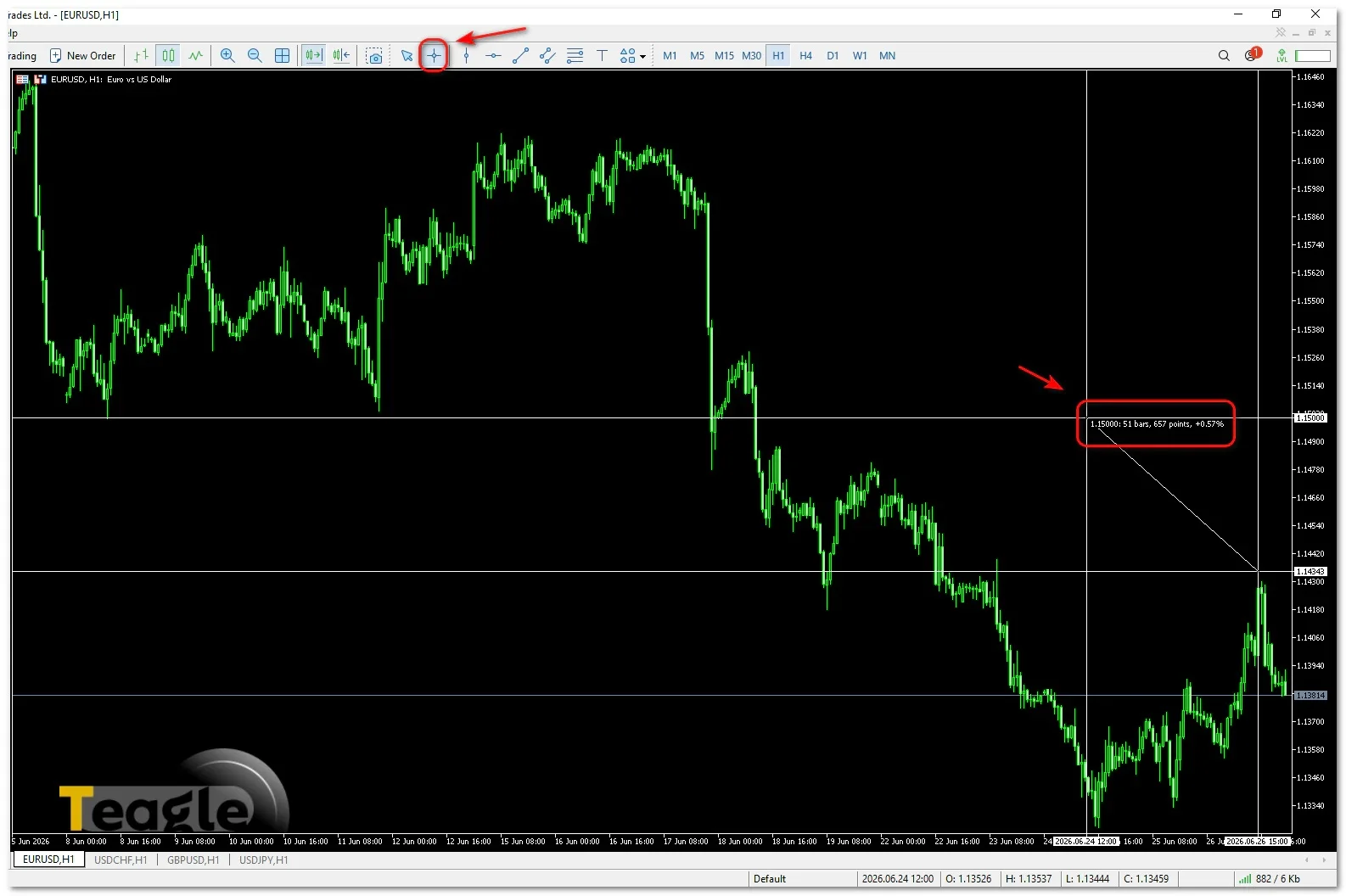
This feature is very useful for checking Stop Loss and Take Profit levels and analyzing past trades.
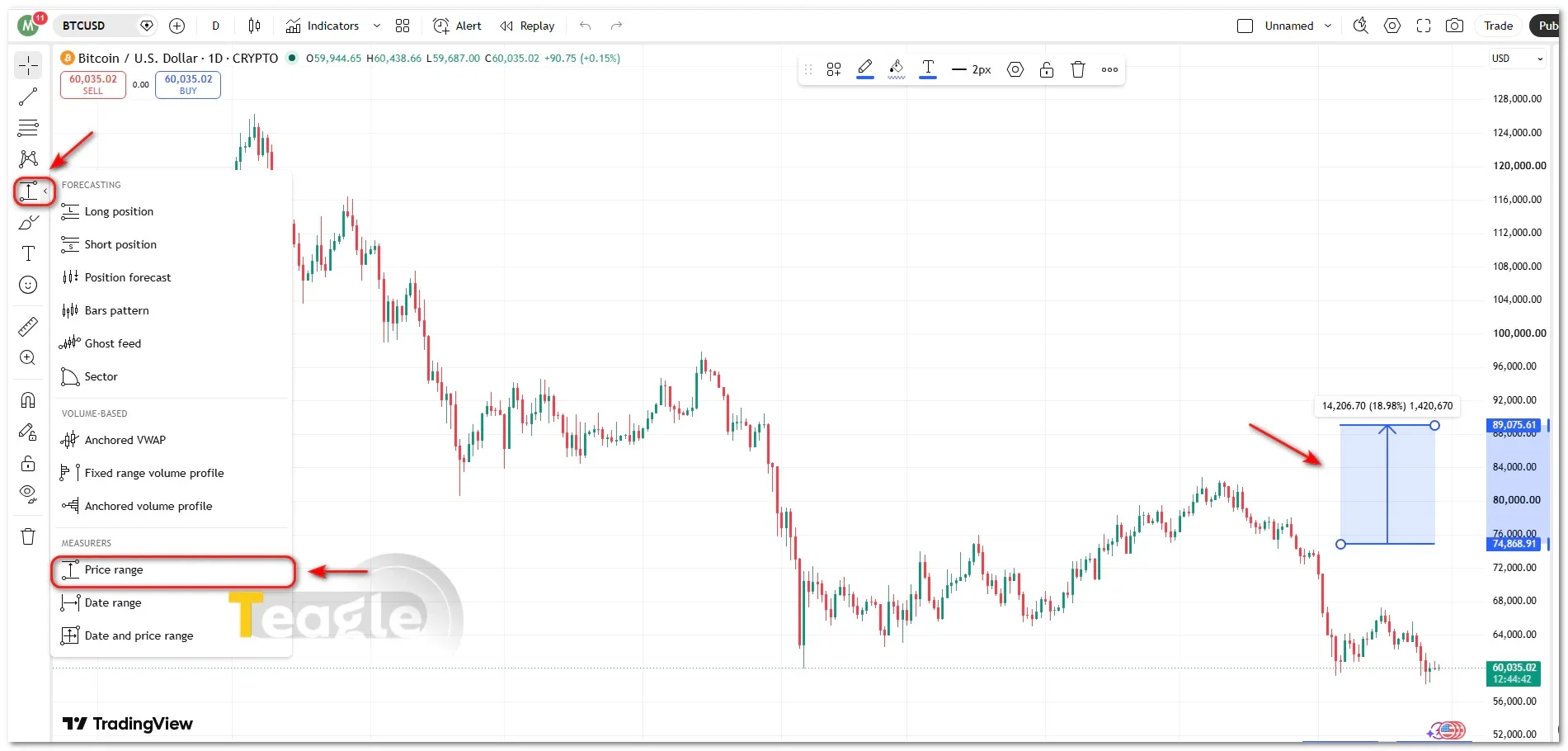
Measuring pips in TradingViewIn TradingView, the Price Range or Long/Short Position tools also let traders measure the price distance between two points. Besides the number of pips, these tools also show the risk-to-reward ratio (Risk/Reward), potential profit or loss, and suitable stop loss and take profit placement.
In addition, by holding the «shift» key and left- clicking the mouse, you can see price changes in percent and pipettes.
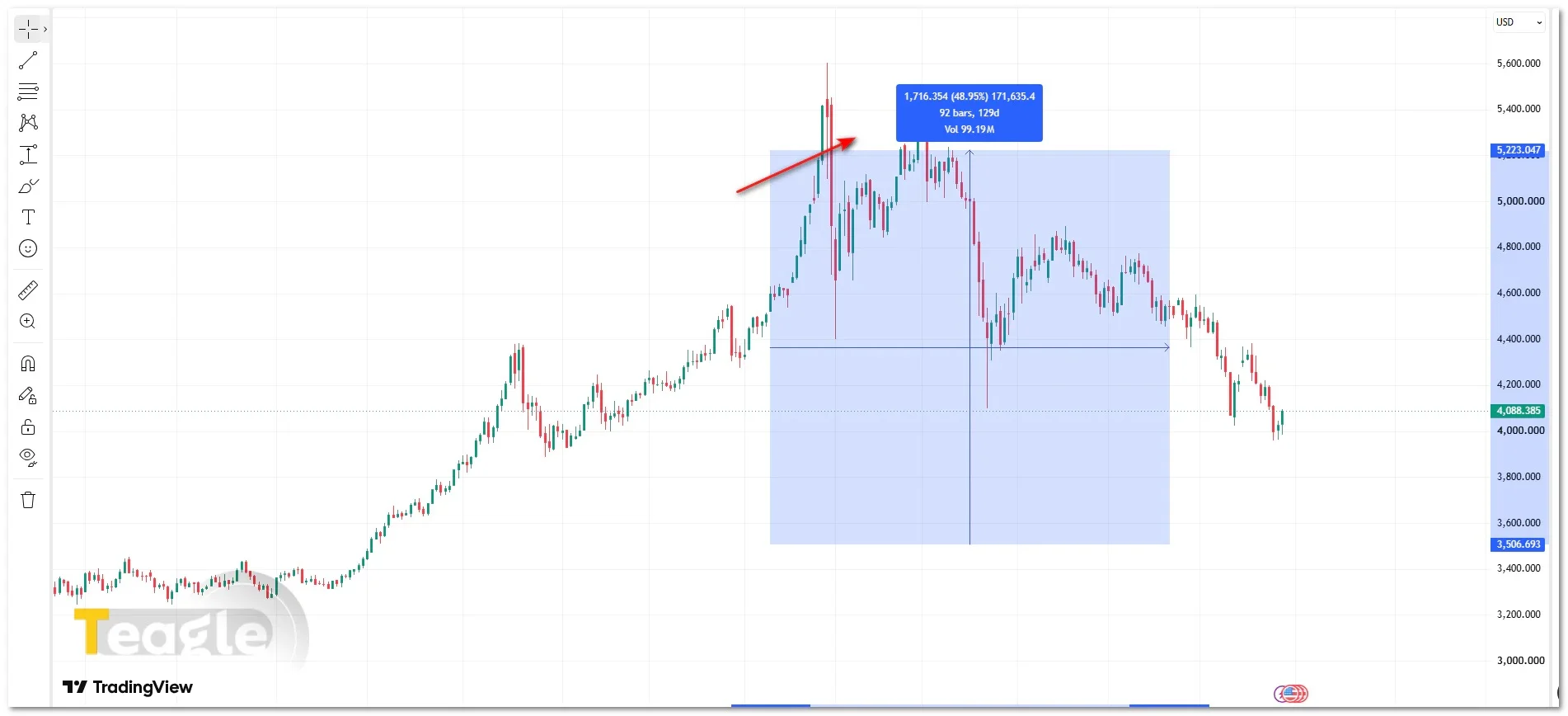
Given this tool's capabilities, many traders first do their analysis in TradingView and then execute the trade in MetaTrader or their broker's platform.
Tools and indicators for calculating pips and lotsIn real trading, speed of decision-making matters a lot. That is why no professional trader does all pip and lot calculations in forex by hand. Numerous tools have been designed to carry out this process accurately, quickly and without errors.
These tools play a vital role especially in volatile markets such as gold (XAUUSD) or fast-moving currency pairs, because even a small mistake in calculating trade size can make the difference between a profitable trade and a heavy loss.
Introducing the Pip Value indicator for MetaTraderThe Pip Value indicator in MetaTrader is a small but very useful tool that turns pip value calculation from a manual, time-consuming task into an accurate real-time display on the chart. Once installed, the indicator shows, based on the trading symbol, the selected volume and the account currency, exactly how much dollar profit or loss each price move generates.
Advanced pip calculation indicators in MT5In the advanced MetaTrader 5, pip calculation indicators are not limited to displaying the value of each pip; they also provide a set of vital information for risk management. In addition to real-time pip value, these tools calculate the margin required for the trade, real-time profit and loss, the break-even point and even the percentage of risk relative to the account balance.
Online pip and lot calculatorOnline pip and lot calculators are among the fastest and most accurate tools a trader can use to determine the value of each pip, the right trade size and the level of risk. Simply enter the trading symbol, lot size, account currency and current price, and these tools instantly calculate the value of each pip, the potential profit and loss, the required margin and the approximate risk of the trade.
As we mentioned, Investing.com is one of the most popular global resources in this area. In addition, Pip Calculator and Babypips.com are other widely used calculators for this purpose.
The role of pips and lots in risk management and trade sizeIn risk management, pips and lots determine exactly how much your account will be hurt if the market moves against you. A pip shows the number of units the price moves, and the lot determines how many dollars of profit or loss each pip produces for you.
Before any decision, a professional trader first sets the stop loss and checks how many pips away it is; then, based on that figure, chooses a trade size so that if the market moves the wrong way, the loss stays within a tolerable range. A beginner, by contrast, usually starts with the size and only after entering the trade realizes how much pressure each pip puts on the account. This small difference is what separates calculated trading from high-risk trading.
How do you determine the right trade size based on risk?To choose the right size, you first need to know how much of your capital can be at risk in each trade. The common rule is to risk only 1 to 2 percent of your capital; that is, if your account is $1000, the acceptable loss per trade will be between $10 and $20.
Now just put the stop loss and the pip value side by side: if the stop loss is 20 pips and each pip is worth $1 at 0.1 lot, the trade's risk is $20 and this size is perfectly standard. But if you open the same trade with 0.5 lot, each pip is worth $5 and the potential loss rises to $100; that is, 10 percent of your total capital. This is exactly the point where the trade gets out of control and risk increases dangerously.
The relationship between leverage, lots and riskLeverage only increases your buying power; it is the trade size that actually creates risk. Many people assume high leverage means high risk, whereas as long as the trade size is small, even 1:500 leverage poses no danger.
Real risk begins when the trade size is chosen larger than the account can handle and every pip of movement creates heavy financial pressure. In practice, three factors determine risk:
- the lot, which determines how many dollars each pip is worth,
- the stop loss, which shows how far the market can move against you,
- and the pip, which is the unit for measuring that movement.
-
So leverage only makes larger trades possible; it is you who controls or destroys risk by choosing the right size. Even with high leverage, if the trade size is 0.01 lot, the risk remains low and manageable.
Pips and lots: the hidden pillars of risk control in tradingUnderstanding concepts like pips and lots in forex is not just learning a few technical terms; it is entering a deeper layer of trading where «numbers» become the real language of risk and capital. Each pip represents the smallest market movement, but when combined with trade size (lots), that same small movement can turn into a significant profit or a serious loss.
What separates professional traders from newcomers is not merely the ability to analyze the market, but the ability to turn analysis into precise decisions on size and risk management. Ultimately, success in forex depends less on predicting prices than on a sound understanding of trade size and each person's risk tolerance.
Contents of this article


Related articles


User reviews

Newest
 Upload image