What Is Margin? The Concept of Collateral in the Forex and Crypto Markets

Author
Admin
Published
 2026/03/05
Updated
2026/10/25
Reading time
5 دقیقه


Have you ever entered a large trade with little capital and suddenly seen your loss multiply? Or, the other way around, multiplied your profit? That is margin, which is essentially the result of using trading leverage; a tool in financial markets that lets traders open large positions with little capital. In margin trading, traders can open positions larger than their actual capital. To do this, part of the trader's capital is blocked with the broker or exchange as collateral or a security deposit (Margin). This security deposit lets traders use trading leverage (Leverage) to control a larger volume of assets in the market.
In this article, we help you fully learn the concept of margin; from its simple definition in forex and crypto to how margin is calculated, getting to know important terms such as Margin Level and Free Margin, reviewing the pros and cons of margin trading, and key risk managementtips. Our goal is for you to become a trader who controls margin, not one who falls victim to it.
Margin in forex in simple terms
Margin, in simple terms, is the amount of a trader's capital that is blocked with the broker as a security deposit to open a trade. This amount lets the trader use leverage to open positions in the market larger than their actual capital. For example, suppose you have 1000 dollars of capital in your trading account and the broker offers you leverage of 1:100 . In this case, you can open positions of up to 100,000 dollars in the market. However, you don't need the full amount to make this trade; only part of it is set aside from your account balance as a security deposit, or margin ..
In the forex market, margin is actually the part of the account's capital that is reserved to hold a leveraged trade. In the crypto market, in margin or futures trading, this amount is likewise used as backing to keep a position open, and in some cases it may involve borrowingassets from the exchange. However, many traders enter leveraged trades without fully understanding how margin works, and the result is often a margin call, liquidation of positions and loss of capital.
The required amount of margin in forex or other markets depends on trade size, account leverage and the type of asset traded, and it also changes as the position size changes. The important point is that the margin amount on trading platforms is usually calculated automatically by the broker, and there is no need to calculate it manually for each trade. Still, learning how to calculate margin matters a great deal for risk management and better control of your trades.
What is margin in the crypto and cryptocurrency market?

In the crypto market, margintrading (Margin Trading) is one of the common ways to make leveraged trades. On exchanges such as Binance or Bybit , traders can take advantage of this feature. In crypto trading there are usually two types of margin:
- Isolated margin (Isolated Margin)
In this mode, a specific amount of capital is allocated to each position separately. So if the trade goes into a loss, only that allocated margin is at risk.
- Cross margin (Cross Margin)
In this mode, the entire account balance is treated as backing for the trades. That is why, if one position goes into a loss, a larger part of the account balance may get involved to prevent liquidation.
Overall, the concept of margin in the crypto market is very similar to forex; but because the cryptocurrency market is more volatile, leveraged trades in this market can carry higher risk. For this reason, money management and risk control are extremely important in margin trading.
How exactly does the security deposit (Margin) work?
As mentioned earlier, when you open a leveraged trade, the broker or exchange blocks part of your account balance as a security deposit (Margin) . This amount stays blocked in your account as long as the trade is open, and you can't use it to open other trades. Margin actually acts as backing for the trade; that is, if the market moves against your forecast, the trade's loss is deducted from your account balance and margin serves as a guarantee to cover this risk.
If trading losses grow and the account's margin level reaches a certain threshold, the broker or exchange issues a warning called a Margin Call (margin call). This term means your account balance is falling and you must either add more capital to the account or close some of your trades to prevent further losses. If the losses continue and the margin level drops below the permitted limit, positions may be closed automatically, a process called Stop Out or liquidation.

Margin calculation formula
Margin= (Lot Size × Contract Size) ÷ Leverage
In this formula:
- Lot Size trade size is;
- Contract Size is the standard contract size, which in forex is usually 100,000 units of the base currency;
- Leverage the account's trading leverage.
Of course, on many trading platforms the margin amount is calculated automatically, and there are even tools such as forex margin calculators that show the exact required security deposit once you enter the trade size and leverage.
A practical example of margin in a trade USD/JPY
Suppose you want to trade 1 lot of the currency pair USD/JPY . In forex, the contract size for one standard lot is 100,000 units, and your account leverage is 1:100.
In this case, the required margin is calculated as follows:
Margin = 100,000 ÷ 100
So you need 1000 dollars of margin to open this trade.
4 vital margin terms every trader should know
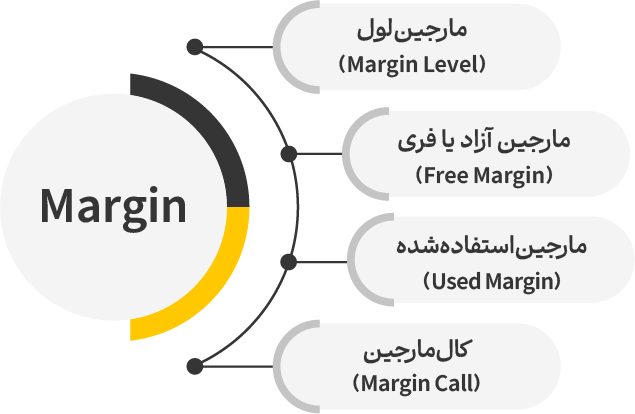
Below, we look at 4 important terms related to margin concepts:
Margin level (Margin Level)
Margin level shows the ratio of account equity to used margin and is considered one of the most important indicators of a trading account's health.
Its formula is as follows:
Margin Level = (Equity ÷ Used Margin) × 100
In other words, the higher the margin level, the safer your account is. If this ratio falls, the risk of a margin call rises. With many brokers, when the margin level reaches about 100% , a margin call warning is issued, and if it drops further, trades may be closed automatically.
Free margin (Free Margin)
Free margin is the amount of capital that remains in your account after trades are opened and that you can use to open new trades.
Put simply:
Free Margin = Equity − Used Margin
In other words, the more free margin you have, the greater your ability to open new trades or withstand market volatility.
Used margin (Used Margin)
is the part of capital locked as collateral to keep current trades open. If you open more trades, Used Margin goes up and the free room shrinks.
Margin call (Margin Call)
A margin call happens when the account's margin level reaches the threshold set by the broker. In this case, the system warns the trader that the account balance is falling and that they must either add more capital to the account or close some of their trades.
If losses keep growing and the margin level drops below a certain threshold, the broker may close your trades automatically. This situation is called Stop Out , and it is done to keep the account from going negative. This can happen to beginner traders, which is why we recommend that you include margin education in your learning plan.
Pros and cons of margin trading
Margin trading is a powerful tool for increasing potential profits in financial markets, but along with this opportunity comes high risk. Fully understanding how it works and what it leads to is a prerequisite for entering such high-risk trades wisely.
3 Key advantages of margin trading
- More buying power: With leverage, you can trade several times your actual capital.
- Diversification: You can invest in several currency pairs at the same time.
- Faster capital growth: If the trader's analysis is correct, using leverage can significantly increase trading profits relative to the initial capital.
3 Main risks of margin trading
- Faster losses: Just as leverage can multiply profits, trading losses grow just as fast, and a significant part of your capital may be wiped out in a short time.
- More psychological pressure: Fast, large swings in leveraged trades can increase stress and lead to emotional decisions, especially for inexperienced traders.
- Misuse of high leverage: Some traders use very high leverage without fully understanding the risks, which increases the chance of a margin call or trades being forcibly closed.
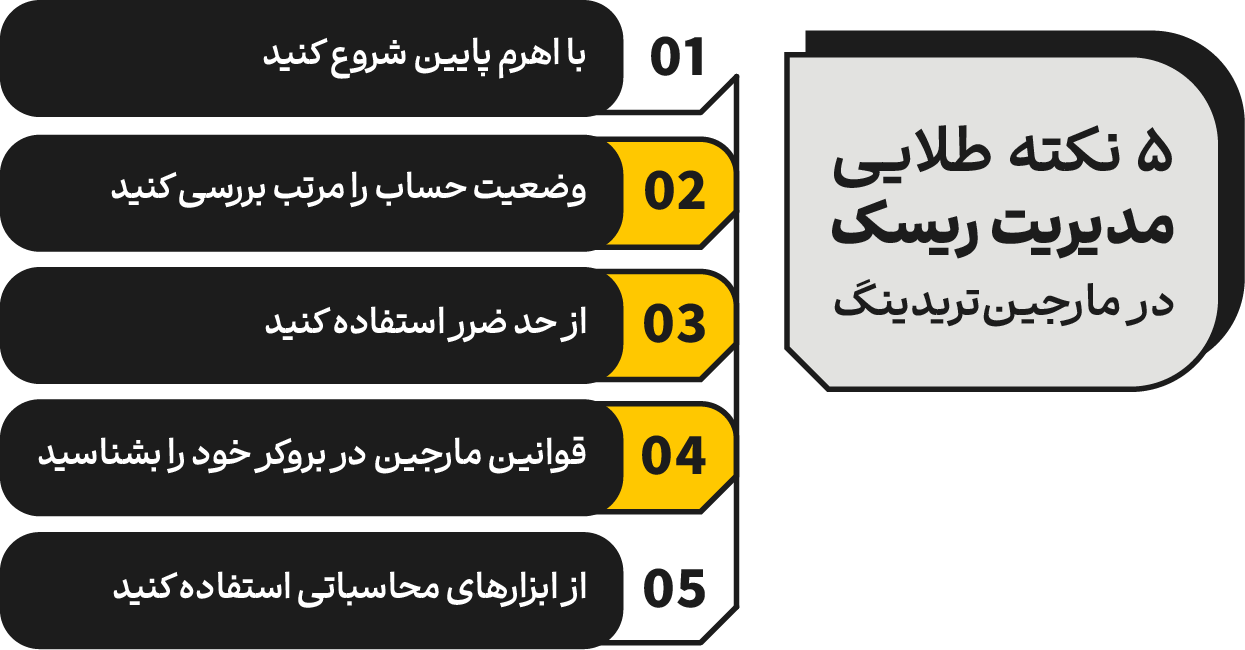
5 Golden tips for risk management in margin trading
- Start with low leverage: Using very high leverage can dramatically increase trading risk. Many professional traders recommend using lower leverage at the start (for example, less than 1:10) ).
- Check your account status regularly: Always check your account's balance, equity, used margin and free margin so you know the real state of your capital and the margin in use.
- Use stop-loss orders : Besides helping with risk management, setting a stop loss can also prevent losses from growing too large and your account from getting close to a margin call.
- Know your broker's margin rules: Each broker may have different margin call and liquidation levels. Knowing these rules helps you manage your trades better.
- Use calculation tools: tools such as a forex margin calculator help you calculate the required margin and the level of risk more accurately before opening a trade.
Frequently asked questions (FAQ)
What is the difference between margin and leverage?
Margin is the collateral that is locked in your trading account to open and hold a trade. Leverage, on the other hand, (Leverage) is a multiplier that lets you open a larger position in the market with less capital.
For example, leverage of 1:100 means that with every 1 dollar of margin you can control a trade worth 100 dollars in the market.
How can you avoid a margin call?
Risk management is the most important factor in avoiding a margin callbecoming . To reduce the risk of a margin call, the following principles can help:
- Choose your trade size in proportion to your capital.
- Always set a stop loss for your trades.
- Keep your account's free margin level at a safe level.
- Do not use very high leverage.
What is the minimum margin to get started?
The minimum capital for starting margin trading depends on the broker or exchange. Many brokers let you open an account with around 10 to 100 dollars. However, many professional traders recommend that, for better risk management and trade control, you start with around 500 dollars or more and with low leverage so you have more control over your capital.
Contents of this article


Related articles


User reviews

Newest
 Upload image