
What Is Liquidation in Crypto?

Author
Admin
Published
 2026/07/14
Updated
2026/10/25
Reading time
5 دقیقه


Liquidation is one of the most common events in leveraged financial markets, and it sometimes wipes out a significant share of traders' account capital. In this article, we explain in simple terms what liquidation in crypto is and how it happens, and we also cover how the liquidation price is calculated and, most importantly, how it can be avoided.
What Does Liquidation Mean? (A Simple Definition)
In simple terms, liquidation refers to the process in which an exchange automatically and forcibly closes a leveraged trading position, because the capital deposited as collateral (margin) for that position is no longer enough to cover the loss.
Put more simply, when a trader enters a trade with borrowed capital (leverage) and the market moves against their prediction, at a certain point the exchange automatically closes the position to prevent the trader's account balance from going negative. At that moment, all the capital allocated to that trade (the margin) has been lost. The term liquidation in crypto comes from the same concept of liquidation in traditional financial markets and liquidation in forex; that is, the broker closes the client's open trades to prevent them from going into debt in leveraged trading, and liquidation in crypto means nothing more than this technical term.
An important point worth mentioning is that liquidation applies only to leveraged trading; a trader who buys or trades crypto in the spot market without leverage will never face the risk of liquidation, because there is no debt or leverage involved.
How Does Liquidation Happen? (The Role of Leverage and Margin)
To understand how liquidation happens, you need to be familiar with 2 key concepts: leverage and margin:
- Leverage means the trader multiplies their trade size using capital borrowed from the exchange; for example, with 1:10 leverage (one to 10), someone with $100 can open and trade a position worth 10 times that amount, i.e. $1000.
- Margin is the capital the trader sets aside as collateral with the exchange or broker.
Now, when the loss on your leveraged trade grows so large that your margin balance falls below the level of capital that must be maintained, the exchange first sends the trader a Margin Call warning, and if there is no response, the liquidation process begins.
The Relationship Between Leverage and the Likelihood and Speed of Liquidation
Simply put, the higher the leverage, the shorter the price distance to liquidation and the faster it happens. A rule of thumb here is:
Chosen leverage multiplied by the loss percentage equals the percentage of total capital lost
For example, with 1:10 leverage, a price move of just 10 percent against the position and prediction means the trader effectively loses all of their allocated margin ; with 100x leverage, by contrast, the same thing can happen with just a 1 percent price swing.
For this reason, very high leverage such as 50x, 100x or more, although it may seem attractive, sharply increases the risk of liquidation, and normal market volatility can easily wipe out such positions within minutes.

The Difference Between Liquidation in Long and Short Positions
In a long (buy) position, the trader bets on the price rising, and liquidation occurs when the price drops below the «liquidation price». In contrast, in a short (sell) position, the trader bets on the price falling, and liquidation occurs when the price rises above a certain ceiling. The dangerous direction of price movement in these two types of positions is exactly opposite; that is why in volatile markets, both longs and shorts are exposed to liquidation risk at the same time.
What Is the Liquidation Price and How Is It Calculated?
The liquidation price is a specific price level at which the exchange automatically closes the trader's position once the market reaches it. This price depends on 4 main factors:
1. Entry price
2. Leverage level
3. Maintenance margin rate
4. Margin mode (isolated or cross)
- Isolated Margin: With this margin mode, only the capital you have allocated to a leveraged trade is at risk, and the rest of your account balance is protected.
- Cross Margin: With this margin mode, your entire account balance can be used to maintain the position; so the likelihood of liquidation is lower, but the risk of losing all your capital is higher.
For a long position in isolated margin mode, a common approximate formula for calculating liquidation on Binance and most similar exchanges is as follows:

For example, with an entry price of $60,000, 10x leverage and a maintenance margin rate of 0.5%, the liquidation price will be roughly $54,300. For a short position, the same logic works in reverse, and the liquidation price sits above the entry price. Keep in mind, however, that this formula is approximate.
How Does Liquidation Differ in Spot, Margin and Futures Trading?
In spot trading, you buy the asset directly with your own capital, without borrowing and without leverage. Therefore, buying and holding crypto in the spot market carries no liquidation risk; even if the price drops 90 percent, you still own the same amount of the asset.
In margin trading, however, you borrow part of the capital needed for the trade from the exchange so you can trade a larger size; this type of trading generally has lower leverage than futures, but it is still subject to maintenance margin, margin calls and ultimately liquidation on the exchange.
In futures trading, the trader does not own the actual asset but trades a derivative contract based on the future price, and can use much higher leverage. For this reason, most liquidations in the crypto market occur in the futures segment.
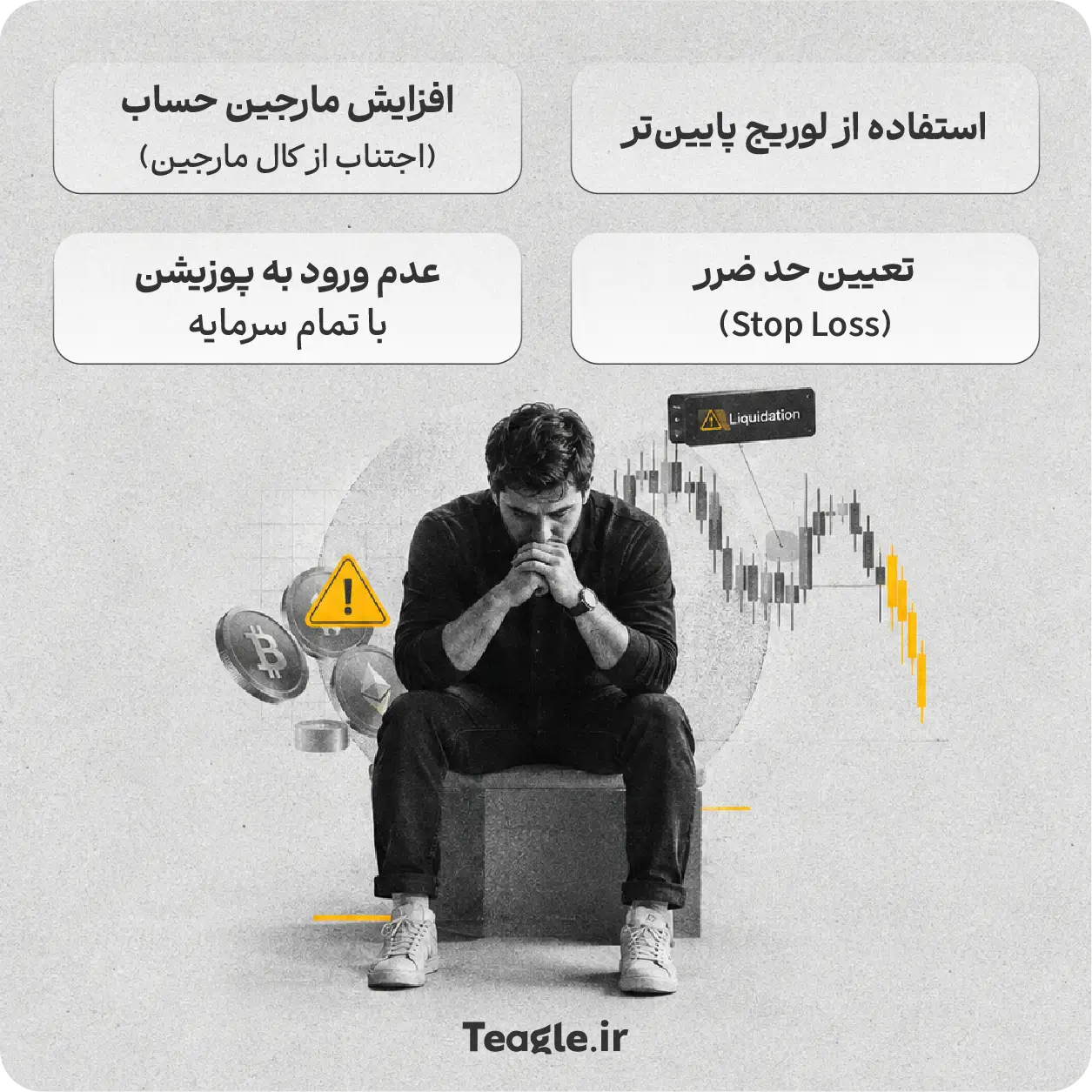
How to Avoid Liquidation?
Liquidation is a phenomenon in financial markets that can be prevented, and by following a few risk management principles, its likelihood can be greatly reduced. Below are some of the key principles for reducing liquidation risk.
Use Lower Leverage
Choosing lower leverage is the simplest and most important way to reduce liquidation risk, since the two are inherently linked. Reducing leverage from 20x to 10x naturally doubles the distance between the liquidation price and the entry price, leaving more room for normal market volatility. Experienced traders usually prefer leverage below 5x to 10x for volatile assets.
Set a Stop Loss
We recommend that your stop loss always trigger before the price reaches the liquidation level, not at the same time. If a trader opens a position with 10x leverage and sets the stop loss 2 to 3 percent away from their entry point, they will in practice exit the trade in a controlled way before the loss reaches the liquidation level, preserving a large part of their capital.
Add Margin to the Account (Avoiding a Margin Call)
If a position is approaching the danger zone, i.e. liquidation, adding extra margin (Add Margin) can push the liquidation price further away. However, this should be a deliberate decision, not an emotional reaction to escape a certain loss.
Don't Enter a Position With All Your Capital
One of the most common mistakes of beginner traders is putting their entire account balance into a single position. This leaves no reserve for adding margin in an emergency, and in cross margin mode it extends the risk of loss from a single position to the entire capital. Allocating only part of your capital to each position and keeping a cash reserve is one of the most fundamental principles of money management in leveraged trading.

What Is Market Liquidity and How Is It Related to Liquidation?
Liquidity refers to how easily a given asset can be bought or sold without causing a significant change in its price. Simply put, liquidity means how quickly an asset can be converted into money without a sharp drop in price.
Although liquidity and liquidation only seem similar in name, in practice they are closely intertwined. In shallow, low-liquidity markets, when a large volume of leveraged positions reach their liquidation price at the same time, the exchange's forced sell orders can quickly push the price lower, and this price drop in turn pushes more positions into the liquidation range.
Contents of this article


Related articles



User reviews

Newest
 Upload image