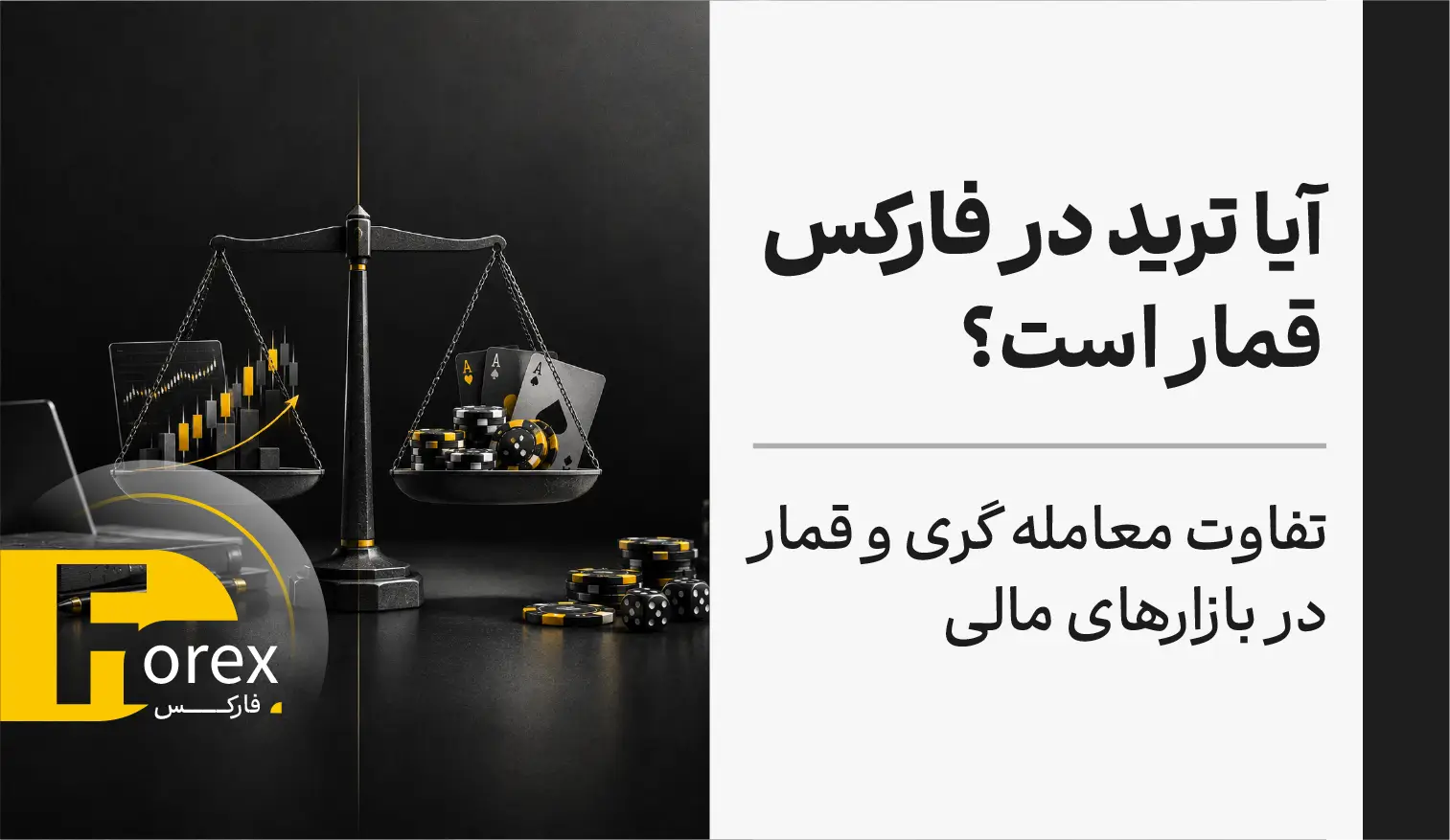
Is Forex Trading Gambling? The Difference Between Trading and Gambling in Financial Markets

Author
Arezoo Ghoochani

Expert review
Mohammadreza Minaei
Published
 2026/09/07
Updated
2026/10/25
Reading time
9 دقیقه


Can forex trading be considered gambling? The answer depends largely on the approach you take when you enter the market. When I started trading forex in 2007, I felt good about being active in the currency market and talked about it whenever I got the chance. Back then, many people didn't even know what forex trading actually was!! Below, we'll look at this topic in more detail.
Is trading really gambling?
Early in my serious trading journey, whenever someone heard I was a trader, they'd usually say: «So you must like gambling» or «You probably love Las Vegas!» I'd quickly explain that if you know what you're doing, trading has nothing to do with casino games.
The truth is that back then I didn't really know what I was doing either; I just hadn't realized it yet. All I knew was that I wanted to become one of those skilled traders who can operate confidently in the financial markets.
Trading is technically similar to gambling in that you put your money at risk and deal with uncertainty. But if you enter the forex market with a structured, disciplined approach based on information and analysis, it can no longer be equated with «pure gambling». If we look at the concept of gambling, three main elements can be seen in it: risk, uncertainty and the possibility of losing something of value. Traders face exactly the same conditions, whether they are trading currency pairs or other financial markets.
Every new trader knows that risk is always present, and every experienced trader knows that losses are an inseparable part of trading. No price move is guaranteed in advance, and the market doesn't reward emotional decisions. So why do some people claim to have strategies with consistent profitability and near-flawless win rates? In many cases, such claims are made to sell a product or give the audience a sense of security, and they make forex trading look much simpler than it really is.
The reality is that even professional traders at banks and hedge funds technically deal with probabilities and risk. The difference is that they base their decisions on probability and statistical edge, not luck; and they run forex like a business, not a hobby!
What is the main difference between forex trading and gambling?
At first glance, trading and gambling look alike, since both involve risk and uncertainty. But the important difference is that a trader can create an edge for themselves through analysis, choosing entry points, risk management and strategy design; whereas in games like roulette, the structure of the game doesn't allow the gambler to shift the underlying odds in their favor.
Put more simply, the key issue is «control». A forex trader can control factors such as the entry point, the amount of risk, the method of analysis and their strategy. This ability to create and manage an edge is what sets structured trading apart from mere betting.
What edge sets a forex trader apart from a gambler?
A casino never lets you see the dealer's cards before you bet. But in forex, you can study past price behavior before entering a trade. In a highly liquid, global market, this is an important advantage. Many new traders ignore this edge and simply react to short-term price moves without understanding the broader market context.
Your goal should be to see forex as a business, not a casino. Instead of making emotional decisions, focus on building habits that, over time, help bring stability and consistency to your trading performance.
How to be a professional trader, not a gambler
Although in terms of risk and uncertainty your work resembles gambling, or the people around you call you a gambler, there are several important practices for professional trading that set you completely apart from a gambler. We'll go over some of the tips professional traders follow in the rest of this article.
1. Think in probabilities when trading, not luck
In trading, a large part of the work is about understanding probabilities and building setups with a reasonable chance of success. Your goal isn't to know the outcome of every trade in advance; it's to choose trades whose potential profit is justified relative to their possible loss.
By using confluence and technical analysis, instead of making decisions based on emotions, you try to tilt the odds in your favor. This is exactly the point where many traders either start to improve or get caught up in trades like «revenge trading» and undisciplined habits.
The more factors line up to confirm a trade setup, the stronger your trading edge can become. In that case, you're less influenced by impulses resembling gambling behavior and move more toward a disciplined, long-term approach.
Early in my trading career, I took a trade that met several criteria at once. A strong pin bar had formed on the daily chart, and price had bounced off a key level I was watching. The overall trend was bullish, which aligned the trade idea with the direction of the market trend. The moving averages were also acting as dynamic support, suggesting that other traders were probably watching this area too.
On the other hand, there was no significant resistance in price's path, so the market had more room to move up. At that point, the trade seemed logical, because several important signals were pointing in the same direction at the same time. When you put factors like these together, you no longer behave like someone who's just chasing quick profits. Instead, you behave more like a trader who wants to understand the logic behind how financial markets move.
2. Trade like a casino owner; don't get attached to the outcome of a single trade
Casinos are one of the best examples for understanding the difference between gambling and trading. A casino owner usually doesn't care about the outcome of a single hand or a particular game, because their statistical edge shows itself over hundreds and thousands of outcomes. The casino knows it will lose in some games or against some customers, but it also knows that over a large number of outcomes, the math will ultimately work in its favor. Their income doesn't come from «luck», but from a consistent statistical edge.
Professional forex traders should operate with a similar mindset. Instead of trying to be right on every single trade, they focus on risk management and money management.
Your job isn't to win on every setup. Your job is to follow a strategy that gives you a clear statistical edge over a large set of trades. Use confluence, manage your risk and size your position correctly before entering the market, so that a single losing trade can't seriously damage your trading account.
A quick look at key tips for trading forex with a professional approach
- In general, don't make the outcome of a single trade your measure of success or failure; a strategy's performance over a series of trades matters more.
- Instead of making emotional decisions, use analysis and the confluence of several factors to improve the quality of your trade setups.
- Before entering a trade, set your risk and position size so that a losing trade doesn't seriously damage your account.
- See forex as a business, not a hobby or a way to make quick profits.
- Losses are part of trading; the goal of risk management isn't to eliminate all losses, but to prevent irreparable damage to your capital.
So, in the end, is forex trading gambling or not?
So is forex trading gambling? To put it very simply, in one sense, yes; because you're putting your money into situations where the outcome isn't certain and you're dealing with probabilities.
But when you enter the market with structure, discipline, analysis and risk management, trading becomes a completely different activity. The more you rely on analysis instead of emotions and see each trade as part of a larger set of trades, the further your approach moves away from gambling.
If someone asks you «So you like gambling?», you might be able to answer: «Yes, but only when the odds are in my favor!»
Original source: Daily Price Action — Is Forex Trading Gambling? The Answer Might Shock You
Contents of this article


Related articles



User reviews

Newest
 Upload image