
Understanding floating risk at prop firms

Author
Hossein Haghshenas
Published
 2026/10/13
Updated
2026/10/25
Reading time
15 دقیقه


Your trade may end up closing in profit, yet you could lose the prop account before that profit arrives. How? All it takes is for the loss on open trades, somewhere along the price path, to cross a limit set by the firm. In that situation, the final result of the trade does not necessarily make up for breaching the limits. Floating risk in prop trading relates to exactly this part of trading: the period when positions are still open and their profit or loss keeps changing.
To keep your account, looking at the balance or the result of closed trades is not enough. You need to know how open loss is calculated, what its cap is and how far you are from it. These are the points we will cover on floating risk, with a focus on the world of prop firms.
What Is Floating Risk in Prop Trading?
In trading terminology, floating profit and loss is the unrealized profit or loss of open trades. For example, when you hold a buy trade and the price is below your entry point, your trade naturally has a floating loss. This loss is not final until the position is closed, but it has already affected the account's current value.
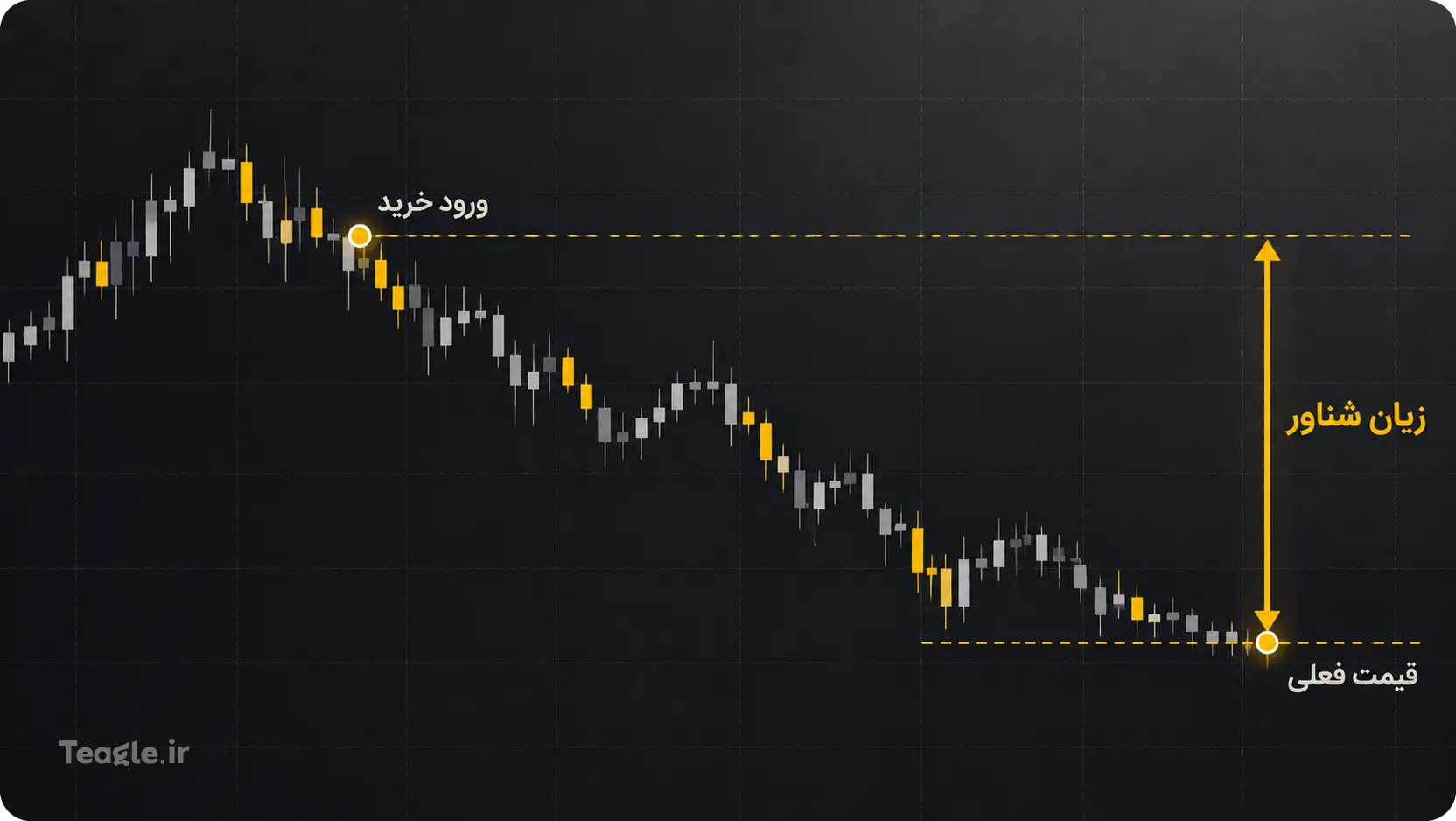
The term «floating risk» in the rules of prop firms usually refers to a limit on the loss of open trades used in prop challenges, commonly called «floating drawdown». Some firms present this limit as the floating loss rule, or Floating Loss Rule. However, its name and how it is applied are not uniform; it may look at all open trades combined, a single trade, or a group of related entries.
The key point is that a floating loss does not mean a floating cap. If your account limit is a fixed amount, higher market volatility does not by itself allow a larger loss. A figure such as 2 percent is not a general rule of the prop industry either, and you need to check the terms of that specific account.
Why Does the Floating Risk Rule Matter in Prop Firms?
If only the results of closed trades were reviewed, a trader could keep losing positions open and appear to perform well. Meanwhile, behind that record, the account could be facing a significant loss. The floating loss limit prevents this part of performance from being ignored.
That said, you should not assume that all prop accounts trade with real capital. For example, FTMO describes its services as being based on simulated trading. So the purpose of risk rules is not only to directly protect money traded in the market; evaluating the trader's behavior and setting the conditions for continuing the partnership also come into play.
From the trader's point of view, the importance of this rule lies in limiting the «I'll wait for the market to come back» option. Your analysis may ultimately be right, but an inappropriate trade size can make you breach the account limit before the price turns around. So getting the direction right without managing position size will not be enough to keep the account.
How Floating Risk and Equity Are Calculated in Trading
We need to get familiar with a few terms. Balance is the recorded account balance and does not include the unrealized profit and loss of open trades. Equity shows the account's real-time value and is affected by changes in open positions. In a simple example, ignoring account credit and separate fees:
Equity = Balance + net profit and loss of open trades
Suppose the account balance is 10 thousand dollars and two open trades are down 120 and 60 dollars respectively. If no other trade is open, the floating loss is 180 dollars and equity is 9820 dollars. If the hypothetical floating loss cap is 200 dollars, you are only 20 dollars away from it.
But this calculation has one important condition: the firm must use the net loss of trades as the basis. Some rules look at the total of losing positions separately. In that case, the profit of one trade does not necessarily offset the loss of other trades for the purpose of staying within the limit.
Before calculating, extract the following from the prop firm's rules:
- Is the allowed percentage calculated from the initial balance or the current balance?
- Does the limit apply to the whole account or to each trade?
- Is the profit of open trades netted against losses?
- How are commission and swap accounted for?
- Is reaching the limit a violation, or crossing it?
Also, don't count fees twice; some of them may already be reflected in the balance or equity.
Floating Risk vs. Drawdown and Stop Loss

Floating loss, drawdown and stop loss are related, but they do not measure the same thing. Floating loss tells you how much your open trades are in the red right now. Drawdown shows the decline in account value relative to a specific baseline. A stop loss is an order to exit a trade under set conditions.
In performance analysis, drawdown is usually measured from the account's previous peak; but prop rules may define the loss limit based on the initial balance, the start-of-day balance, or a trailing cap. So you should not calculate every drawdown limit with the same formula.
Suppose you have 300 dollars of closed losses today and your open trades are 150 dollars in the red. Your floating loss is 150 dollars, but under a daily rule that counts both, the day's loss reaches 450 dollars, before any possible fees.
Having a stop loss does not guarantee that no limit will be breached either. The combined loss of several trades may hit the account cap before their stop losses are triggered. Also, slippage can cause the exit order to be executed at a different price.
|
Floating risk |
Drawdown |
Stop Loss |
|
Shows the unrealized loss of open trades. |
Shows how much the account value has declined relative to a specific baseline. |
An order to exit a trade at a set level. |
|
Changes moment by moment as the market price changes. |
Usually calculated from the account's peak to the lowest subsequent level. |
Triggers the exit order once the price reaches a specified level. |
|
Applies only to positions that have not yet been closed. |
May be measured based on equity, the initial balance, the start-of-day balance, or a trailing cap. |
Used to control the loss of a specific trade or position. |
|
Measures the current loss status of open trades. |
Shows the account's overall decline relative to the calculation baseline. |
May be executed at a level different from the set price due to slippage. |
Consequences of Breaching the Floating Risk Rule in Prop Accounts
The consequence of breaching floating risk is not the same at every prop firm. Depending on the program, trades may be closed, the trader's profit share may be reduced, or the account may be closed. So two separate questions arise:
1. What counts as a violation
2. What is the penalty for breaching floating risk at a prop firm?
You should get these answers clear for yourself before buying an account. Also, it cannot be claimed without evidence that breaching a rule at one firm creates a shared record that prevents you from working with all other prop firms.
Strategies and Methods for Controlling Floating Risk in Trading
Controlling floating loss does not start when you open a trade; before entering, you should know how much damage the account would take if several analyses turned out wrong at the same time. The three steps below help put this plan into practice, and we will go through them next.

Using Stop Loss Properly
First, identify the point at which price reaching it would invalidate your trading scenario. Then set the size in proportion to the distance from entry to the stop loss and your risk budget. Artificially tightening the stop loss to open a larger size does not necessarily manage risk better.
There is no fixed percentage that suits every account. Choosing the risk per trade depends on the prop firm's limits, the number of simultaneous trades and the strategy's performance. For example, if the hypothetical open loss cap is 200 dollars, allocating the whole amount to one trade leaves no room for fees or differences in exit execution.
Don't move the stop loss further away just to postpone accepting a loss. Such a change increases the risk budget you set before entering.
Managing the Size and Number of Open Positions
The number of trades alone is not a good measure; the main issue is their combined potential loss. Four small trades together may create more risk than one large trade. Before a new entry, check its effect on the account as a whole.
Trade correlation also matters. Several trades on different symbols may all be hurt by the same factor, such as a stronger dollar. In that case, the apparent variety of symbols does not mean the risk is actually spread out. For example, in an account with a hypothetical cap of 200 dollars, 3 trades with a planned risk of 50 dollars each carry 150 dollars of risk in total. The remaining distance is a limited margin, not a guarantee of safety. Wider spreads, slippage or fees can change the actual result. Besides the floating loss cap, also check the remaining daily loss capacity. The daily rule may restrict you sooner.
Using indicators and risk management tools
An open P&L display, a position size calculator and an equity alert can make monitoring easier. Some tools can also close positions automatically at a set level; however, using them must be consistent with the firm's rules. Below, we briefly list 3 of these tools:
- Position size calculator (Position Size Calculator): Taking your account balance, risk percentage and stop-loss distance, it calculates the appropriate position size so that the potential loss does not exceed the set amount.
- Risk and floating P&L display (Risk Dashboard): It shows the P&L of open trades, equity, drawdown and the total risk of positions on the chart in real time.
- Equity protection tool (Equity Protector): When equity or floating loss reaches a set level, it sends an alert or closes trades; however, its automatic operation must be consistent with the prop firm's rules.
A tool is only as effective as its settings. If the firm adds up the losses of losing trades separately, a tool that only shows net P&L may misrepresent how far you are from the limit.
Set the alert before the violation threshold so you have time to make a decision. Also know when the trading day resets; in some models, a change in the daily limit's reference point can change the status of open trades relative to the allowed cap.
FAQs about floating risk in prop firms
1. Do all prop firms have a separate floating risk rule?
No. Losses on open trades may count toward the daily or overall account limit without there being a separate rule for floating risk
2. If the trade ends up in profit, is the earlier violation cancelled?
If the rule treats a momentary breach of the cap as a violation, the final profit does not undo it. The trade's outcome and compliance with the limit are two separate matters.
3. How do we manage floating risk?
Set position size based on the stop loss and the account's remaining capacity, measure the total risk of your positions, and leave a safety margin for costs and volatility.
4. Is floating risk the same as drawdown?
No. Floating loss relates to open trades; drawdown measures the account's decline relative to a set reference point and may also include losses on closed trades.
Contents of this article


Related articles



User reviews

Newest
 Upload image