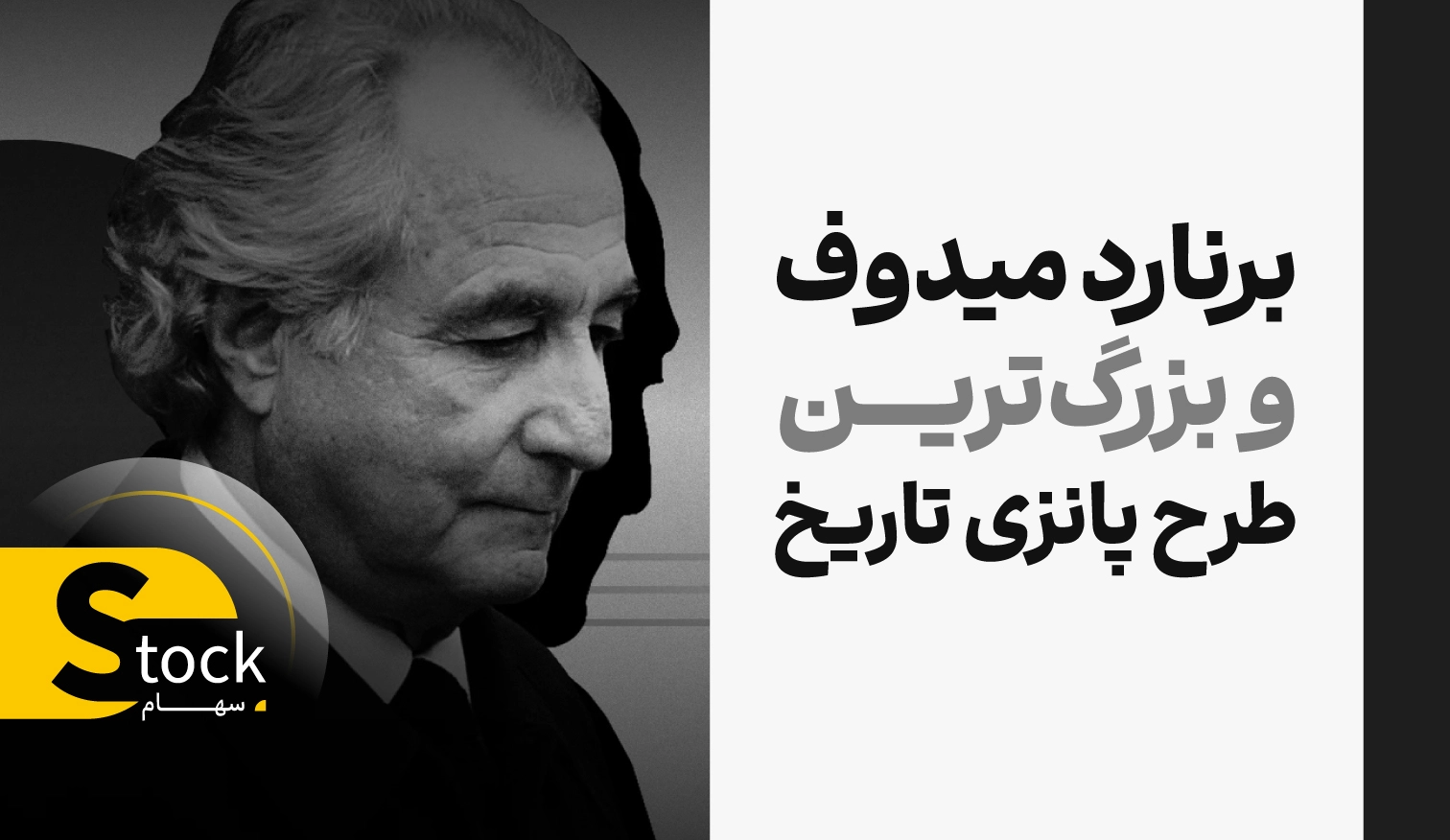
The Ponzi Scheme and the Story of the World's Biggest Financial Fraud

Author
Admin
Published
 2026/03/09
Updated
2026/10/25
Reading time
5 دقیقه


Despite all their complex regulatory structures and advanced analytical tools, financial markets have been a breeding ground for clever deceptions. And no story is as big or as appalling as the case of Bernard L. Madoff. This Ponzi scheme took in about 19 billion dollars of investors' real capital, but with fake statements that added up to about 65 billion dollars, it earned the title of the largest Ponzi scheme in history. For any trader, analyst or investor, understanding how this fraud worked is not just a matter of historical curiosity but a vital necessity for protecting capital. In this article, the Teagle content team explains the structure of a Ponzi scheme and tells the shocking story of the Madoff fraud, drawing on financial and academic sources.
Ponzi: financial alchemy built on empty promises
Before getting into the Madoff story, we need to revisit the roots of this fraud. The Ponzi scheme takes its name from Charles Ponzi, who made it famous in the 1920s. It is a fraud model dressed up as an investment, in which returns to earlier investors are paid not from real business profits but from the money of new investors.
The deception: a subtle mechanism
Ponzi scheme structures work Initial attraction: The scheme's operator promises very high, steady, risk-free returns (for example, 20% a year), which is itself a form of fraud. Early payouts: Using newcomers' money, small returns are paid to early investors to win their trust.
The trust this builds leads early investors to encourage their friends and acquaintances to invest too. As long as inflows of new capital exceed the promised payouts, the scheme stays standing. But as soon as withdrawals outnumber new investments, the scheme collapses, just as happened in 2008.
Academic sources stress that the most important red flag in Ponzi schemes is returns that are disconnected from real market performance . Returns that are unrealistically high and steady contradict the volatile, risky nature of legitimate financial markets.

Madoff's empire: a brokerage with a spotless record
Bernard Madoff, who had previously run legitimate businesses on Wall Street and had even served as chairman of the NASDAQ stock exchange, used this same mechanism for a modern, large-scale Ponzi scheme. Madoff's fraud probably began in the 1980s or the early 1990s. According to FBI analyses and academic papers, Madoff differed from traditional Ponzi schemes in three crucial factors that delayed its discovery.
Leveraging credibility and reputation
Instead of operating through an unknown company, Madoff used the respected name of his own firm, Bernard L Madoff Investment Securities. He specifically targeted the very wealthy, charities and trusted figures in New York's Jewish community, and drew in large inflows through social networks and personal trust.
A secret investment method
Madoff claimed to use a highly complex trading strategy (usually a combination of buying stocks and using call and put options) that was too complicated to be copied. In reality, he made no trades at all. This strategy, which worked like a black box , kept analysts from verifying his claims.
Regulatory failure
The worst part of this story was the failure of regulators such as the U.S. Securities and Exchange Commission (SEC). The agency was warned several times by people such as Harry Markopolos, but because of Madoff's reputation and the complexity of his defenses, the early red flags were not taken seriously.
Key point: A paper in an academic publication (SCIEPUB) notes that despite the long history of Ponzi schemes, the fraudulent nature of this scheme remained hidden for decades because of the firm's legitimate appearance.
Financial analysis: why were Madoff's returns an illusion?
For professional traders, the numbers tell the truth. In the Madoff case, the numbers were abnormal:
Strange consistency
During major market crises, including the dot-com crash in 2000 and the 2008 financial crisis, Madoff's accounts not only avoided losses but consistently reported reasonable profits. Such consistency in volatile markets is a major statistical contradiction.
No real trades
In fact, Madoff's clients' accounts were never traded on the New York Stock Exchange. They were simply fictitious entries and exits recorded in the firm's books, manipulated by a small team of Madoff's employees.
Impact on the market
When Madoff confessed in December 2008 and the scheme collapsed, it dealt a heavy blow to investors' trust in the asset management industry. The event showed that the biggest risk sometimes comes from the people we trust the most.
Markopolos's analytical method
When Markopolos examined the data from Madoff's accounts, he noticed something that is mathematically impossible in the investment world:
Madoff's monthly returns were almost always positive and showed very little volatility.
Put simply, his analytical method was this: suppose Madoff's fund returned between +0.8% and +1.2% a month, consistently, for several years. Over the same period, the real market, such as the S&P 100 or S&P 500, sometimes rose 5 percent in a month or fell 8 percent in a month.
Madoff claimed to use the Split‑Strike Conversion strategy, meaning:
· Buying stocks
· Selling call options
· Buying put options
According to real data, this strategy should have a volatility of about 3% to 5% a month and sometimes lose money in bear markets; but Madoff's data showed a consistency that was statistically impossible.
Using just three indicators, a very low standard deviation, an impossible Sharpe ratio and no correlation with the market, Markopolos concluded that the scheme was definitely a statistical fraud.
In the fund management world, this test is known as the “Stress–Consistency Check”. That is:
If returns are always positive with no volatility, zero losses are reported in abnormal markets, and the Sharpe ratio is very high, the data is very likely fake!
Markopolos later said:
«I knew within 5 minutes that he was lying, because math never lies.»
Lessons from the Madoff story: the need for financial vigilance
The story of Bernard Madoff is a financial tragedy that teaches traders some fundamental lessons:
· Be skeptical of guaranteed returns
In financial markets, high returns come with high risk. If a profit seems too good to be true, it almost always is.
· Examine the institution, not just the results
The reputation of a person or a company, even one with a record of leading a stock exchange, should never replace careful scrutiny of transparency and real performance.
· The importance of third-party verification
Investors should make sure that the trades claimed by an investment manager are verified by a transparent third party, such as a brokerage or another legal custodian.
In the end, the Ponzi scheme and the Madoff case serve as a permanent reminder that vigilance, critical thinking and refusing to give in to greed are the strongest tools of any successful trader in the markets.
Contents of this article


Related articles



User reviews

Newest
 Upload image