
What Is Coin Mixing and a Crypto Mixer, and How Does It Work?

Author
Arezoo Ghoochani

Expert review
Mohammadreza Minaei
Published
 2026/09/19
Updated
2026/10/25
Reading time
6 دقیقه


A crypto mixer (Coin Mixer) is a service that gives users a higher level of privacy by obscuring the link between the source and destination of crypto transactions. This capability has made mixers attractive to privacy advocates and, at the same time, a controversial topic for regulators and law enforcement.
In 2021, the founder of the Bitcoin Fog mixer was arrested on charges including money laundering and operating an unlicensed money transmitting business. A year later, the US Treasury Department sanctioned Tornado Cash, an Ethereum-based mixing service, effectively banning its use by US users.
In a reversal of its 2022 decision, the Treasury Department announced in March 2025 that it had removed Tornado Cash from the Office of Foreign Assets Control (OFAC) sanctions list. In a March 2026 report, the agency also acknowledged that crypto mixers can have legitimate uses for lawful users of digital assets in «providing financial privacy».
But what exactly do mixers like Tornado Cash and Bitcoin Fog do, and why do some people use them? In this article, we look at the technology behind mixers, how they work, their legitimate and illegal uses, and the legal status of these tools.
What is a crypto mixer and what is it used for?
A crypto mixer is a service that helps users hide or obscure the link between the source and destination of a transaction. In a typical setup, the user sends their crypto to the mixer, the funds are pooled with other coins or tokens, and after the mixing process an equivalent amount is sent from a different address to the recipient's address. This makes it harder to establish a direct link between the sender and the recipient.
These services can have legitimate privacy uses. Just as you might not want your employer or others to know the details of every bank transaction or credit card purchase you make, you might not want the details of all your crypto transactions to be visible to others either.
As the use of cryptocurrencies and blockchain technology has grown, so has the link between real-world identities and blockchain addresses. Because transactions on public blockchains are recorded on a transparent, distributed ledger, the purchases, transfers and interactions associated with an address can be visible to others. This is exactly where mixers come in: by creating distance between the incoming and outgoing transactions, they provide greater privacy.
However, this same capability can also appeal to cybercriminals, since hiding the link between wallets and transactions can make it harder to trace the origin of funds. As a result, mixers have become a focus for law enforcement. Crypto mixers therefore sit at the intersection of privacy protection and money laundering concerns. On one hand, public blockchains are inherently transparent and some users need more privacy; on the other, the same tools can be used to hide the origin of illicit assets.
Privacy advocates argue that mixers can be especially important in situations such as journalism, civil disobedience or protests, particularly when revealing a person's financial connection to a specific activity could put them at risk.
Why are crypto mixers dangerous?
Government agencies and law enforcement, by contrast, see mixers as tools criminals can use to launder money with crypto. In their view, services like Tornado Cash can hide the origin of funds and make tracing assets more difficult.
When it sanctioned Tornado Cash, the US Treasury Department said criminals had used the service to launder money and that the mixer had processed more than $7 billion in virtual currency since its launch in 2019. Blockchain analytics firm Elliptic had also said that around $1.5 billion of that amount was linked to illicit activity. The Treasury further said these funds included a total of $103.8 million in assets stolen from crypto bridge services by the Lazarus Group, a North Korean state-sponsored cyber group.
In November 2024, the US Court of Appeals for the Fifth Circuit ruled that the Treasury Department had exceeded its authority in imposing the sanctions. The court also held that Tornado Cash's immutable smart contracts are not «property» because they cannot be owned. The ruling reversed the lower court's decision and explained that protocols running on smart contracts cannot necessarily be classified as a «service», since they execute without human intervention.
In March 2025, the Treasury Department lifted its sanctions on Tornado Cash. Explaining its decision, the department cited its review of novel legal and policy issues raised by applying financial sanctions to activities in evolving technological and legal environments. A month later, a federal court ruled that the Treasury's actions had been unlawful and permanently barred the Office of Foreign Assets Control (OFAC) from reimposing sanctions on Tornado Cash. Judge Robert Pitman of the US District Court for the Western District of Texas issued an order prohibiting the Treasury from re-enforcing these sanctions against the mixer.
In July 2025, the US Court of Appeals for the Eleventh Circuit dismissed crypto advocacy group Coin Center's petition over the Tornado Cash sanctions. The group had argued that the Treasury exceeded its statutory authority in sanctioning the protocol. After both parties agreed the petition was moot, the court agreed to end the appeal, since OFAC had lifted the sanctions in March of that year.
In August 2025, Tornado Cash developer Roman Storm was found guilty by a Manhattan jury of operating an unlicensed money transmitting service, but the jury could not reach a verdict on the money laundering and sanctions evasion charges. After the jury failed to agree on all counts, the US Department of Justice asked Judge Katherine Polk Failla of the Southern District of New York in March 2026 to set an October 2026 date for a retrial.
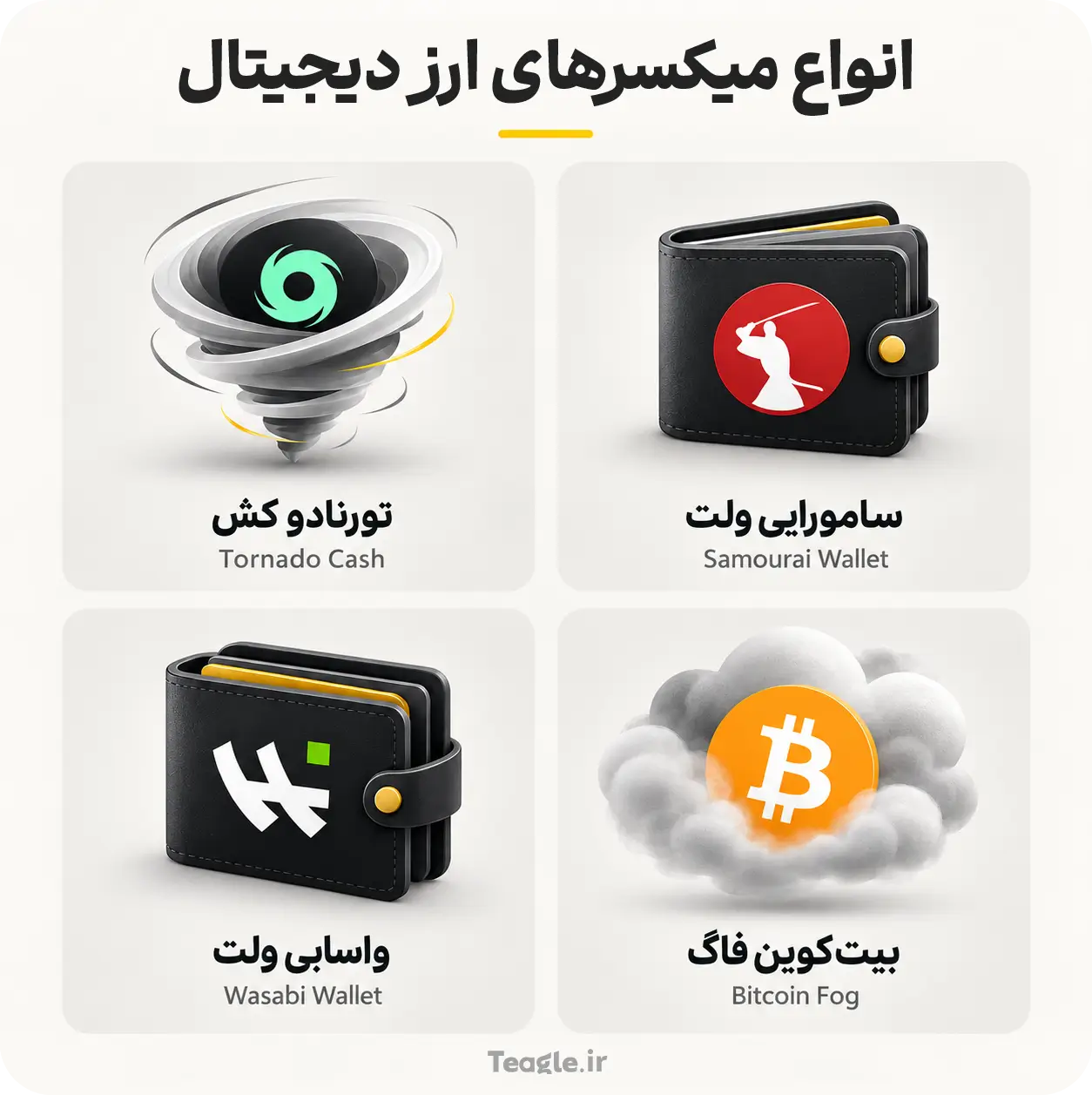
Types of crypto mixers
- Tornado Cash: Launched in 2019 by Alexey Pertsev and Roman Storm, this mixer was sanctioned by the US Treasury Department in 2022 and operates exclusively on the Ethereum network. Tornado Cash is a non-custodial service.
- Samourai Wallet: A non-custodial Bitcoin-only mixer launched in 2015 by Keonne Rodriguez and William Lonergan Hill. Its founders were arrested in 2024 and charged with conspiracy to commit money laundering.
- Wasabi Wallet: This wallet was launched in 2018 by the anonymous collective zkSNACKs and uses the ZeroLink protocol to enhance transaction privacy. In 2024, following the arrest of the Samourai Wallet founders, Wasabi blocked US residents from using its mixing service.
- Bitcoin Fog: Launched in 2011 by Roman Sterlingov, this service was a custodial mixer, meaning it held users' funds during the mixing process. Sterlingov was convicted of money laundering in 2024.
How do crypto mixers work?
Before Tornado Cash went offline, the service used smart contracts to receive tokens from one address and allow them to be withdrawn to another.
Other crypto mixers work in a similar way. A smart contract can act as a pool in which users' deposited assets are combined. When assets are withdrawn from the pool, the direct, visible on-chain link between the source and destination addresses is broken, making it harder to trace the transaction directly.
These mixers are usually non-custodial, meaning no third party has direct control over users' wallets and funds, and the core process is carried out through smart contracts. The absence of an intermediary means the protocol's operation depends on code and smart contracts rather than the decisions of a central operator. However, this same feature can also make such services attractive to criminals looking to launder stolen assets, as highlighted in the Lazarus Group case.
Timeline of the most important events related to crypto mixers
- October 2011: Bitcoin Fog, a Bitcoin tumbler service, was launched.
- December 2019: Tornado Cash was launched as a crypto mixer.
- April 2021: The US Department of Justice announced the arrest of Roman Sterlingov, the operator of Bitcoin Fog.
- August 2022: The US Treasury Department sanctioned Tornado Cash, the Ethereum-based mixer. A few days later, its developer Alexey Pertsev was arrested in Amsterdam on money laundering charges.
- March 2024: Roman Sterlingov, the operator of Bitcoin Fog, was convicted of money laundering.
- April 2024: US authorities arrested the founders of the Bitcoin mixer Samourai Wallet and charged them with conspiracy to commit money laundering.
- May 2024: Wasabi Wallet announced the preemptive shutdown of its mixing service and restricted US customers from using its services. At the same time, Phoenix Wallet removed its app from US app stores, and the hardware wallet Trezor also announced it was discontinuing its Coinjoin feature.
- November 2024: The US Court of Appeals for the Fifth Circuit ruled that Tornado Cash's immutable smart contracts cannot be classified as «property».
- March 2025: The US Treasury Department lifted its sanctions against Tornado Cash.
- April 2025: A US federal judge issued a ruling permanently barring the Treasury Department from reimposing sanctions on Tornado Cash.
- July 2025: A US appeals court granted a joint motion to end crypto advocacy group Coin Center's appeal over the OFAC sanctions.
- August 2025: Tornado Cash developer Roman Storm was found guilty of conspiracy to operate an unlicensed money transmitting business; however, the jury failed to reach a verdict on the money laundering and sanctions evasion charges.
- March 2026: In a report to Congress, the US Treasury Department acknowledged that crypto mixers can have legitimate uses for law-abiding crypto users in providing financial privacy.
- March 2026: Federal prosecutors sought a retrial of Roman Storm on the money laundering and sanctions evasion charges on which the jury had failed to reach a verdict in August 2025.

Legal uses of crypto mixers
To understand one of the legitimate uses of mixers, imagine a business owner and crypto enthusiast named Robert who wants to send some Ethereum to a hacktivist group active in Ukraine. Robert does not want his donation to be directly traceable to his identity, so he uses a crypto mixer.
Robert goes to the mixer's website and deposits the Ethereum he intends to donate. The funds enter the mixer's smart contract and sit in its pool alongside hundreds, thousands or even millions of other transactions. Once the deposit is confirmed as successful, Robert goes to the withdrawal section, enters the recipient's address and completes the process of sending the Ethereum through the mixer.
Finally, the Ethereum is transferred from the mixing process to the recipient's address. On the recipient's side, the address shown in the transaction belongs to the mixer, not Robert's original address, so the direct link between sender and recipient on the public blockchain becomes more obscured. This hypothetical scenario is based on an example that Ethereum co-founder Vitalik Buterin raised in a tweet after the Treasury Department sanctioned Tornado Cash. In its March 2026 report to Congress, the Treasury Department also showed a more flexible stance toward the legal uses of mixers, stating that legitimate users of digital assets may use mixers to maintain financial privacy on public blockchains.
The future of crypto mixers and blockchain privacy
Despite numerous court cases and sanctions against crypto mixers, the debate over privacy in the crypto market continues. The Treasury Department's acknowledgment in March 2026 that mixers have legitimate uses marks an important shift in the official approach to these tools; however, cybercrime experts have criticized what they see as Washington's «inconsistent» policy on mixers and crypto privacy.
David Sehyeon Baek, a cybercrime consultant, told Decrypt about the contradiction that, on one hand, the Treasury Department has explicitly accepted that mixers and privacy tools can have legal uses, while on the other, the Department of Justice continues to pursue a criminal case against a mixer developer, even after the jury in the first trial failed to reach a verdict on all charges.
The November 2024 ruling on immutable smart contracts was also regarded by crypto and privacy advocates as an important milestone. Under this ruling, self-executing code that operates without administrative control cannot be classified as «property» and become subject to sanctions merely because the code itself exists.
Alongside traditional mixers, newer projects such as Railgun have emerged with the aim of providing users with on-chain privacy while trying to remain compliant with legal requirements. Railgun is not considered a traditional mixer; the platform does not combine assets from multiple different sources the way classic mixers do. Its founders believe this design helps Railgun avoid some of the problems that ultimately led to sanctions or lawsuits against other mixers.
The platform also uses a mechanism called «Private Proof of Innocence» to prevent bad actors from using it for illegal purposes. For example, on 11 July 2024, an individual or group called Inferno Drainer, known for stealing crypto assets, attempted to launder 174 ETH through Railgun, but Railgun detected the wallet's link to a malicious actor and blocked the transactions.
Whether crypto privacy projects' efforts to build legally compliant mixing tools can change lawmakers' minds remains a matter of debate. Even so, privacy on public blockchains is likely to remain one of the key issues in the crypto industry, and privacy advocates continue to stress the need to prevent crypto from becoming a tool for mass surveillance.
Lia Holland, campaigns and communications director at Fight for the Future, also stressed in 2022 that hackers and cybercriminals must be stopped, but tackling them should not come at the cost of endangering human rights and legal freedoms.
Conclusion
A crypto mixer is a tool for increasing transaction privacy that, by creating distance between incoming and outgoing transactions, makes the direct link between source and destination on the blockchain harder to trace. On one hand, these tools can be used to protect the financial privacy of law-abiding users; on the other, because of this very feature, they can be used by criminals to hide the origin of illicit assets.
Tornado Cash, Samourai Wallet, Wasabi Wallet and Bitcoin Fog are well-known examples of mixers, and the legal cases and regulatory actions related to them show that the line between privacy, law enforcement and the responsibility of developers of this technology is still debated. Legal developments in recent years, including the US Treasury Department's change of stance on Tornado Cash and its acceptance of the legitimate uses of mixers, show that the legal and regulatory status of this field is still evolving.
Source
Decrypt — What Are Coin Mixers and How Do They Work
Contents of this article


Related articles



User reviews

Newest
 Upload image