
Is buying gold with a loan and installments a good financial decision?

Author
Marzieh Mazaheri
Published
 2026/08/22
Updated
2026/10/25
Reading time
5 دقیقه


In turbulent economies facing high inflation rates, preserving the value of assets and the purchasing power of money is a key concern for many people and investors. Gold, thanks to its historical track record as a safe haven against economic volatility, has always attracted attention.
However, rising gold prices and liquidity constraints have made buying it with cash difficult for part of society. This gap between rising gold prices and people's cash purchasing power has led options such as installment purchases and loan financing to attract more attention than before. But accepting or rejecting this approach requires a careful analysis of its advantages, disadvantages and associated risks, so that each person can make an informed decision suited to their financial situation.
Why is buying gold with a loan or in installments considered an option in current conditions?
In periods of rising inflation, the value of the national currency gradually declines, which pushes people toward assets that can preserve part of the value of their capital. Gold, as a capital asset that in many inflationary periods has been able to withstand the loss of currency value, becomes more attractive in such conditions. However, rising gold prices can make buying it with cash difficult for many people.
Buying gold with a loan or in installments is one way to make entering this market easier for people who cannot afford to pay cash. With this method, a person allocates part of their capital to gold without paying the full amount upfront, while keeping more liquidity for their other needs. Of course, this decision only makes sense when the costs of the loan or installments, the repayment terms and the likelihood of gold price changes are carefully weighed together; because the goal is not simply to buy gold, but to determine whether this way of buying ultimately helps preserve or increase the value of capital, or whether its financing cost wipes out the potential advantage.
Advantages of buying gold in installments in an inflationary economy
Buying gold in installments under inflationary conditions can offer significant advantages for people looking to preserve the value of their assets. While reducing the pressure of a cash purchase, this method makes it possible to allocate part of future income to buying an asset.
Preserving the value of money and smart investing
One of the most important functions of gold in an inflationary economy is its ability to preserve the value of money . As the inflation rate rises, the purchasing power of the national currency declines. Buying gold can be a way to preserve part of an asset's value against the loss of purchasing power. When gold is bought in installments, a person is effectively using current money, whose value declines over time, to buy an asset whose value usually rises in line with inflation or even more. This process creates the opportunity to benefit from future increases in the gold price and, from this perspective, is considered a smart investment.
Ability to buy more gold with a smaller budget
Installment purchases reduce the budget constraints of buying with cash. People can acquire more gold with a smaller down payment and a commitment to monthly installments. This advantage is especially important for those who lack substantial initial capital to buy gold but want to enter this market. With this method, gold can be accumulated gradually, and people will be able to strengthen their investment portfolio against economic volatility without having to spend all their liquidity at once.
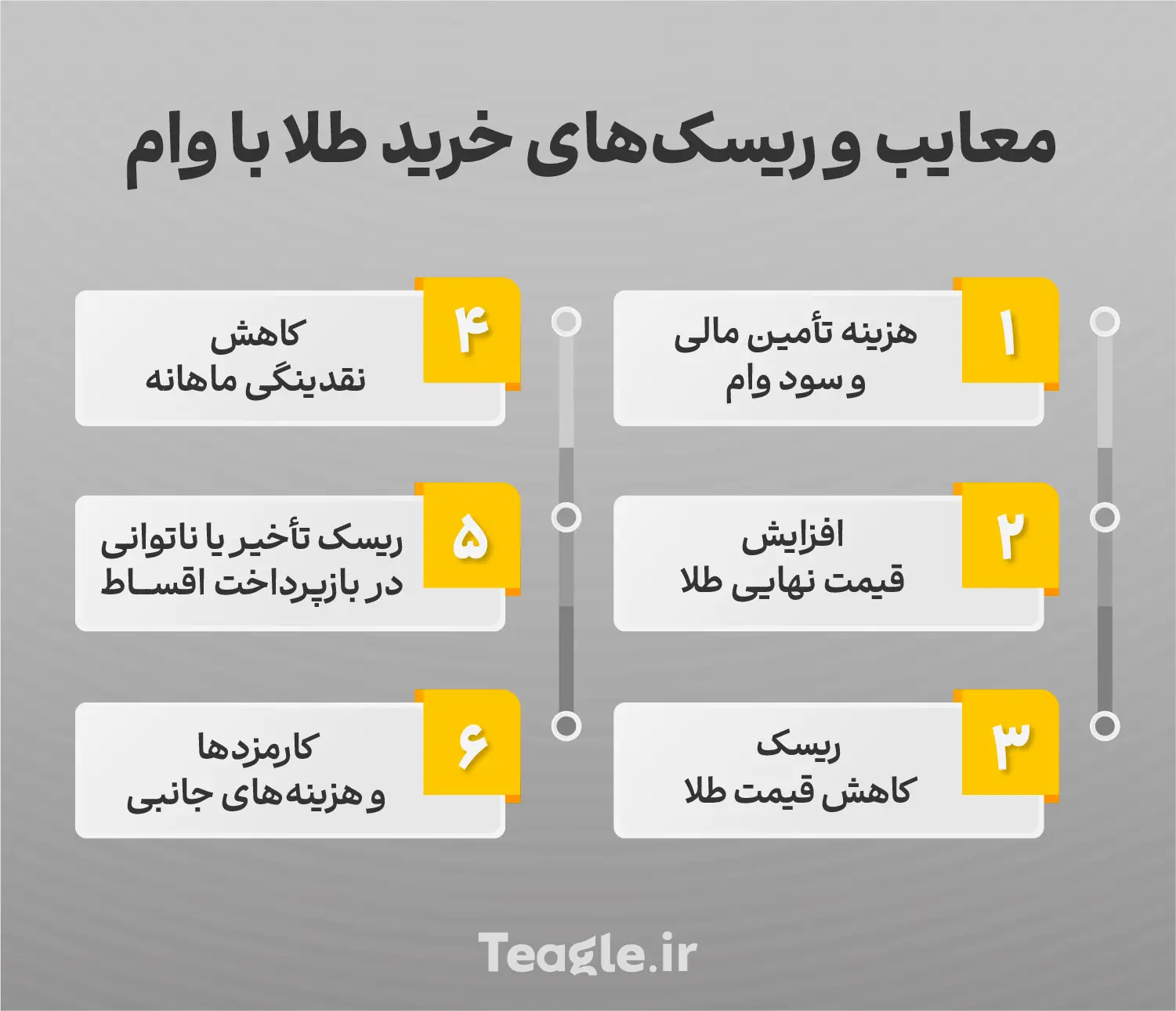
Disadvantages and risks of buying gold with loans and installments
Despite the advantages mentioned, buying gold with a loan or in installments is not free of risks and drawbacks. A careful review of these aspects is essential for responsible financial decision-making.
Fees, bank interest and price bubbles
One of the most important disadvantages of buying gold in installments is its higher total cost compared with buying in cash. Depending on the type of facility and contract, the buyer may pay, in addition to the principal, loan interest, fees or an amount for the installment sale terms. Therefore, looking only at the amount of each installment is not enough; the total paid by the end of the repayment period should be compared with the cash price of gold.
On the other hand, the gold price may contain a bubble at the time of purchase. The bubble refers to the difference between the market price and the intrinsic value of gold, and it can grow during periods of rising demand or market excitement. In such conditions, the buyer may acquire gold at a price above its intrinsic value; something that, if the bubble shrinks, can wipe out part of the expected return. As a result, combining installment costs with buying gold at bubbly prices can increase the total cost and reduce the final return on investment.
Risk of being unable to pay installments
The most important risk in this type of purchase is being unable to pay the monthly installments. Unpredictable economic conditions, job loss or sudden financial problems can interrupt installment payments. In such a case, a person may face late-payment penalties, legal pressure and even the loss of the gold purchased. This situation not only puts the initial capital at risk but can also damage the person's credit history. Therefore, making sure you can pay installments regularly throughout the entire period is an absolute necessity.
Types of methods for getting a loan and buying gold in installments
There are several ways to buy gold in installments or with a loan, each with its own terms and features. Knowing these methods helps in choosing an option suited to your financial situation.
Some platforms and payment gateways allow installment purchases of goods and services without needing a guarantor or a cheque. These methods often operate based on online credit scoring and people's financial history. For example, platforms such as «Snapp Pay» and «Kamaan» in Iran offer such services, through which you can indirectly make installment purchases using your own credit. These methods usually have a set credit limit and may not be suitable for buying large amounts of gold, but they are a practical solution for buying small amounts of gold with low sums.
Gold purchase loans with a Sayadi cheque
With this method, people get a loan or buy gold in installments by providing a Sayadi cheque (new cheques registered in the Sayad system). Because it can be tracked and is registered in the banking system, a Sayadi cheque carries more credibility. Companies such as «Azki Loan» and «Digi Shahr» are among the platforms offering this type of service against a Sayadi cheque. This method usually allows higher amounts than methods without a guarantor, but it requires having a chequebook and a suitable financial history.
Getting an instant loan by pledging gold as collateral
Interestingly, existing assets can sometimes be used to raise the liquidity you need. That is, if you already own gold or coins, instead of selling them you can, under some loan schemes, deposit them with a bank as collateral and get a loan in return. This way, without selling the asset, you gain cash access to part of its value.
One of the best-known examples in this area is Bank Kargoshaei, affiliated with Bank Melli, which offers qard al-hasan and murabaha facilities against pledged gold to meet financial needs. With this method, the gold remains with the bank as collateral until the loan is settled, and the facility amount is determined based on the bank's valuation and rules. Some banks and institutions also have schemes based on coins or gold deposit certificates; so the type of gold accepted, the facility limit, the interest rate and the repayment terms should be checked with the provider when applying.
Comparing cash and installment gold purchases: which is better?
Choosing between buying gold in cash or in installments depends less on one method being «better» and more on the buyer's financial situation and the cost of financing. The comparison below can make the decision easier:
|
Criterion |
Buying gold in cash |
Buying gold in installments |
|
Initial capital |
Full amount must be paid at the time of purchase |
Possible to buy with less initial capital |
|
Financing cost |
None |
Includes interest, fees or the difference between cash and installment prices |
|
Total cost |
Usually lower |
Usually higher than a cash purchase |
|
Liquidity |
A larger share of liquidity is tied up in the purchase |
Part of your cash is preserved |
|
Debt risk |
None |
There is an obligation to pay installments |
|
Benefiting from gold price growth |
From the time of purchase, any increase in the value of the entire asset belongs to the buyer |
Similar to a cash purchase, but installment costs reduce the return |
|
Suitable for |
People with sufficient cash who want to reduce the cost of purchase |
People with limited cash or who need to keep part of their capital accessible |
Which option is better for you?
A cash purchase is usually the cheaper and less risky choice, especially if you can pay the full amount and don't want to take on a new financial obligation.
Buying in installments can make sense for people with limited cash, provided that the total interest and fees, the price difference compared to a cash purchase, and your ability to repay the installments are carefully examined. If the potential rise in the gold price cannot offset these costs, buying in installments will be less justifiable as an investment.
Golden tips before signing a gold installment purchase contract
Before signing any contract to buy gold in installments or taking out a loan for this purpose, it is essential to follow the tips below to prevent potential problems:
1. Carefully review the terms and conditions: Read all the clauses of the contract carefully, including the interest rate, installment amounts, late payment penalties, hidden costs and termination conditions.
2. Compare different offers: Compare the interest rates and fees offered by different sellers and financial institutions to choose the best option.
3. Calculate your repayment capacity: Make sure you are able to pay the installments regularly throughout the entire term. The financial burden of the installments should not exceed 20 to 30 percent of your monthly income.
4. Transparency of the final price: Ask the seller to provide the final price of the gold, including all costs and interest, clearly and in writing.
5. Verify the seller: Make sure of the credibility and legal licenses of the gold seller or financial institution.
Is buying gold with a loan right for you?
The decision to buy gold with a loan or in installments depends heavily on your personal financial situation and your expectations of the market. In inflationary conditions, this approach can be a way to preserve the value of your assets and benefit from gold's growth potential, especially for people who don't have the cash needed for a cash purchase. Advantages such as being able to buy more gold with a smaller budget and countering the loss of currency value make this method more attractive. However, its drawbacks should not be overlooked, including extra costs such as bank interest, fees and the risk of being unable to pay the installments. Carefully evaluating these factors and paying attention to the golden tips before signing the contract is vital for a successful financial decision. Ultimately, this choice is only appropriate when a person makes it based on their own analysis, with a full understanding of the risks and confidence in their ability to repay.
Contents of this article


Related articles


User reviews

Newest
 Upload image