Comparing Traditional and Modern Financial Markets in Iran
Author
Admin
Published
 2026/03/06
Updated
2026/10/25
Reading time
5 دقیقه


Financial markets play a very important role in facilitating capital flows and allocating resources efficiently. In Iran, this financial sphere is divided into two parts: traditional financial markets, whose roots lie in very old economic institutions, and modern financial markets, which are the product of technological progress and globalization. Understanding the operational differences and inherent risks of these two types of markets is fundamental for any Iranian trader and investor seeking to preserve the value of their assets and earn stable returns. Teagle aims to offer you, our dear readers, an in-depth analysis of these two areas so that you can get a clear and accurate picture of the opportunities available in the country's economic environment.
What role do financial markets play in the economy and investing?
Beyond being a place to buy and sell assets, financial markets provide efficient tools for channeling small and large amounts of capital toward productive sectors of the economy.
Their main role is to provide the facilities governments and companies need to raise funds by issuing securities, as well as to provide mechanisms for managing collective risk. These markets give investors an environment through which they can diversify their portfolio, preserve the value of their money against inflation, and gain access to good liquidity. The efficient functioning of these structures directly affects macroeconomic stability and the dynamism of the production and consumption cycle.
What are the types of financial investment markets?
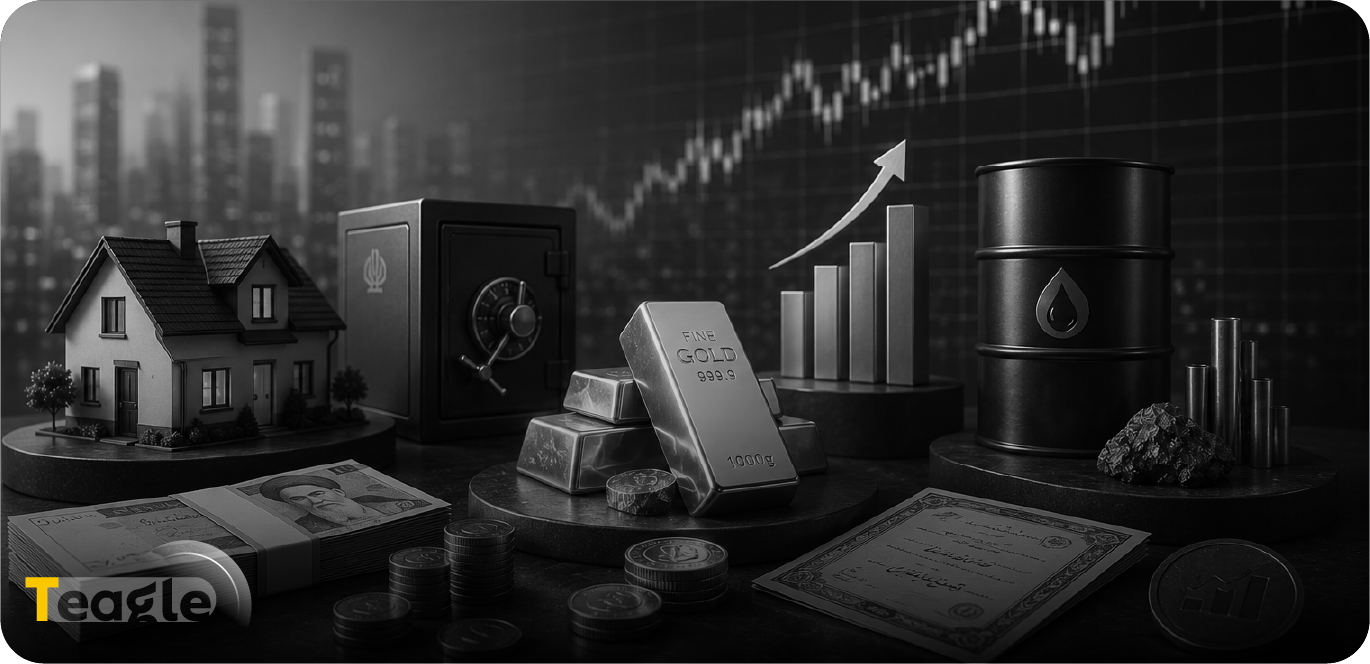
Financial investment markets can be classified by criteria such as the type of asset traded, the time horizon of contracts and the risk tolerance of investors. One of the best-known distinctions is the division of markets into short-term and long-term.
In short-term markets, usually known as the «money market», short-maturity instruments are traded to managedoing liquidity and provide short-term financing. In contrast, long-term markets, or the «capital market», focus on assets with intrinsic value and financial instruments with longer time horizons.
The scope of these markets is very broad, ranging from traditional markets based on physical assets such as gold, currency and real estate to modern markets based on new financial technologies and decentralized technologies (DLT) such as cryptocurrencies.
Traditional financial markets
These markets come with classic financial frameworks, and they operate under accepted regulations and established institutional infrastructure. In Iran, these markets are usually closely supervised by government bodies, and their operational transparency reduces execution risks for participants. In fact, such markets are the main structures through which most of the financing of large companies and long-term investment takes place.
Stock and securities market
is known as the most important pillar of traditional markets, a place for trading shares of public joint-stock companies as well as debt securities such as participation bonds. This market plays a dual role: on the one hand, it is a channel for injecting capital into the economy through companies, and on the other, it provides a platform for individuals' long-term capital growth.
In Iran, the stock exchange is seen as a symbol of structured, analysis-based investing.
Gold and coin market
The gold and coin market is very important in Iran, because gold has always, in all circumstances, been regarded as one of the safest tools for preserving asset value against declining purchasing power and economic crises. Thanks to its good liquidity, its ability to be quickly converted into cash and its direct link to the global price of an ounce of gold, this market is popular with investors. In addition, changes in the domestic exchange rate also play an important role in determining the final price of gold and coins.
Money market
The money market focuses on facilitating trades in short-term financial instruments, usually with maturities of less than one year. Its main function is the temporary management of liquidity shortfalls or surpluses for large economic institutions and banks. This market is the foundation for implementing the central bank's monetary policy and includes instruments such as short-term treasury bills, certificates of deposit and other short-term debt instruments.
Housing and real estate market
Because of their tangible, real nature, the housing and real estate market has always been one of the largest and most stable investment areas in Iran. This market includes assets with long lifespans and low depreciation, which is why many investors consider it a good choice for preserving the value of their capital over the long term.
It is worth noting that although the housing market is less liquid than markets such as the stock market or gold, in inflationary conditions it can act as an effective tool for preserving asset value against declining purchasing power.
Commodity market
The commodity market is where standardized and approved raw materials and products, including metals, agricultural products and petroleum products, are traded. In Iran, this market usually operates through the Iran Mercantile Exchange, and its goal is to create transparency in the pricing of production inputs and to meet the needs of manufacturers.
Modern financial markets
Modern financial markets are platforms that, by using digital technologies and the internet, have broken through geographical borders and provided global access. Their main features include extremely fast execution, deep liquidity in some assets and increasingly complex trading instruments. For Iranian traders, entering this space means accepting the risks associated with international sanctions and needing secure access tools such as VPN .
Crypto and cryptocurrency market
The crypto and cryptocurrency market, which is built on blockchain technology, is regarded as the newest financial sector. By focusing on decentralization, this market makes it possible to transfer value without the need for traditional financial intermediaries. This field, especially with the emergence of digital currencies, has drawn widespread attention because of its potential and astronomical returns alongside the risk of extreme volatility.
Forex market
The forex market is the most liquid market in the world and is dedicated to trading national currencies against one another. Participants in this market seek to profit from moment-to-moment changes in currency exchange rates. Despite limited official access for Iranians, a considerable volume of trading takes place through international brokers, which requires specialized knowledge of risk management for currency positions.
Derivatives market
The derivatives market includes instruments whose value depends directly on an underlying asset such as (stocks, commodities or interest rates). These instruments, which include futures contracts and options , are usually used to hedge against price fluctuations, manage financial risk and also for speculation. At the global level, these instruments are much more complex than the simple structures available on Iran's domestic exchange.
Proptrading and investing with other people's capital
Prop trading is a new model in which specialized firms provide their capital to professional traders. This process is an example of investing with other people's capital, allowing traders to access large trading volumes without using substantial personal capital and to receive a percentage of the profits as a fee. This model requires the trader to prove strong trading ability.
markets Web3, NFT and DeFi markets
These markets are new layers of the digital economy that run on smart contracts. DeFi (decentralized finance) aims to eliminate traditional financial intermediaries and offer lending and borrowing services automatically. NFTs, meanwhile, establish unique digital ownership in the world of art and virtual assets. The ultimate goal of these spaces is to create an automated and transparent financial ecosystem.
Comparing traditional and modern financial markets (pros and cons)
To understand more precisely the boundaries between these two categories of financial markets, a comparative analysis in terms of capabilities, limitations, advantages and disadvantages is essential.
|
Aspect |
Traditional markets (such as the stock exchange) |
Modern markets (cryptocurrency and forex) |
|
Laws and legal protection |
Closely supervised by domestic bodies; clear legal protection |
Scattered international oversight; risk of no legal protection in Iran |
|
Trading volume and liquidity |
Good to moderate; liquidity is strong in major assets |
Very high; forex is the most liquid market in the world |
|
Trading hours |
Limited to specific business hours (usually Saturday to Wednesday) |
24 hours a day and 7 days a week |
|
Main risk |
Political and macroeconomic risks and company volatility |
Technical risks (hacks, lost keys), extreme volatility |
|
Analytical tools |
Usually based on traditional fundamental analysis |
Requires advanced technical analysis knowledge and digital tools |
Which financial market is right for Iranian investors?
There is no absolute answer to which market is right for Iranian investors; it depends entirely on the investor's time horizon and risk tolerance.
1. The stability path (traditional markets): Investors whose main priority is preserving the value of their capital against inflation and avoiding the risks of extreme market volatility should focus on assets such as the gold and coin market and shares of fundamentally strong companies on the stock exchange. These markets are safer in rial terms.
2. The high-return growth path (modern markets): Traders who have the necessary technical knowledge and can handle the volatility of crypto or forex can allocate part of their assets to these markets to benefit from their higher growth potential, while being fully aware of the risks.
A sensible approach is to build a diversified portfolio that combines a balanced mix of the security of traditional markets and the growth potential of modern markets.
Contents of this article


Related articles

User reviews

Newest
 Upload image