
The Story of the 2015 Swiss Franc Crisis and Its Consequences

Author
Marzieh Mazaheri
Published
 2026/03/04
Updated
2026/10/25
Reading time
5 دقیقه


January 15, 2015 was one of the most unforgettable days in the history of the currency market; a day when a few-line decision by the Swiss National Bank threw the global forex market into chaos within a short time.
The Swiss National Bank (SNB) announced, without prior warning, that it would no longer defend the minimum rate of 1.20 francs per euro. A market that for more than three years had viewed this price level as an almost certain floor suddenly found this shield removed.
The result was a sharp jump in the value of the Swiss franc, a historic crash in the EUR/CHF pair and volatility that many traders, and even forex brokers, were not prepared to face. Some traders lost all their capital within minutes, and several companies in the forex industry faced a liquidity crisis or bankruptcy.
This event, which later became known as the Swiss franc shock or SNB Shock , is still one of the most important historical examples for understanding central bank policy risk, the danger of high leverage and the limits of stop-loss orders in crisis conditions.
Background to the crisis: why did the Swiss National Bank set the 1.20 cap?
To understand the controversial 2015 decision, we need to go back a few years.
In 2011, the European debt crisis pushed investors toward safe-haven assets and currencies to preserve the value of their holdings. The Swiss franc was one of the main destinations for this capital.
Rising demand for the franc caused the currency to strengthen sharply, which put pressure on Switzerland's export-driven economy. A stronger franc made Swiss goods more expensive for foreign buyers and at the same time increased the risk of falling inflation and of the economy slipping into a very low-inflation environment.
Under these conditions, on September 6, 2011, the Swiss National Bank announced that EUR/CHF should not trade below 1.20 francs per euro. To defend this level, the SNB said it was prepared to buy foreign currency in unlimited quantities if necessary.
This policy lasted for more than three years and sent the market the message that the 1.20 level was a very strong line of defense. But maintaining such a commitment came at a cost.
The greater the pressure for the franc to strengthen, the more foreign currency the SNB had to buy to defend the set floor. As a result, the Swiss central bank's balance sheet and foreign exchange reserves grew dramatically. Eventually, changing conditions in the global economy made continuing this policy increasingly difficult for the SNB.
The hour of the shock: what happened on January 15, 2015?
On January 15, 2015, the Swiss National Bank announced that it was abandoning the minimum rate of 1.20 francs per euro.
At the same time, the SNB lowered the target range for the three-month LIBOR by 50 basis points and cut the interest rate on part of the sight deposits held at the central bank to minus 0.75 percent. The aim of the rate cut was to make holding francs less attractive and to offset part of the pressure caused by removing the exchange rate floor.
The decision was made at a time when pressure on the euro had increased, and the SNB later explained that the continued weakening of the euro meant the 1.20 floor could only be maintained through permanent and ever-increasing currency interventions; a situation that was no longer considered sustainable.
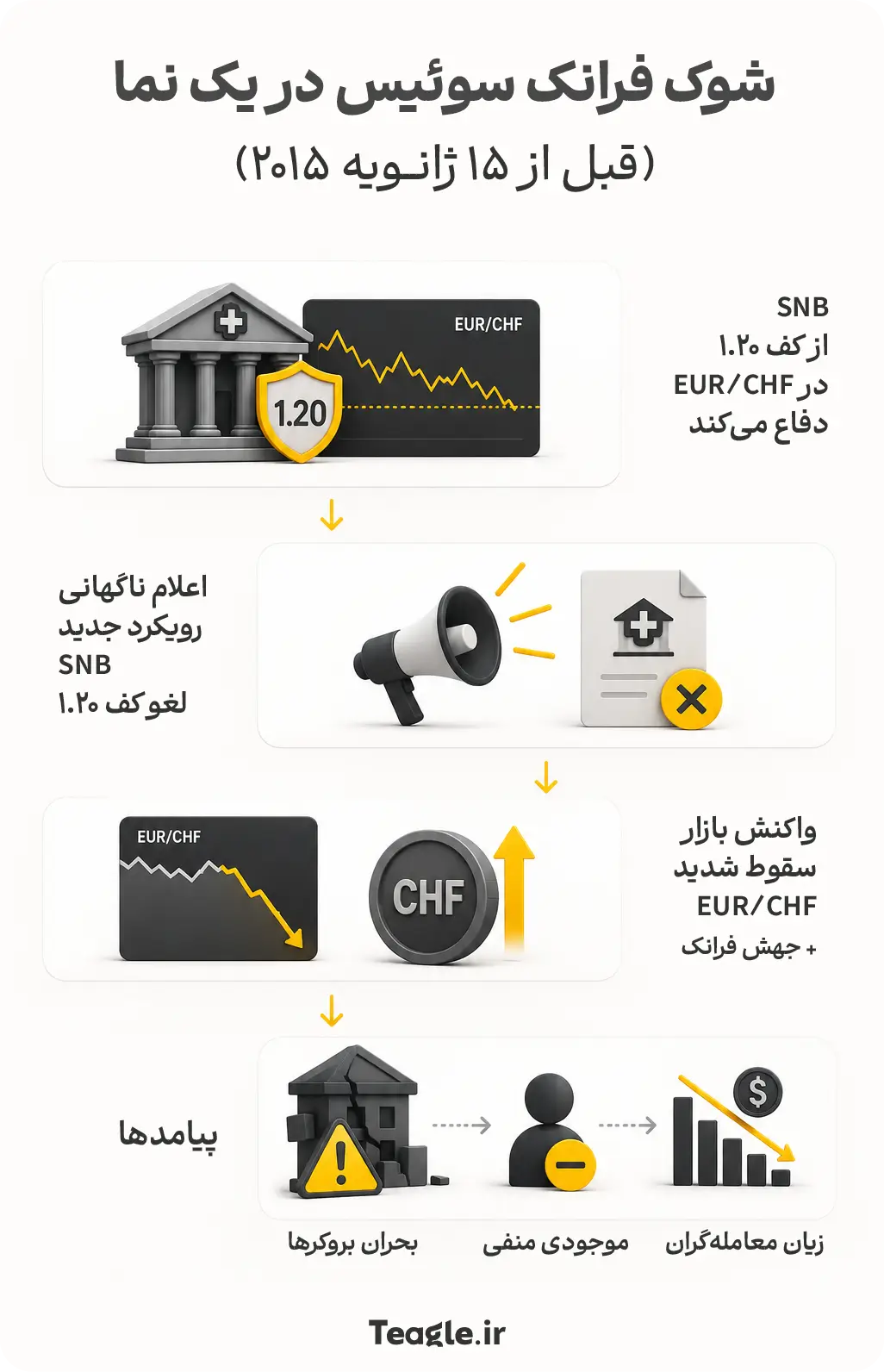
Until then, many market participants believed the SNB would continue to firmly defend the 1.20 level. In fact, this very confidence had led some traders to build their trading strategies around the durability of this level. But once the news broke, this assumption collapsed within seconds.
The EUR/CHF crash: when market liquidity vanished
After the currency floor was scrapped, EUR/CHF fell at an almost unprecedented speed. The pair, which had been trading near 1.20 before the announcement, reached around 0.85 on some sources and trading platforms during that day's extreme volatility.
Under normal conditions, a trader can expect a stop-loss order to be executed close to the set price. But during the franc shock, at certain moments there was effectively not enough liquidity in the market. Put simply, there were sellers, but not enough buyers at prices close to the last traded rate.
The result was that many stop-loss orders were executed with extremely severe slippage . In some cases, traders were taken out of the market at prices far beyond their expected stop-loss level.
This showed that even a stop-loss does not guarantee an exact exit at a specific price when an extreme event occurs.
Victims of the franc shock: brokers that faced crisis within hours
The Swiss franc shock did not only hit traders' accounts; the business model of many forex brokers also came under pressure. Because of leverage, many traders not only lost the capital in their accounts but in some cases ended up with negative balances. This created a serious problem for brokers.
When a client suffers a loss larger than their account balance, depending on the account structure and agreement, the broker may be left with the client's negative balance as debt. During the franc shock, the size of these debts was very large for some companies.
Alpari UK: entering insolvency proceedings
Alpari UK was one of the best-known victims of this event. On January 19, 2015, the company entered formal Special Administration, because after the franc shock it no longer had the financial capacity to continue operating normally.
FXCM: capital crisis and emergency financing
FXCM also faced one of the most serious crises in its history. According to documents published later, the EUR/CHF shock created about $275 million in debit balances and negative equity in FXCM client accounts. This left the company temporarily short of certain capital requirements.
The impact of the shock on Switzerland's real economy
The sudden strengthening of the franc did not only affect the currency market; it also put direct pressure on Swiss businesses and households. As the franc rose, Swiss goods became more expensive for foreign buyers, and exporters, manufacturers, luxury goods makers and tourism faced reduced competitiveness and pressure on profits. On the other hand, imports became cheaper for people in Switzerland and their purchasing power increased. So a strong franc was bad news for exporters but had advantages for consumers and importers; this shows that a change in the exchange rate can create different winners and losers in an economy at the same time.
|
Financial indicator |
Before January 15, 2015 |
Immediately after the shock |
After stabilization (2016) |
|
Rate EUR/CHF |
1.20 (pegged) |
0.85 (free fall) |
1.05 - 1.10 |
|
Volatility (Volatility) |
Very low (artificial) |
Historic record of 30% in one day |
Return to normal volatility |
|
Market liquidity |
Deep and stable |
Liquidity black hole (zero) |
Rebuilt with more caution |
What path did the Swiss National Bank take after 2015?
One of the most important points about the franc crisis is that the story did not end on January 15, 2015.
After removing the currency floor, the SNB still faced the issue of a strengthening franc and used a combination of monetary policy tools to manage this pressure.
Negative interest rates remained one of the SNB's most important tools for years. The Swiss central bank finally exited the negative rate environment gradually in 2022, as global inflationary pressures rose. During this period, intervention in the currency market also remained one of the SNB's key monetary policy tools.

The SNB in 2026: policymaking without repeating the 2015 mistake?
At its latest monetary policy assessment on June 18, 2026, the Swiss National Bank kept its policy rate unchanged at zero percent.
The SNB also stated that, if necessary, it is more willing to intervene in the foreign exchange market to prevent a rapid and excessive appreciation of the franc, as such appreciation could threaten price stability in Switzerland.
This approach shows that the exchange rate remains an important part of the SNB's decision-making framework. However, there is one fundamental difference from the pre-2015 era: today the SNB is not committed to defending a specific, official number in the market.
As a result, the market does not face a «fixed red line» that traders can bet on with complete confidence.
Could another shock like 2015 happen again?
The answer is that the chance of the exact same scenario repeating is low, but the risk of surprise central bank decisions is never zero.
One of the main reasons the 2015 shock was so severe was that the market had trusted the durability of the 1.20 floor for a long time. This trust had led many traders to assume the SNB would defend this level under any circumstances.
But no monetary policy can stay detached from economic conditions forever. When the cost of maintaining the policy rose, the SNB decided to abandon it, and this sudden change caused market expectations to collapse. Today too, although central banks try to communicate more transparently with the market, investors should not treat current policies as permanent commitments.
The Most Important Lessons of the Swiss Franc Crisis for Traders
The 2015 Swiss franc crisis was not just a historic event in the forex market; it became one of the most important real-world examples of risk management in crisis conditions. The events of that day showed that even reputable currencies, highly liquid currency pairs and policies that seem stable for years can face unexpected changes in a short time. Examining this event offers several important and practical lessons for today's traders, which are:
- No central bank policy is permanent.
- High leverage can be very dangerous during abnormal events.
- A stop loss is not always executed at the set price.
- Liquidity is not permanent.
- Low-probability risks should not be ignored.
Swiss Franc Outlook for the Second Half of 2026
More than eleven years after the historic 2015 shock, the Swiss franc remains one of the world's most important safe-haven currencies. Even so, global economic conditions, geopolitical tensions and changes in the monetary policy of major central banks can continue to affect demand for the franc.
At the same time, the Swiss National Bank still considers excessive strength of the franc to be an important factor in assessing monetary conditions.
The SNB's latest decision in June 2026 also shows that the bank has interest rates and possible intervention in the currency market at its disposal as tools for maintaining price stability and managing monetary conditions. As a result, the Swiss franc story is not over yet; but today's market approaches future decisions with an important lesson from the past.
The 2015 Swiss Franc Crisis: A Major Risk Management Lesson in Forex
The 2015 Swiss franc crisis clearly showed how much central bank decisions can change the course of financial markets in a short period of time. The Swiss National Bank's sudden removal of the exchange rate floor caused a sharp jump in the value of the franc, historic volatility in the EUR/CHF pair and heavy losses for many forex traders and brokers.
However, the most important legacy of this event goes beyond one day of extreme volatility in the currency market. The franc shock reminded market participants that no price level, monetary policy or central bank commitment should be assumed to be permanent and unchanging, because as economic conditions change, policies can also change suddenly.
For traders, the main lesson of this crisis remains clear: risk management should not be designed only for normal market conditions; its real value becomes clear when the market moves against all expectations.
Contents of this article


Related articles



User reviews

Newest
 Upload image