
What Is Arbitrage in Trading and How Can You Use It?

Author
Admin
Published
 2026/05/23
Updated
2026/10/25
Reading time
5 دقیقه


Arbitrage is known as one of the ever-present concepts in financial markets. Put simply, arbitrage means profiting from the price difference of a single asset across different markets with minimal risk. From this definition, it is clear that arbitrage also has traditional roots, and with such a tool, sometimes substantial profits can be made in all kinds of economic exchanges. So it can be inferred that when no arbitrage exists, markets are in balance and alignment, both in terms of time and place. In this article, we look at what arbitrage, a word that sounds foreign to the Persian language, actually is and how we can use it.
Arbitrage defined in simple terms
To explain arbitrage precisely in simple terms, we first need to go back to an important principle in economics called the «law of one price». This law states that in a frictionless market (a market without intermediaries or information barriers), a single asset should not trade at two different prices in two different places or at two different times. However, due to variables such as transaction costs, the speed at which news spreads and geographic factors, real financial markets deviate from this law.
Arbitrage comes into play where this law appears to be broken; that is, buying an asset in the cheap market and quickly selling the same asset in the expensive market. This is not only profitable for the arbitrageur, but, according to the rule of supply and demand, by shifting demand (buying) to the cheap market and supply (selling) to the expensive market, it ultimately leads to price convergence and enforcement of the law of one price.
Today, arbitrage-based trading has gone beyond physical goods and includes financial markets such as securities, stocks, forex currency pairs, cryptocurrencies and even derivative contracts. Its execution has also become more efficient and closer to arbitrage-based strategies through technology and trading bots.
Risk-free arbitrage profit: reality or illusion?
We sometimes hear that arbitrage is bound up with the concept of «risk-free profit» (Risk-free Interest). This association may stem from the simultaneous or near-simultaneous buying and selling of the asset, which is why the trader is expected not to be exposed to market volatility and ultimately to earn a risk-free profit. In practice, however, this reasoning can be somewhat misleading, because real markets contain layers of systemic and operational risks that, if overlooked, can leave us with a bigger loss than we expected at the end of the road.
The correct analysis is that although arbitrage may not deal with market risks (volatility, etc.), it is exposed to execution risks. This becomes more tangible when we look at arbitrage in cryptocurrencies; delays in the blockchain network, the destination wallet being suspended, etc. are among the execution and operational risks. On the other hand, liquidity risk and the lack of sufficient volume to sell in the target market should not be overlooked.
How does arbitrage work?

The operational mechanism of arbitrage is built on precision and continuous, simultaneous monitoring of several markets or trading platforms. Simply put, the arbitrage process begins with identifying a market inefficiency. In other words, differences in liquidity and in the number of active traders on each platform or market for a single asset make that asset ripe for arbitrage. This mismatch leads the arbitrageur to the price difference mentioned above.
Of course, we should not forget that with technological progress and life in the age of artificial intelligence, this process is not done manually; instead, a professional arbitrageur uses an arbitrage scanner to continuously monitor hundreds of assets across dozens of different platforms and markets.
As soon as a price difference is found, the second stage begins: precise calculations to maximize profit. The calculation ensures that, in the end, the profit from the price difference exceeds the total of fees, time cost and other risks.
Once the calculations confirm definite profitability, the trades are executed simultaneously, milliseconds apart. The arbitrageur repeats this process at high volume until the price difference is closed.
Arbitrage calculation formula
In arbitrage trading, mathematical precision takes priority over chart analysis. Before clicking the buy button, the trader must be able to estimate the final return accurately. The basic formula for calculating the net profit of a simple arbitrage trade is as follows:
$$Profit = [V \times P_{sell} \times (1 - F_{sell})] - [V \times P_{buy} \times (1 + F_{buy})] - C_{transfer}$$
|
Symbol |
Meaning |
|
Profit |
Net profit |
|
V |
Asset volume |
|
P_{sell} |
Price in the expensive market (sell) |
|
F_{sell} and F_{buy} |
Fee percentage |
|
C_{transfer} |
Blockchain network transfer cost |
|
P_{buy} |
Price in the cheap market (buy) of exchanges |
In more complex arbitrage such as triangular arbitrage (Triangular Arbitrage), the formula changes to checking the balance of the exchange rates of three currency pairs ($A/B, B/C, C/A$).
The condition for a profitable opportunity in this case is as follows:
$$E = P_{A/B} \times P_{B/C} \times P_{C/A}$$$$
Opportunity\ Condition: E \times (1 - F_1) \times (1 - F_2) \times (1 - F_3) > 1$$
|
Symbol |
Meaning |
|
E |
Product of the exchange rates of the three currencies |
|
F_1, F_2, F_3 |
Fee for each of the three trades |
If the result of this equation is greater than 1, a triangular arbitrage opportunity exists.
If the result of this fraction is greater than 1, it means a triangular arbitrage opportunity exists. Of course, an arbitrage calculator and other mathematical models evaluate all these formulas in a fraction of a second to measure the profitability of the position and report it to the arbitrageur.
Types of arbitrage strategies
Traders use various methods and arbitrage strategies depending on the type of market and their level of expertise. The table below compares the most common strategies and their features:
|
Arbitrage strategy |
Definition |
Complexity level |
|
Spatial arbitrage |
Exploiting the price difference of a single asset in two geographic locations or two different financial institutions |
Medium |
|
Triangular arbitrage |
Using the difference in exchange rates of three different currencies or assets on a single exchange |
High |
|
Temporal arbitrage |
Profiting from the price difference of an asset at different times (e.g., spot and futures markets) |
Medium |
|
Interest rate arbitrage |
Buying and selling between the market of a country with a low interest rate and a country with a higher interest rate |
Medium |
Arbitrage in different markets
Arbitrage opportunities in each financial market are rooted in that market's structure and how liquidity is distributed. Below, we look at arbitrage market by market.
What is arbitrage in forex?
As an active market with high liquidity, forex offers a competitive space for arbitrageurs. Arbitrage in forex usually focuses on temporary flaws in currency pair exchange rates. One common method is interest arbitrage, in which the trader sells a currency with a low interest rate and buys a currency with a high interest rate, profiting from the interest differential (positive swap).
One arbitrage method, which is prohibited by many brokers and leads to account suspension, is latency arbitrage (Latency Arbitrage). In this method, the trader uses very fast servers to exploit the few-millisecond delay some brokers have in updating prices and places trades, thereby earning large profits at high trading volumes.
Arbitrage in the cryptocurrency market
The high volatility of cryptocurrencies and the activity of hundreds of centralized and decentralized exchanges worldwide provide an ideal environment for arbitrage. For example, the difference in the price of Bitcoin or Ethereum across different exchanges can sometimes lead to huge profits. Alongside traditional arbitrage, decentralized arbitrage is also used in the cryptocurrency market. This arbitrage results from price differences between centralized exchanges (CEX) and decentralized exchanges (DEX).
Arbitrage in the stock market and the Iranian stock exchange
Arbitrage in Iran is mostly done in the usual way, that is, from price differences. One of the existing arbitrage methods in Iran's stock market and exchange is for arbitrageurs to profit from the price of a stock and the price of the same stock in the form of an options contract (Option).
Commodity arbitrage (saffron, coins, gold)
The Iran Mercantile Exchange provides a unique platform for commodity arbitrage. In this market, traders profit from the price difference between the spot market (commodity deposit certificates) and the futures market.
- Saffron and coins: When the price of a saffron or coin futures contract for delivery in the coming months is much higher than the spot price, the arbitrageur buys the commodity in the spot market (deposit certificate) and simultaneously opens a sell position (Sell) in the futures market. This price difference, also called the «cost of carry», gives the trader a guaranteed profit after deducting storage costs and fees.
- Gold: Gold arbitrage can involve the price difference between gold bullion on the exchange and the open market, or even the difference between the domestic gold price and the global rate (factoring in the dollar rate). This method is used especially during periods of currency turmoil and economic crises as a strategy for preserving capital value and earning a reliable profit.
Suitable Tools and Platforms for Arbitrage

More than anything, success in arbitrage depends on analysis and speed of execution. That is why, with advances in technology, precise tools have become available to traders so they can carry out arbitrage automatically, which we will review below.
Crypto Arbitrage Bots
Arbitrage bots can connect to exchanges via API and analyze prices in a fraction of a second. These bots can monitor hundreds of crypto assets simultaneously and, as soon as they spot a price gap, execute arbitrage trades automatically.
|
Arbitrage bot / platform name |
Features |
|
Bitsgap |
Arbitrage scanner across multiple exchanges with smart order placement |
|
3Commas |
Support for most exchanges and smart order placement |
|
Cryptohopper |
Smooth user interface and support for most exchanges |
|
Coinrule |
Ability to set up strategies without programming knowledge |
|
HaasOnline |
Support for various types of arbitrage and a powerful bot |
It is worth noting that traders can customize orders and arbitrage strategies using coding knowledge. It is also worth noting that many professional traders design their own custom arbitrage bots using Python and the CCXT library.
Iranian and International Arbitrage Websites
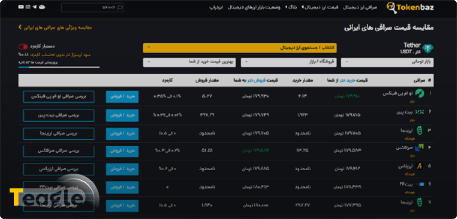
For Iranian arbitrageurs, there are platforms that display price differences across domestic exchanges. TokenBaz (TokenBaz.com) scans arbitrage opportunities on Iranian exchanges, shows the best buy and sell prices for Tether and other cryptocurrencies, and updates its prices once every 60 seconds. Internationally, sites such as Bitsgap and https://arbitragescanner.io are well-known sites for identifying global price gaps.
Pros and Cons of Arbitrage Trading
As a way of earning income, arbitrage, like any other method, is a mix of advantages and operational challenges, which we outline below.
Pros
- Low market risk: Unlike ordinary traders, a professional arbitrageur is not worried about the overall market falling or rising, because their profit comes from the price difference, not the price direction.
- Fast profitability: High-volume arbitrage trades usually complete in the shortest possible time and lead to quick profits.
- Variety of methods: Arbitrage can be carried out in various markets, from forex to commodity exchanges, and different types of arbitrage can be implemented across different markets.
- Improved market efficiency: By correcting unfair prices, arbitrageurs contribute to the transparency and health of the market as a whole.
Cons
- Need for large capital and trading volume: Because price gaps are small, you need substantial starting capital to earn a meaningful, worthwhile profit.
- Trading costs: Sometimes total fees exceed the arbitrage profit, making the trade uneconomical or even loss-making.
- Fierce competition: The ultra-fast algorithms of large institutions wipe out arbitrage opportunities within seconds.
- Technical risks: Network delays, exchange outages or calculation errors can turn arbitrage trades into losses or cause slippage and price changes.
- Legal risk: On some platforms and brokers, certain arbitrage methods may lead to account suspension.
How to Trade with Arbitrage?
To enter the world of arbitrage and arbitrage trading, you first need the necessary knowledge in this field, and then, follow the path below step by step to stay protected from potential risks.
1. Set up the necessary infrastructure: As the first step in arbitrage, register on several reputable exchanges and different brokers. Holding liquid capital (Tether or Rial) at these financial institutions is essential for executing trades quickly.
2. Choose a monitoring tool: Decide which real-time scanner or arbitrage bots you will use to identify price differences. In the age of technology, an arbitrageur should not search for price differences manually.
3. Calculate costs precisely: Before putting arbitrage into action, you must calculate buy and sell fees and network transfer costs. With the arbitrage method, we recommend targeting a net profit of at least 3 times the trading costs mentioned.
4. Simultaneous execution: Timing is crucial in arbitrage. That is why the best way to reduce risk is to execute the buy order on the first exchange and the sell order on the second exchange simultaneously. If a trader buys first and then tries to transfer, the price may change in the meantime.
5. Money management: Successful arbitrageurs never put all their capital into a single position and always keep part of their assets to cover unexpected volatility.
Who Is an Arbitrageur and What Are Their Characteristics?
Arbitrageurs are specialist traders who earn income from price differences and arbitrage strategies. These individuals usually have a structured, math-driven mindset and, instead of following market emotions, act on price data and price monitoring.
The Difference Between an Arbitrageur and an Ordinary Trader
The difference between an arbitrageur and an ordinary trader lies not only in strategy but also in how they view risk and time. The table below shows the differences between these two types of traders:
|
Feature |
Ordinary trader |
Arbitrageur |
|
Analysis |
Technical, fundamental, market psychology |
Technical, fundamental, mathematics, modeling, fee assessment, quantitative analysis |
|
Risk |
Risk of price fluctuation over time |
Risk of execution delay and liquidity |
|
Trade duration |
A few seconds (scalping) to a few months (investing) |
A few milliseconds (bots) to a few days (time/futures arbitrage) |
Frequently Asked Questions About Arbitrage
How much profit do arbitrage trades make?
Arbitrage profit depends directly on the amount of capital and the frequency of trades. Generally, the profits discussed in arbitrage trading are achieved with large capital and high trading volume.
Are arbitrage bots better than manual trading?
The answer is definitely yes; in today's world, where speed is everything, bots have a decisive advantage. Bots are capable of detecting price gaps by comparing prices in a fraction of a second, something that is practically impossible even for a professional trader.
Why do some brokers not allow arbitrage?
This applies to latency arbitrage, not all types of arbitrage. Latency arbitrageurs exploit the slowness of some brokers' systems to earn profits that are essentially the result of a system flaw rather than expert analysis.
Contents of this article


Related articles



User reviews

Newest
 Upload image